For more than 50 years, Danspace Project has presented contemporary dance in New York City’s oldest site of continuous religious worship. Completed in 1799, St. Mark’s Church-in-the-Bowery stands on land that once belonged to the indigenous Lenape and was likely built by enslaved people.
Veteran dance improviser Ishmael Houston-Jones shares these facts with the audience at the beginning of OO-GA-LA Reimagined, admitting that he doesn’t know any individual names associated with the place’s problematic history. But this is part of his invitation to heighten our awareness of a collective history that most would rather not think about, and provides context for the ensuing performance.
OO-GA-LA Reimagined is a dance with many ghosts. We see a young Houston-Jones dancing with Fred Holland projected above the church’s main altar. A shrine dedicated to Holland, who died of colon cancer in 2016, sits humbly in one corner–a visible reminder of loss and grief. Juxtaposed with their youthful selves dancing on the wall, I think about how we dance through time.
The piece aims to accomplish much more than a straightforward restaging of the improvisational score performed as Untitled Duet in 1983 (portions of which were projected thanks to the archives of Cathy Weiss and Lisa Nelson). Back then, Houston-Jones and Holland were often referred to as the “bad boys of the downtown scene,” their work injected some punk rock spirit into the Contact Improvisation community by refusing to allow the predominantly white and supposedly apolitical postmodern dance world to ignore their Blackness and/or queerness. While their peers danced barefoot in flowing costumes, this duo wore combat boots and jeans; where others in the Contact Improvisation scene explored continuous physical touch as a basis for dance, they avoided touch altogether, seeking to unearth new forms of contact that challenged the prevailing orthodoxy. A copy of their 1983 “Wrong” manifesto–which served as the score for Untitled Duet and was included in the OO-GA-LA Reimagined program–highlights Holland & Houston-Jones’ position: “We are Black.” “We will play a loud, abrasive sound score.” “We will fuck with flow.” And so on.
Untitled Duet has been reimagined to respond to the context of our current moment as a trio featuring three fierce performers/collaborators: Stephanie Hewett, Kris Lee, and AJ Wilmore. Their new manifesto builds upon the 1983 score while infusing it with their own dynamism: “We care but will not be careful.” “We are drop dead gorgeous.” “We will pierce the space with our multitudes.” And more.
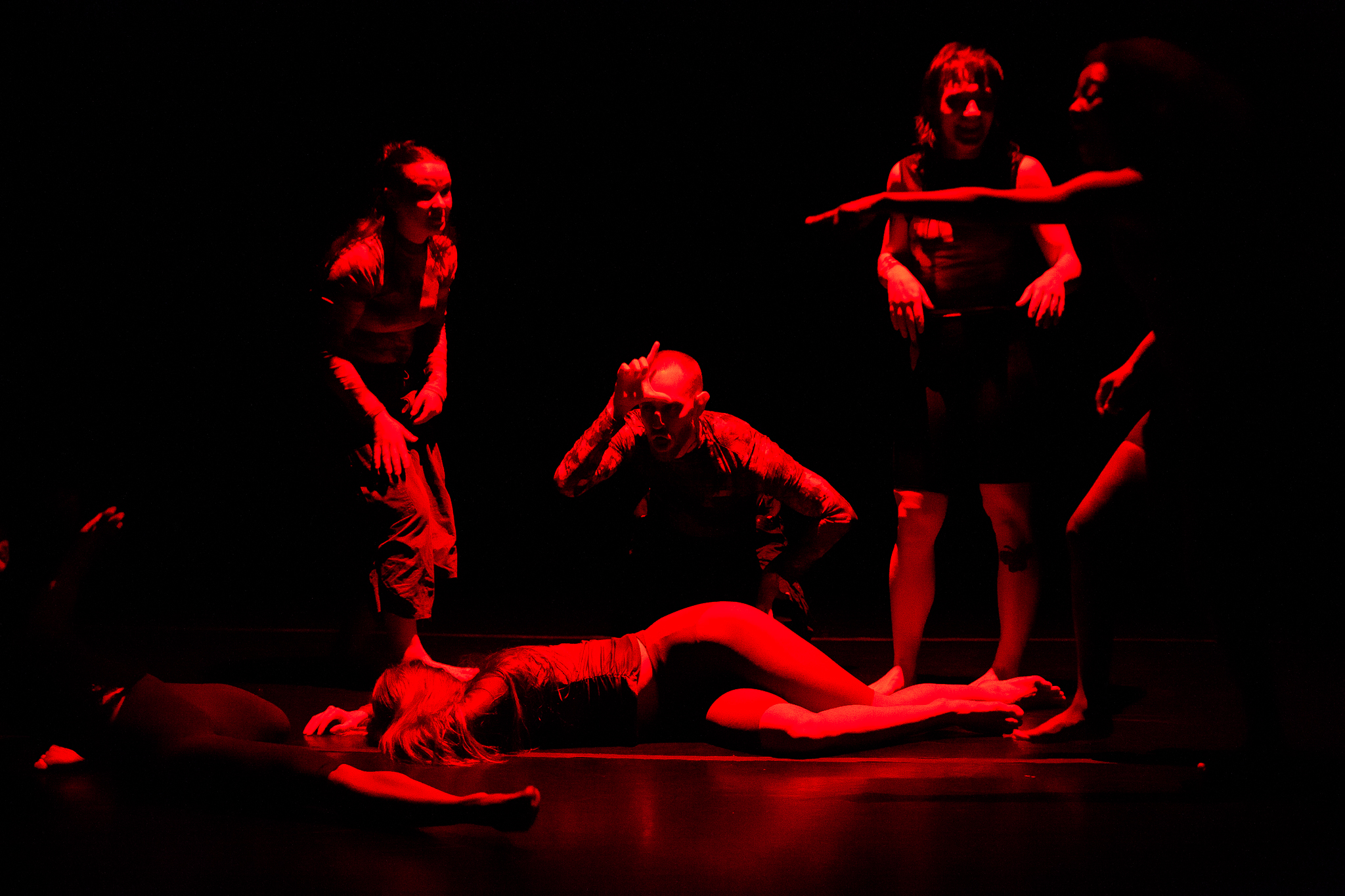
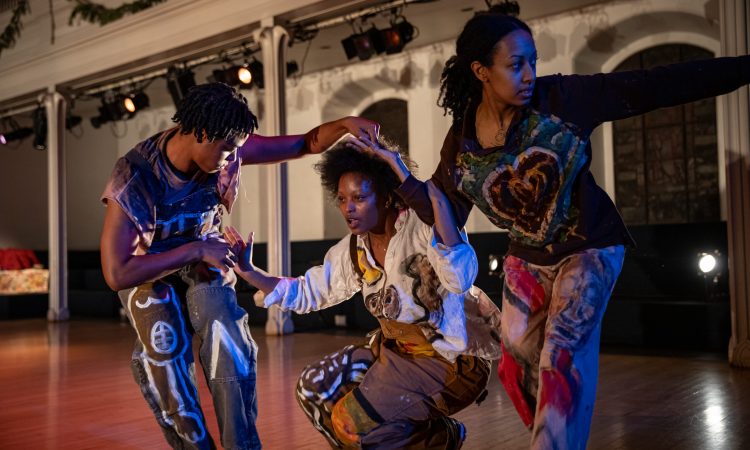
In his beautiful but too-brief opening solo, Houston-Jones shares recollections of Holland while performing minimal hand gestures, which are sporadically interrupted by his falling to the floor. Then the trio spills onto the stage wearing overalls painted with vivid colors in anthropomorphic patterns by Malcolm-x Betts, perhaps evoking Jean-Michel Basquiat’s neo-expressive art. As they begin digging into OO-GA-LA Reimagined’s structured improvisation, they effortlessly embody an impressive range of movement vocabularies. In one moment, they create low sculptures, using their backs and legs to support each other’s weight. In others, they twerk against a pillar and carry a draped body over one shoulder in a slow circle. Playful risk permeates their performance, and not just through the intrepid range of movement languages onstage. By the time the performers step closer to the audience (talking and shouting close to our faces, as well as dancing so far behind the seats that we have to turn around), it’s crystal-clear that OO-GA-LA Reimagined is an electric art without limits.
In addition to their astounding physicality, Hewett, Lee, and Wilmore also expertly manipulate sound in real time. In one moment, Hewett peels off to the onstage mixing table to choose a vinyl track they think will hit the right mood. In another, Wilmore speaks and sings into the mic as their vocals are distorted and remixed, before requesting a specific tune while performing a particularly sensual solo. When Lee maxes out the volume and repeatedly yells, “We’re percolating!” and “It’s about time!” Their rage is so palpable that many in the audience urge them on with clapping hands and vocal encouragement.
OO-GA-LA Reimagined is pure punk, raw, and radical art that seeks to animate, instigate, and provoke. It demands more than quiet observation from its audiences. As the world continues to seethe, we need more of this kind of fearlessness. Houston-Jones and his collaborators, in their naked display of friendship through art, show us how to create and resist. OO-GA-LA Reimagined is a call to join them in this courageous mess, before it all boils over.
Ishmael Houston-Jones, OO-GA-LA Reimagined (The Fred Holland and Ishmael Houston-Jones 1983 Duet Danced into the 21st Century Danspace Project, Co-presented with Live Artery / New York Live Arts, Jan. 8-10, 2026.