The following is a selected writing from one of tD’s Emerging Writer Fellows, Savannah Bunn. Savannah is a BFA in dance and choreography student at Stephen F. Austin State University in Texas. Learn more about Savannah here.
Charlotte Perkins Gilman’s short story The Yellow Wallpaper (1892) has long been read as a foundational feminist text. It’s a narrative that exposes the violence of misogyny and oppression disguised as concern and care within the context of nineteenth-century societal and medical perspectives. Read through the lens of historical psychological realism and symbolism, Gilman’s depiction of postpartum depression emerges as both deeply personal and socially imposed, shaped by her own lived experience and by a patriarchy that controls women’s bodies through diagnosis and constraint. Translating these themes into choreography offers an embodied perspective that allows the text’s emotional and political layers, written over a century ago, to unfold in a way that still resonates today. This interdisciplinary approach revitalizes a classic work while highlighting ongoing issues surrounding gender, mental health, and bodily autonomy. In translating this text into choreography, I sought to inhabit not only the story’s psychological unraveling but also its tension between repression and resistance, between stillness and the desperate need to move.
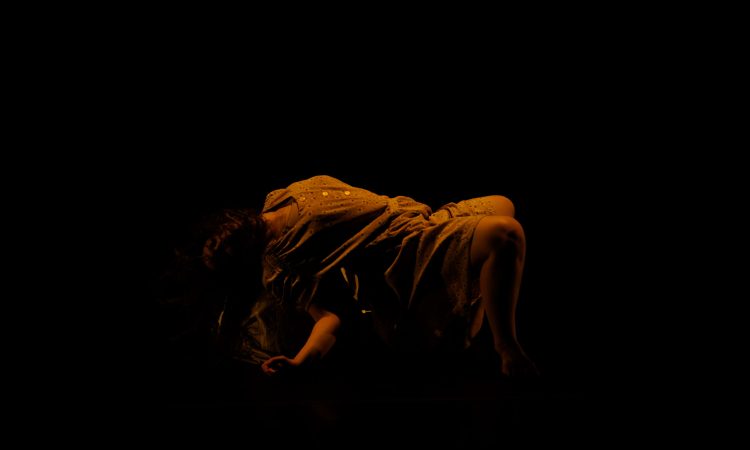
The choreography begins in near darkness: a single dancer in a white gown is confined to a pool of downlight. Sitting with her back to the audience, only the small twitches of her shoulders and spine are visible. The movement of the limbs becomes weighted and disjointed. Phrases splinter into abrupt starts and stops, joints articulate out of sequence, her hands clawing at her own skin in a futile attempt to free that which is writhing beneath. Her body twists and arcs, folding in on itself and extending outward, filling the space in the downpool of cool light with contorted, restless shapes. This endeavor becomes the embodied equivalent of the narrator’s isolation within Gilman’s short story, where the body carries the weight of being watched, dominated, and diagnosed.
As the first woman behind the wallpaper appears, squirming upstage in the same pool of downlight, a duet marked by mirroring movement suggests the narrator’s juxtaposing feelings of comfort and unease as she confronts the simultaneous nature of her own reflection and the trapped woman, spiraling inward toward psychological unraveling. Over time, the shadow pushes her toward an emerging presence: John, who, as both her husband and doctor, perpetuates her isolation and sustains the oppressive structures around her.
As the duet between the narrator and husband unfolds, their movement oscillates between tenderness and control. He lifts her gently, but his support comes with an infantilizing restraint; she reaches toward the audience; he redirects her inward. Their movements entwine through coiling arcs that rise and fall, her agency glimpsed yet denied, mirroring Gilman’s depiction of the ‘rest cures’ paradox, where stillness functions as supposed healing, yet stillness also equals decay.
When the shadow returns, the trio blurs boundaries of both identity and control as the dancers’ bodies overlap, twist, and pull apart, each motion suggesting care intertwined with containment. As John exits, the narrator’s gestures fracture further, her attention once again drawn to the unseen wallpaper.
The shadow woman runs to the back, merging with the line of dancers who embody the yellow wallpaper. The narrator hesitates, then follows, her movement compelled by desperation as she rips the chunk of wallpaper down in one swift motion, bringing the six surrounding dancers into a collective collapse, the chaos of their fall echoing destruction and release. They rise in unison, their movements slowly steadying into a shared rhythm. As they spread across the space, their unison becomes a quiet rebellion, an embodied act of liberation born from the fragments of confinement. The piece ends just as the story ends: the narrator crawls over her husband’s unconscious body, dragging her shoulder along the wall. The motion feels both triumphant and haunting, as if madness and freedom have fused into one.
Translating The Yellow Wallpaper into movement revealed how dance can function as critical interpretation. Drawing on Gilman’s vivid imagery of the wallpaper’s “unsettling” patterns, the creeping shadows, and the tangled dynamics of care and control, the choreography transforms these textual details into motion, making the story’s tension and psychological depth palpable both in the performer’s body and to the audience’s eyes. The body became a site of research, one that made Gilman’s questions about mental illness, gender, and autonomy immediate and tangible. In embodying both the narrator’s confinement and her revolt, the choreography suggests that liberation may not be tidy or peaceful, but raw, unsettling, and necessary.
*Excerpted from Savannah Bunn’s longer research and choreographic study, Ephemeral Patterns: Reflecting on the Major Themes of Mental Illness, Misogyny, and Oppression Through Historical Psychological Realism and Symbolism illustrated in Charlotte Perkins Gilman’s Short Story The Yellow Wallpaper: A Choreographic Study. November 2025. Denard Haden School of Theatre and Dance, Stephen F. Austin State University, Advised by Professor Heather Samuelson, etc. for full text.