I have seen The Nutcracker almost every year for the past twenty-five years. I can hum its entire eighty-five minute score from memory. Like so many dancers, it was one of my first great loves.
About Face: Disrupting Ballet is Jennifer Lin’s feature-length documentary on yellowface in ballet, with both La Bayadère and The Nutcracker at its center. Watching this film and writing about these ballets feels personal because ballet shaped my body, discipline, and concept of beauty. Further, one thing unites myself, Jennifer Lin, and the dancers in the film: we are all of mixed-race Asian ancestry, navigating a duality that brings up persistent questions of identity and belonging. Lin’s film offers catharsis, modeling attentive care that asks ballet to confront itself honestly, while also opening space for dialogue about representation. And for me, the film raises a difficult question: how do you love something that has also caused harm?
Behind the Movement
About Face spotlights two friends and New York City dancers of Asian descent: Georgina Pazcoguin (“The Rogue Ballerina”), a former soloist with New York City Ballet, and Phil Chan, an author, producer, and choreographer. Together they launched the Final Bow for Yellowface, a movement challenging ballet companies to remove offensive racial stereotypes. This is monumental, given that classical ballet was created for European courts hundreds of years ago, reflecting Western ideas of the “Orient” and an exotic, consumable East.
Both The Nutcracker (George Balanchine’s version) and La Bayadère (Marius Petipa) belong to a lineage of classical ballets shaped by these orientalized tropes, in which imagined “Eastern” cultures are filtered through Western fantasy. These ballets used racial stereotypes to make the “East” legible to Western audiences at a time when travel was largely inaccessible.
The Chinese or Tea divertissement in The Nutcracker relies on pointed fingers, bobbing heads, and exaggerated smiles, bearing no resemblance to authentic Chinese dance. La Bayadère presents an even thornier problem, highlighting a question that is just as ludicrous as it is exploitative: how does a mostly white cast become Indian? Historically, the answer has been yellowface, brownface, and oriental fantasy.
Yellowface
So let’s talk about Yellowface. Yellowface uses makeup, costuming, gesture, caricature, and movement vocabulary to imitate stereotypes of East Asian appearance. It exaggerates eye shape, skin tone, facial features, and movement qualities. While widely recognized as offensive, it has long been normalized in the world of classical ballet canon, protected by tradition and prestige.
Voices like Phil Chan, Jennifer Lin, and Georgina Pazcoguin are now asking ballet to confront yellowface directly. In About Face, Scottish Ballet updates the Chinese dance in The Nutcracker, receiving both praise and backlash. Chan reimagines La Bayadère, relocating its Royal India setting to a 1920s Hollywood film studio, turning Orientalism itself into the subject. What begins as an online pledge initiated by Chan and Pazcoguin becomes a global reckoning. Hundreds sign on, companies respond. Some listen, others resist. For Asian American dancers, the stakes are deeply personal.
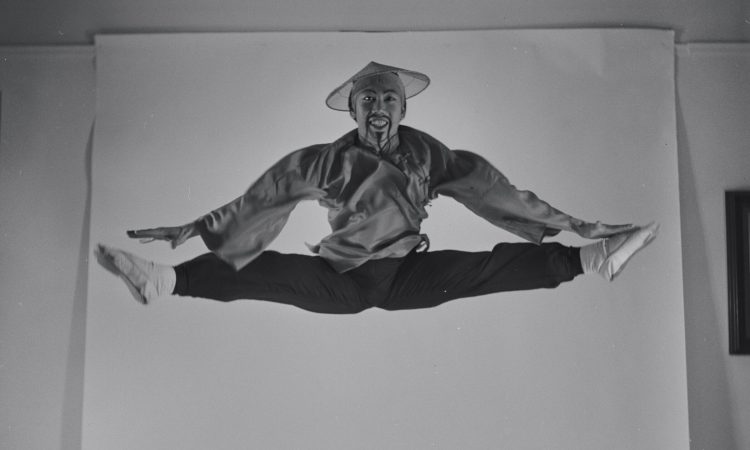
Onstage aesthetic fantasy often translates into offstage racialized limitation, nowhere more painfully evident than in the life and career of George Lee, the first Asian performer featured in New York City Ballet. His groundbreaking role in Balanchine’s Nutcracker did not protect him from erasure.
Balanchine cast Lee in the Chinese role because he was of Chinese descent. In Ten Times Better, Lin explores how his success ended abruptly. “Why?” she asks rhetorically. “Was he too short, or was he too Chinese?” Despite his historical significance, Lee spent the latter half of his life working as a blackjack dealer in Las Vegas, largely unknown to the audiences he had once captivated. When Lin asked to interview him, he reportedly said, “Why do you want to talk to me? I am nobody.”
Ballet demands that dancers dissolve themselves in service of a role. When roles are racialized, that dissolution becomes internalized minimization: visibility without belonging. As Pazcoguin explains, this is the reality of an Asian American ballet dancer. The unspoken rule is clear: be grateful, do not ask questions, and never risk the role.
Between Stage and Self: Growing Up Mixed in Classical Ballet
I performed in La Bayadère in 2004. To perform in Royal India, dancers must alter themselves dramatically. It felt normal and unquestioned at the time.
In The Nutcracker, I was never cast in the Chinese “Tea” dance. Shorter girls danced it—angular and precise, ribbons in hand, hips nowhere near the choreography. At fifteen, taller, long-limbed, darker, I got the Arabian “Coffee”.
I remember friends in the dressing room: Caucasian girls who danced the Chinese divertissement flawlessly, their eyeliner wings higher and sharper, keen to read as “Chinese.” Subtle Asian jokes were par for the course.
I guess I wasn’t Korean enough to be insulted, but my mom was. Does that count? I laughed with my friends, othered and included at once, caught in the absurd in-between.
I realize now that my own racism pointed inward. What about me is exotic? When do I turn on my whiteness? When do I become more Asian? How does my body decide?
I love classical ballet. But yes, its history is racist. It’s expensive and inaccessible: tuition, transportation, an adult to drive you to class, pointe shoes costing 80 to 150 dollars per pair, with pairs of shoes that only last days at advanced levels. Historically, this has made ballet a white-girl endeavor. Period.
Cancel culture is real, and it is frightening. That said, neither Phil Chan, Georgina Pazcoguin, nor Jennifer Lin are trying to cancel ballet. Neither am I. What we are asking for is an examination of the impact of its narratives. We must interrogate in order to elevate the art form.
As an educator, I refuse to delete or sanitize history. But we must never yield in our pursuit of recognizing patterns. We must discuss problems honestly—and level up.
With About Face, Lin asks: What has ballet taken from the Asian American community by utilizing yellowface, and can we move away from it as a practice? If someone were to say no, I’d ask: What is it about the racialization of classical ballet that you find necessary and empowering?
Ballet is my first and most enduring love. We do not cancel what we love. We study it, question it, expand it—all to allow ballet to finally become the art form it promises to be. To love ballet is not to freeze it in time; to love ballet is to let it evolve until it is for everyone.
Information for this article was gathered in a phone conversation with filmmaker Jennifer Lin on February 2, 2026.