Part cinematic musical-drama and part epic-fable, Mona Fastvold’s The Testament of Ann Lee (2025) chronicles the life of the 18th century religious leader. Persecuted for her religious beliefs in the late 1700s, the English-born Ann Lee (played by Amanda Seyfried), fled to the New World to found the Shakers, a radical, Christian sect born from Quaker tradition. Today, the Shakers are remembered for their physical, ecstatic worship, their deep commitment to total celibacy, and their functional aesthetics (especially in designing furniture).
Choreographed by Celia Rowlson-Hall, the film resists documentary realism, asking viewers to separate history from modern interpretation. Akin to Brecht’s Life of Galileo or Shakespeare’s Julius Caesar, The Testament of Ann Lee uses the past to interrogate present values within contemporary culture.
The Dancing
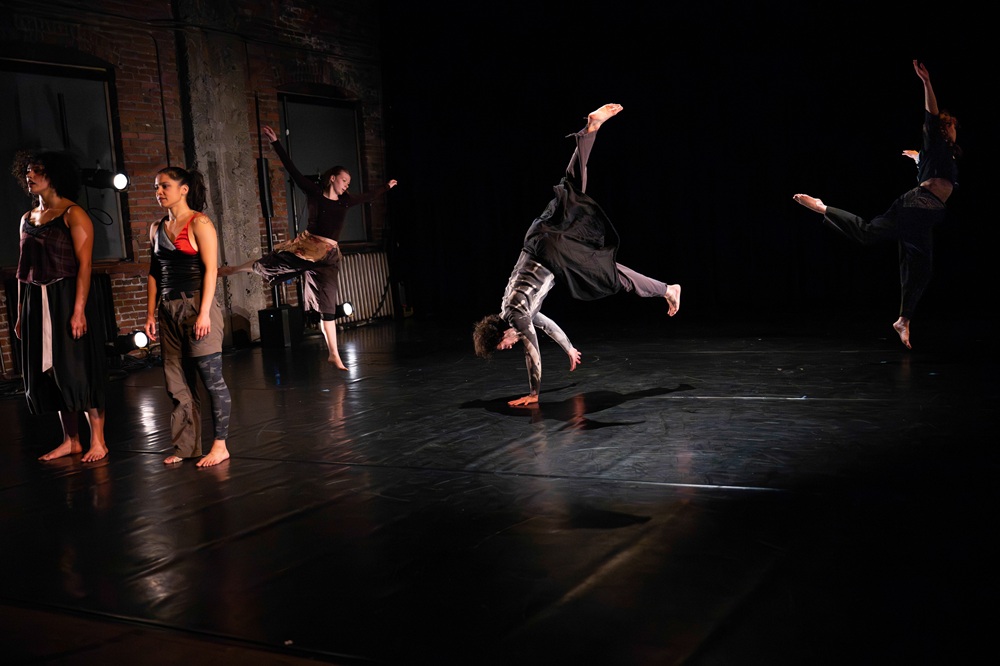
Precisely how the Shakers danced as part of their spiritual practice remains a bit of a mystery. That ambiguity has often enticed many choreographers to investigate this history and attempt to bring their movement practices to life onstage as dance. Doris Humphrey’s The Shakers from 1930, and more recently, Reggie Wilson’s Every Movement Is Sacred, capture and reproduce what is known about the gestures of the Shakers with as much historical accuracy as possible, creating theatrical odes to the past.
In The Testament of Ann Lee, however, Fastvold and Rowlson‑Hall use the facts of the past as a catalyst to evoke an expressionistic vocabulary in the present. This personal and imaginative telling of Lee and the Shakers is very contemporary, rendering the film original, visceral, and frankly, ahistoric.
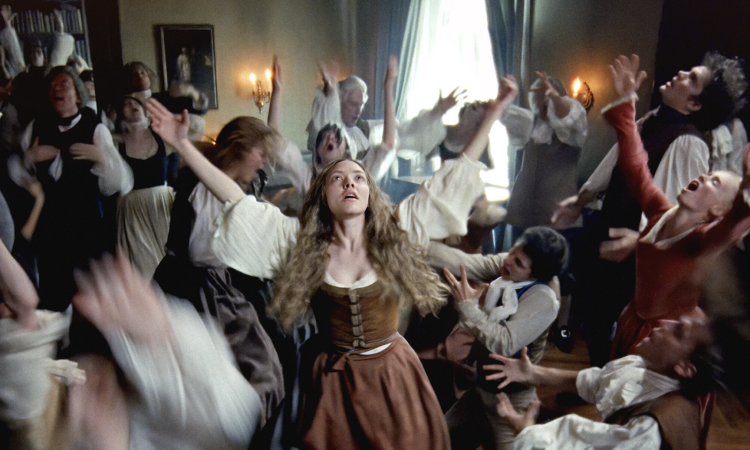
Instead of the anthropological approach of Humphrey or Wilson, Rowlson-Hall admits in interviews that she mostly followed her imagination in building the choreography for the film, even describing Shaker worship as a “rave party.” While yes, these moments are exhilarating on screen, and no, we shouldn’t confuse that with the spiritual reality the Shakers lived experiences, Rowlson‑Hall’s linking of worship with rave culture immediately opens a specific register of meaning: Raves, like Shaker meetings, dissolve the self through movement and music. Raves ride on pleasure, flow, and sometimes a little chemical assistance. Given that the real-life Ann Lee and her followers didn’t use MDMA, one must conclude that the sect shook for God, purification, and devotion instead. Whether bass-driven or sacred, some might argue that both ecstatic releases point to the same thing:the Divine.
The Shakers ostensibly purified themselves of sin by embodying heightened states of spirituality through endurance events of movement and song. Through this devoted physicality, Shaker worship was a path to get closer to God; but also, the movement itself was a means to deny the pleasures of the flesh.
Curiously, Rowlson-Hall’s choreography is almost hyper-sexual in form. Instead of casting something out (let’s call it “the Devil”), the Shakers we encounter in the film sweat, writhe, and collide. While ostensibly a religion of sexual abstinence, the primal moans of these worshippers is startling: an erotic charge stirs, while somatic tremors of desire with zero pious restraint seem woefully obvious. The film’s most powerful moments suggest total embodiment and thus, a surrender to the body. Yet when two young members wish to consummate their affection, Lee immediately banishes them; Fastvold’s Shakers seem content to sublimate their impulses. Despite the sensual allure of these rave-like movement sequences, The Testament of Ann Lee comes off as unwaveringly anti-body and anti-flesh.
The Politics of the Body
On one level, Fastvold (who co-wrote the screenplay with Brady Corbet) asks viewers to see Lee as a visionary and politically progressive leader. The film paints her as a bold feminist, a progressive abolitionist, a benevolent pacifist—and a stark contrast to her short-sighted (and predominantly) male contemporaries. Soon after arriving in New York, Seyfried shouts “shame” at the (white) men publicly auctioning a group of enslaved Africans. In a different scene, a voiceover informs viewers that the Native Americans were nothing but welcoming to Lee and her fellow settlers on their land.
Moments like these remain largely symbolic, if not awkwardly hollow and contrived. Aside from a brief exchange with her brother William (Lewis Pullman) in which Lee proudly declares herself and the Shakers pacifists, political gestures remain surface level. Enslaved people and Indigenous characters remain silent throughout the film, and the bloody American Revolution happens largely off-screen. The film’s so-called progressive politics feel performative: The Testament of Ann Lee earnestly tells us how enlightened its titular character is, but we never get to see her wisdom in action, and thus get to decide for ourselves.
The film is more complicated in its treatment of the body. Lee believes flesh and sex are the roots of corruption. Total celibacy is central to Shaker theology, and all other forms of communion between the sexes–including between spouses–are strictly forbidden. The Testament of Ann Lee seems to reject Michel Foucault’s famous dictum that “sex equals knowledge equals power.” In this cinematic rendering, sexuality and knowledge are eternal adversaries, with abstinence and denial presented as the only path to enlightenment.
In addition to total abstinence, Lee´s relationship to human sexuality is confusing. In the film, the only sexual encounter depicted in-depth is between Lee and her husband Abraham (played by Christopher Abbott), one that is portrayed as unhealthy, violent, “impure” (think dubious consent; think flogging). Moreover, this sex is linked with recurring scenes depicting Lee in agony and traumatic grief over the repeated losses of her children. Her husband’s emotional response to these deaths is absent (an odd claim–they were his children, too–but it furthers the narrative that Lee is more sensitive or aware than the men around her). Taken together, the film seems to conclude that sex is something inherently dangerous, even fatal. We never witness any healthy examples of sex or sexuality in The Testament of Ann Lee. Is Fastvold´s narrative gesturing to the post-Roe generation?
Later, shortly before the Shakers set sail for the New World, William renounces his relationship with a male lover with surprising ease. Who is he? What are the contours of this same-sex relationship–how long did it last, and did William’s sister Ann know about it? So many questions, but as with the other marginalized populations depicted in the film, we never find out. Physical love and longing, at least according to Mother Ann (an honorific which infantilizes everyone in the sect, including her sibling), is a sin that must be resisted completely at all times. This lover has no spoken lines, no story, and thus is merely a symbol instead of an actual character. As with the fleeting gestures to American slavery and genocide, Fastvold hints at a statement about homosexuality (politically progressive, presumably), but it’s left unexplored.
Shakeout: Final Thoughts on The Testament of Ann Lee
In Man’s Search for Meaning, Holocaust survivor Viktor Frankl writes that “suffering ceases to be suffering the moment it finds meaning.” Fastvold emphasizes the loss of Lee’s four babies—an experience that would fracture anyone, overwhelming in every human and spiritual way possible. Seen through Frankl’s lens, her theology feels less like a set of ideals and more like a strategy for survival.
Within Shaker ideology, the community-wide demands for celibacy, denial, and spiritual rigor become ways to impose order on Lee’s personal trauma. This effort at transformation does not absolve her restrictive beliefs. Instead, it makes them feel human and understandable even in their extremity.
The tragedy remains as audiences watch the film: bodies and desires remain tightly controlled. The tension between freedom and restraint is made to feel personal.
Though depicted as a kind of modern heroine, Lee is just as Puritanical as America’s earliest colonial settlers, if not moreso. In the mid- to late-18th century, she sought spiritual freedom just as America began its quest for political independence. Now, in 2026, the United States faces threats to countless personal and political freedoms. What do Fasvold and Rowlson-Hall want us to take from this connection between past and present? How does the courage to seek meaning in suffering resonate for us today?
Women’s bodies remain sites of political control, and LGBTQ people, especially trans people, continue to face erasure and violence. In this context, the film’s suggestion that suffering can be solved by eliminating desire feels deeply troubling. The dancers on screen move with abandon; they sweat, writhe, and collide in ecstatic choreography, yet all this physical freedom disguises a message that is fundamentally ascetic and politically conservative. The bodies themselves become a Trojan horse: vibrant, alive, and mesmerizing, even as the narrative condemns pleasure, desire, and embodied experience.
Did the filmmakers intend the seduction of dance to mask such a conservative ideology? Cloaked in remarkable beauty, The Testament of Ann Lee reads like a confused form of propaganda. The dancers’ bodies speak with a truth that cannot be concealed, and yet none of them find peace–at least, not in this world.
The Testament of Ann Lee (2025)
Directed by Mona Fastvold
Written by Mona Fastvold & Bradley Corbet
Choreography by Celia Rowlson‑Hall