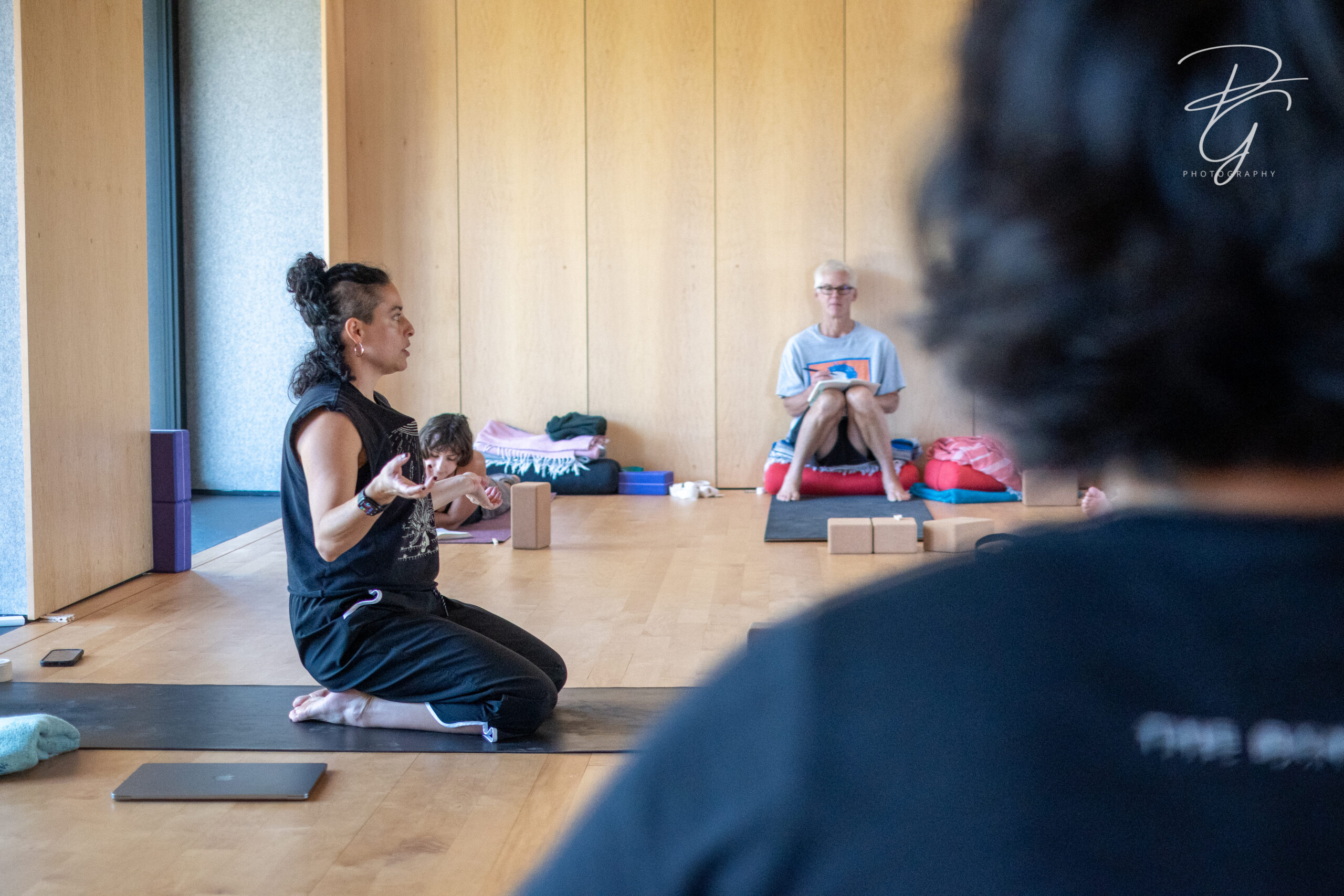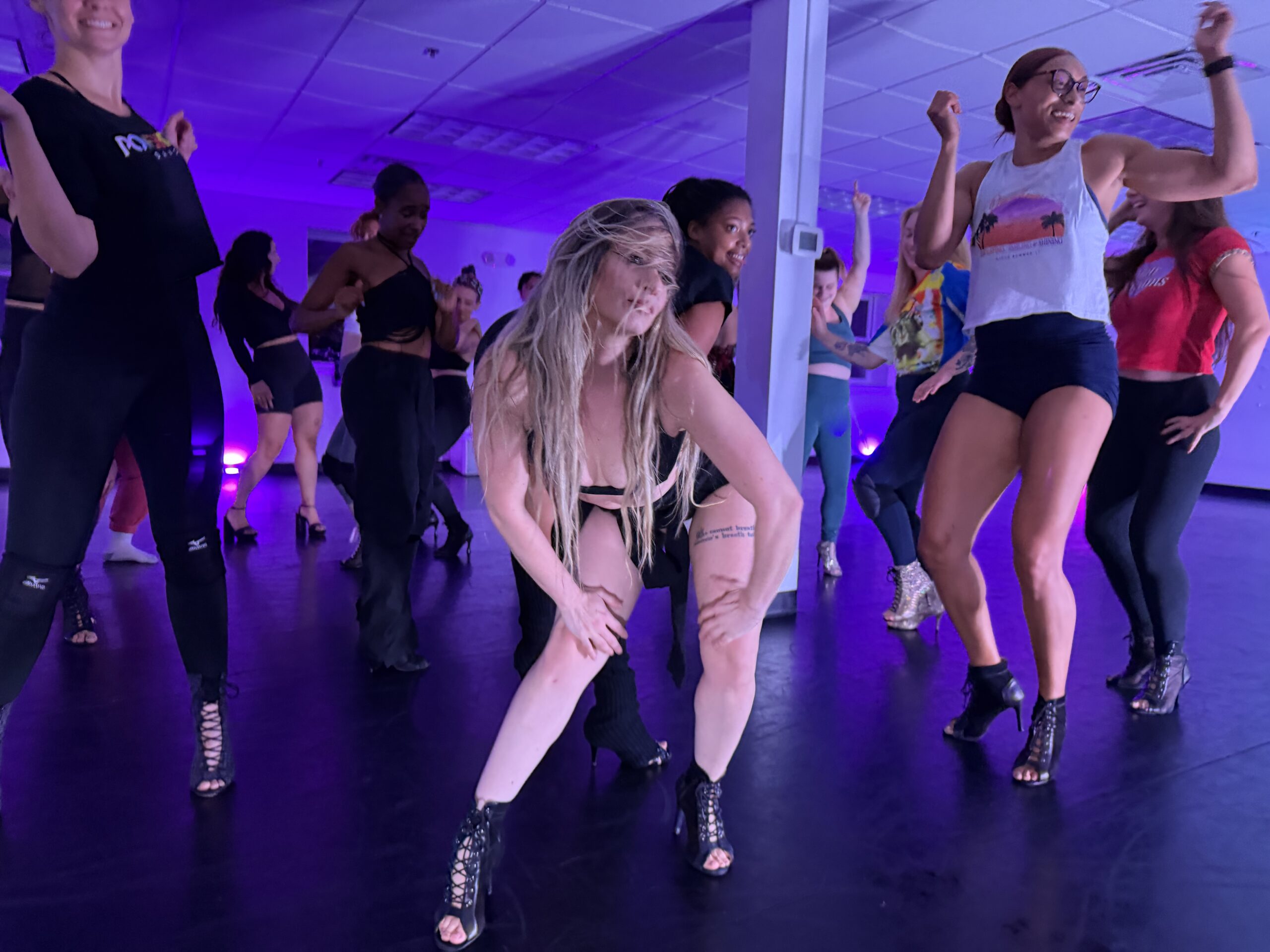
Cracking open the central dissonance between idealism and reality, the 2024 anthology Resistance and Support: Contact Improvisation @ 50, unspools half a century of Contact Improvisation (CI) through the challenges, heartbreaks, reinventions, advocacy, and hopes that, together, ask what it really means to be people, in society, in touch with one another.
Over the course of 20 essays, 33 contributors from around the world implore readers to evaluate CI as a body archive, social proposition, and political time capsule where physics meets feminism, momentum collides with sex, centripetal force separates neutrality from goodness, and gravity keeps romanticism from flying away in a whirlwind of linen pants and well-worn kneepads.
Editor Ann Cooper Albright describes the collection as an effort to “honor history without nostalgia, to embrace the form without worshiping it.” From this vantage point, Contact Improvisation isn’t a static set of rules, but rather a series of drafts, passed along globally to be edited and rewritten from different locales of experience and community need. This ability to co-author CI, collecting offshoots and areas of research offers an escape route from any singular notion of “the form.” Instead, Contact Improvisation emerges throughout Resistance and Support as a process of formation—a meeting, separation, and transformation of tectonic principles.
Drafted in 2022 in conjunction with Critical Mass—the 50th anniversary celebration of Contact Improvisation at Oberlin College—the essays mark the midpoint between the deaths of CI pioneers Nancy Stark Smith (1952-2020) and Steve Paxton (1939-2024). The text lives in the space between a version of CI still capable of defaulting to the lived opinions of its instigators and one that can’t.
Origin stories become question marks: Which principles are foundational? Which need to go? Which might be both? When tradition finds itself at odds with transformation, what happens? Who, specifically, gets to help make these decisions? And, as Sarah Young asks in her chapter, “Underscoring Nancy Stark Smith’s Legacy,” to what extent can CI “morph from its original intentions before it is no longer recognizable?”
Technically speaking, nobody owns CI. In an interview for Dance Magazine Paxton described Contact Improvisation as “a form arising from us rather than imposed upon us.” The writers in Resistance and Support—CI teachers, practitioners, renegades, students, experimenters—are all part of that “us.”
If Contact Improvisation does indeed bloom forth from those who practice it, then there must be room for all of the propositions and provocations put forth through Resistance and Support. The writers assert that:
- There is no such thing as a neutral body
- The dancing can be rough, percussive, loud, hot, femme, and angular; flow isn’t the ruler of the jam
- “Physics” (the dancing part) and “chemistry” (the intimacy part) can live together in specific contexts
- Perhaps we aren’t truly improvising because only some movement choices seem valid
- CI isn’t actually built for everybody
- Invitation can be a nice word that sometimes masks a brutality
These essays excite me, not only for the excellent writing, collective expertise, and spread of perspectives they reflect, but also because the very fact of this book’s existence is a matter of democracy. Regardless of how a reader might respond to any of the individual writings—I certainly balked at a few that made the CI purist in me hiss—the act of compiling a globally sourced set of essays about a dance form first proposed in the US into a book published in the UK directly aligns with CI’s founding egalitarianist spirit. If Contact Improvisation is indeed meant to be a practice of the people, then the civic engagement and meaningful pushback evidenced throughout Resistance and Support certainly directs readers to place themselves within, rather than just near, the development of CI’s next chapter.
In his collaborative essay with Emma Bigé, Paul Singh writes,
“I love hearing the stories of how Steve [Paxton] refused ownership of Contact Improvisation, and said something to the effect of ‘take it and run with it,’ but then, that does require we go for the grab, and own it, not in the proprietary sense, but really in the sense of making the effort to inflect it with our desires and become responsible for what we do and don’t do, what we reveal and what we mask.”
Together, the writers in this book lay the groundwork for this type of revamped authorship, an examination and reworking that will likely look different across CI jams, classes, and experiments around the world. Michelle Beaulieux outlines an entire system for organizational assessment and accountability in “Getting There from Here;” the members of EPIICO cover issues of class, labor, economics, and travel in “Resistances and Horizons;” and Joy Mariama Smith proposes “Not”—both a challenge to assumptions in CI, and a cheeky rebellion against the established structure of the academic essay. Collective care and participatory processes are alive and well here.
Resistance and Support evidences a continued, passionate investment in a healthy future for Contact Improvisation and its practitioners. An essential reader for CI enthusiasts, social practice nerds, language lovers, politically engaged citizens, armchair anarchists, and thoughtful skeptics, the anthology amasses a network of unapologetic, well crafted ideas that leave room for imagination, debate, and the co-creation of CI’s next steps. Engrossed in the essays, I laughed, nodded along, shook my head, rolled my eyes, experienced companionship, got pissed off, and annotated the daylights out of the whole collection. I’m generally not a re-reader, but I can’t wait to pick this book up again.
Ann Cooper Albright (Ed.), Resistance and Support: Contact Improvisation @ 50, Oxford University Press, 2024
Contributors: Ann Cooper Albright, Michelle Beaulieux, Emma Bigé, Aaron Brandes, Ma Paz Brozas Polo, Dena Davida, Joseph Dumit, Ariadna Franco, Huichao (Dew) Ge, Lesley Greco, Lisa Claire Greene, Rosalind Holgate Smith, Kristin Horrigan, Dorte Bjerre Jensen, Ming-Shen Ku, Carol Laursen, Shuyi (Candy) Liao, Adrianna Michalska, Aramo Olaya, Esmerelda Padilla, Robin Raven Prichard, Gabrielle Revlock, Elisa Romero Morato, Brian Schultis, Paul Singh, Joy Mariama Smith, Guru Suraj, Ann Carolina Bezerra Teixeira, Mariana Torres Juárez, Laura Villeda Aguirre, Sarah Young, Yuting (Elsie) Wang, Xiao Zhang.