In March, writers from thINKingDANCE attended the Saturday performance of Rennie Harris Puremovement’s Losing My Religion. Here, Sofie Rose Seymour and Noel Price-Bracey respond to the opening and closing sections of this world premiere.
Prologue – Sofie Rose Seymour
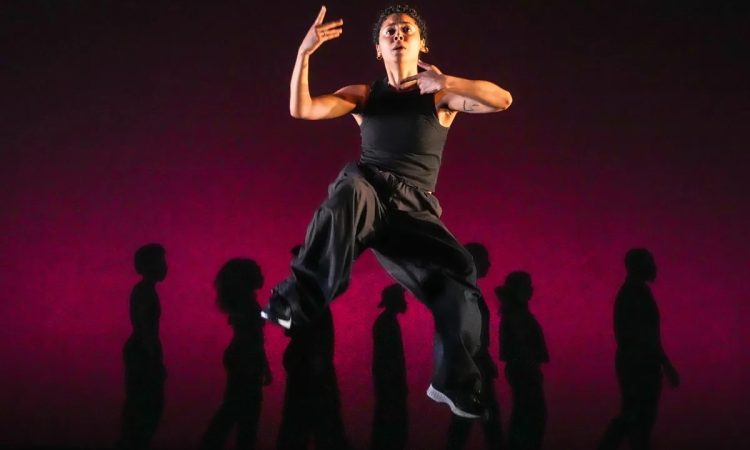
It’s begun before it begins. No time for a toprock introduction — a lone windmill troubles the air of the dark theater, t-shirt a disembodied glow, a prologue before the Prologue begins, mise-en-scène to history. A light rises on this sole dancer already upside down and whirling, and an audience that doesn’t know how to respond. Tentative business casual cheers punctuate — we’re not being good members of this cypher. By the end, we’ll give a standing ovation cued over a national anthem, but for now, there is uncertainty in the face of this raucous grace.
The b-boy whirls. A neighbor crosses. Affectionate – youngblood…are you ready for the revolution? An implied presence we’ll never see on stage prompts a response — fuck the police. Middle fingers. Exit. Life continues.
The prologue is pedestrian in the truest sense, a scene that could and has played on a given neighborhood street word for word. It’s also the height of virtuosity, and claims the true home of movements both physical and social.
I find myself viewing the rest of the piece as a prism of this brief scene, as it refracts in the combinatorics of individuality within ensemble, in music and soundscape, in Chapter headings and newsreel projection, in unseen presences.
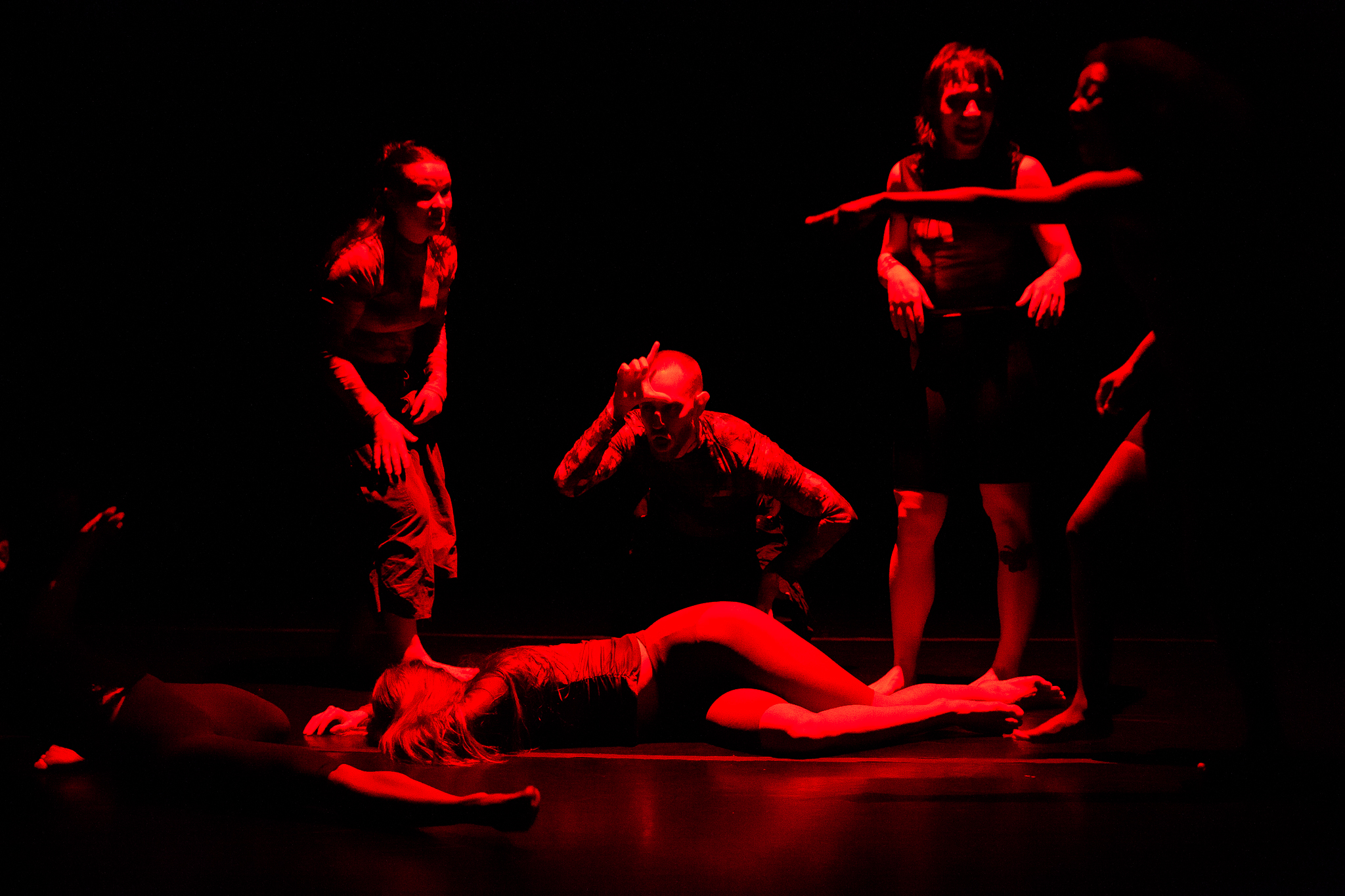
The Prologue kaleidoscopes in choreographies of daily life: taking to the streets in protest, cycles of violence, the well-worn steps of which we find ourselves caught repeating, joyous revolt persisting on a can’t-stop groove, a cypher where everyone is cheering and giving the love back and showing us how it’s done— and where three people slowly cross unseen upstage, bound by the constraint of invisible five point restraints. It’s the choreography of the unseen noose, gun, boot pushing you down as these mechanisms of violence ripple in canon through a corps of community, a lone woman left mourning the bodies laid out. This, alongside the persistence of rhythm and grace, video game resurrection, and complex joy that insists upon its own survival. Are you ready for the revolution?
But we’ll get to that. A voice whistling the Black National Anthem fills the space. “Chapter 1: The Killing” drips blood on the chalkboard. There is much still to come — but at the end of the night, I leave with it stuck in my head: let us march on ‘til victory is won.
Chapter 3: Revolt – Noel Price-Bracey
Twelve or so dancers move on to the stage with a Shango spirit. Their thunder, like the Yoruba Orisha (Deity), sounds and vibrates through the auditorium. On entrance, one member of each small platoon appears in all black, a stark difference from the white garments of the first chapter or the cream and neutrals of the second. Black, the symbol of guerrilla warfare; the camouflage color of Africans and the Diaspora resisting the system.
The pulse of house music, curated by Sound Designer, Composer, and Engineer Darrin M. Ross, maintains motivation as the artists rush on and off the stage. The jack in their upper bodies unwavering, their footwork relentless, the release of the body exquisite and necessary to sustain the pace of the craft and choreography. I notice this aptitude in Principal Dancer/Company Manager Marguerite Waller; she seems never to leave the field. She traverses the long battle with stamina and comfort. I could not take my eyes off the warriors dancing as ogun (the Orisha of iron and war), and I almost missed the message that flashed amongst the collage of images projected on the back wall: A man with his mouth in the shape of a scream holding a sign that reads “Stop Killing Black People.”
I feel invited to rock and shout as the dancers fight on, sweat dripping, legs lifting and sharply slamming down again. The program notes call for the “audience to imagine the ways in which they {we} can use their {our} bodies as resistance.” I feel a palpable resistance from the audience, but not in the way I expect to. Outside of the row of colleagues next to me and a few others behind me, the patrons are silent, under control, bodies and voices caught in expectation – “observer’s etiquette.” But this was Chapter Three, this was The Revolt, the final chapter of the evening. When should we shout if not now?
I can not speak for the silence of the audience, but I can say, as far as I have seen, Rennie Harris often, if not always, nurtures casts that exemplify a core ingredient in liberation movements: the principle of solidarity amongst minorities (men of color and women, across race and class). We, the audience, witness the collective labor of the cast. Black Women, Black Men, and White Women exhausting themselves together in expectation of something long hoped for and intentionally deferred.
Losing My Religion, Rennie Harris Puremovement, Penn Live Arts, March 19-21, 2026.