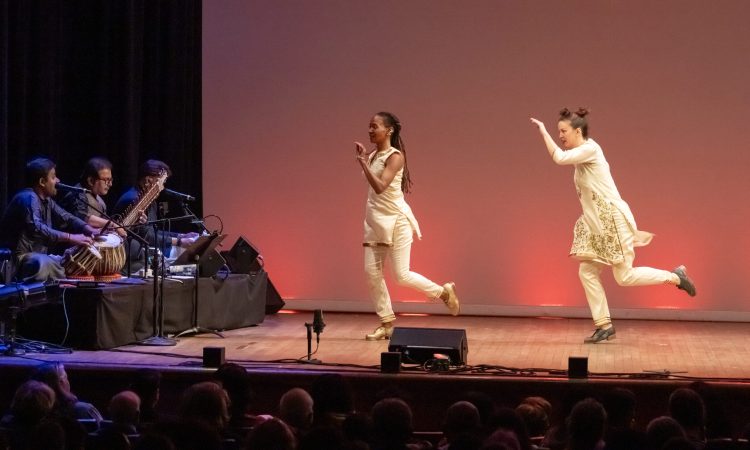
On one side of the stage sits a Hindustani band; on the other, a three-piece jazz ensemble. They face each other in low light. A tabla rings out. A sitar is tuned. The jazz musicians watch and wait. Then they meet—sound swelling, vocals by Ambarish Das piercing above the call, the music growing larger and larger, cymbals building and crashing again and again.
The musicians set up the central proposition of SPEAK: a conversation between Kathak and American tap dance. From the outset—in the pre-show talk, the publicity, everything—the curators and performers made it clear this was not a melding of styles, but an exchange between them. Speaking is what they do, but other imperative verbs emerge: play, match, answer, listen, look, wait, stop, go…
Joy saturates the room. They are smiling, playing, waiting, watching one another. And these dancers are no joke—heavy hitters, deeply seasoned performers who carry immense wisdom in every movement choice. It felt important that they were seasoned artists; to me, a conversation of this magnitude requires the nuanced physical language that comes with technical mastery, improvisational maturity, and lineage within the form.
The structure unfolds through duets, trios, quartets, and solos. The music enters and recedes, shaping itself around the shifting order of things. Dancers Rachna Nivas, Rukhmani Mehta, Michelle Dorrance, and Dormeshia pull from the richness of their traditions and improvise alongside each other without hierarchy or dilution. In fact, it shows us what they share. The improvisational forms show dancers’ close interactions with musicians. The work layers Jazz and Kathak traditions, overlapping rhythm, response, and exchange: Kathak dancers perform Twelve with a vocal recitation tradition to the swing of Seven Steps to Heaven by Victor Feldman and Miles Davis. American Tap Dance masters enter a traditional North Indian call-and-response, and in one section jazz scatting and Hindustani vocals work alongside each other.
Nivas and Mehta dance barefoot, bells ringing around their ankles. Through their work, I began to understand just how expansive Kathak can be—in rhythm, in shape, in subtle gesture, and in its capacity for on-the-spot composition in dialogue with the tabla, here played by Satyaprakash Mishra. As they explained the meaning behind the dances I saw how specificity and detailed storytelling can emerge directly from that range. The form revealed itself to be far less tightly bound than I had once imagined.
Of course, the differences between traditions remain—and are openly celebrated. They are immediately visible: in Mehta’s precise, measured hand shapes; in Nivas’s quick and elegant eye movements and sharp sculptural poses; in the walking line of the upright bass and the swing of the jazz trio; in Dorrance’s wide-flying arms and grounded, leaning attack; and in Dormeshia gliding through her rhythms, teasing ever more from the musicians with each turn.
The evening feels seamless—both improvised and meticulously crafted. There is little to no pause between pieces, yet the shifts are unmistakable: changes in intention, time signature, in who took the spotlight and which tradition is centered in the exchange.
In the pre-show, we were encouraged to shout out, clap along, cheer the performers—to make it a party. Very few people held back, and I loved every second of it. So often I find myself in hushed theaters, surrounded by audiences bound by the same rigid rules of quiet attention. Here, the energy is different. At one point, I find myself laughing out loud, leaning forward, shouting yes! and clapping without hesitation.
I love how this conversation between dance and music generates such palpable joy. It ripples through the room—contagious, bold, and powerfully bright.
SPEAK featuring Rachna Nivas, Rukhmani Mehta, Michelle Dorrance, Dormeshia, February 21, 92NY, Kaufmann Concert Hall, New York, NY
Musicians: Jayanta Banerjee (Music Director and Sitar), Satyaprakash Mishra (Tabla), Ambarish Das (Vocals), Caili o’Doherty (Piano), Dennis Bullhoes (Kit Drums), and Noah Garabedian (Bass)