I walk up the carpeted steps of the historic Hudson Opera House toward the oldest surviving theater in New York State. Something is already happening up there—a low, soul-sprung vocalization. I hear it through the curtained door when I put my phone away and remove my shoes, as the sign on the wall requests.
Inside Hudson Hall, benches and chairs are arranged in the round for the U.S. premiere of my tongue is a blade, a three-hour durational work created by Sweat Variant (a collaboration between choreographer Okwui Okpokwasili and set and sound designer Peter Born). I choose my seat carefully, knowing I’ll be here for a while. The work is part of PS21: Center for Contemporary Performance’s The Dark, a new winter festival featuring over 80 performances across Columbia County, NY.
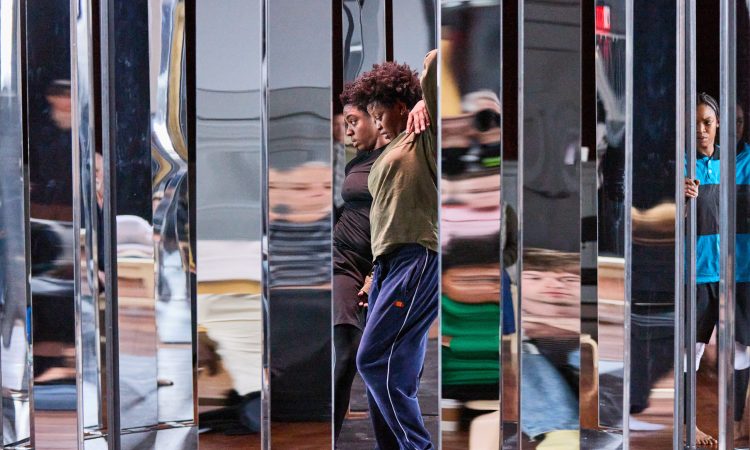
At the center of the room is a structure: round, about 8 feet wide and just as tall, with a black bottom and narrow mirrored panels running vertically around its circumference. Two dancers stand inside the structure on its stationary, central base. Two other performers spin the outer part clockwise. All four (Okpokwasili, Bria Bacon, Kris Lee, and AJ Wilmore) sing in a wordless, throaty way. As the audience settles around them, the sound grows more sorrowful. Guttural. At times, it sounds like a wailed “why?”
Through gaps between the reflective panels, I catch glimpses of Okpokwasili standing with her palms open, looking around, jerking, gasping. The voices lower and Born’s electronic score rises—heavy breaths, a staticky sound, then a mechanical chugging that matches the velocity of the spinning, spinning, spinning structure. As the speed escalates, so does Okpokwasili’s intensity. Something bad is inside her, and she’s trying to push it out. An exorcism with the audience as a witness.
Lee joins Okpokwasili inside the structure, calmly stepping through one of the rotating openings onto the base. Together, they undulate and vibrate their torsos, their arms slipping around each other, but not catching hold. The soundscape swells with screeching flute, low strings, and drums. The physical contact finally calms Okpokwasili, and she slows down, smooths out, and holds Lee. Lee holds her back. Okpokwasili steps off the platform and walks alongside Wilmore, who has been tirelessly spinning the structure.
Around this time, about 30 minutes in, I notice the structure has a top. Arched metal with a hanging light at the center. I wonder how my kids are doing back home. I notice the way the mirrors reflect daylight onto the wooden floor. I wonder what I will eat for dinner. I think about how, at the beginning of a meditation, my monkey mind is always swinging around. I realize that one of the performers, Bacon, is no longer there, but I don’t know when she left. (I later find her sitting on a bench behind the structure when I stand up to find a new seat and perspective.) Attention is a funny thing.
A pattern begins to make itself clear: solo, duet, solo, duet. Each performer, in their own way, moves something deep, dark, and murky out of their bodies. They hold each other through this, and I am reminded of being held through full-body panic attacks, of holding my own babies when they thrashed around in pain, of the many ways humans physically care for each other.
A chime sounds. I assume it’s been about 45 minutes, but it’s been 90. Time, too, is a funny thing.
The pattern doesn’t change. The second 90 minutes are similar to the first. But at one point, the two performers inside go completely still, and the structure spins rapidly around them. This is a striking moment—the blur around the stillness.
Near the end, the soundscape picks up, getting faster and more upbeat. The performers become more outwardly emotional, and I become more inwardly meditative. At one point, Bacon starts wailing, and Okpokwasili soothes her, whispering, “It’s okay, it’s okay, it’s okay.” I truly can’t tell whether this is a planned part of the performance. The possibility that the utterance is spontaneous and real makes the moment feel profound. Eventually, the quartet all exit the structure and the room. The spinning slows, then stops, but the music lingers.
In some ways, this show offers the expected: Sweat Variant has a long track record of exploring the space between dance, theater, and visual art, while tracing themes of embodied inheritance and Black interiority. All of these elements appear throughout my tongue is a blade. It’s the strength of visual metaphor—seeing only fragments of the whole, glimpsing others in slivers, and catching my own reflection staring back—that surprises me.
A three-hour performance is a real test of physical and mental endurance for both the performers and the audience. While this show could land in two hours, some of the most visceral moments—Bacon’s raw wailing, Okpokwasili’s soothing—don’t arrive until the depths of hour three. It would be a shame to miss these powerful images that require the patience of the slow burn. Endurance requires practice, and practice requires time, and time remains a funny thing.
my tongue is a blade, Okwui Okpokwasili & Peter Born, Hudson Hall in Hudson, NY, February 21 and 22, 2026