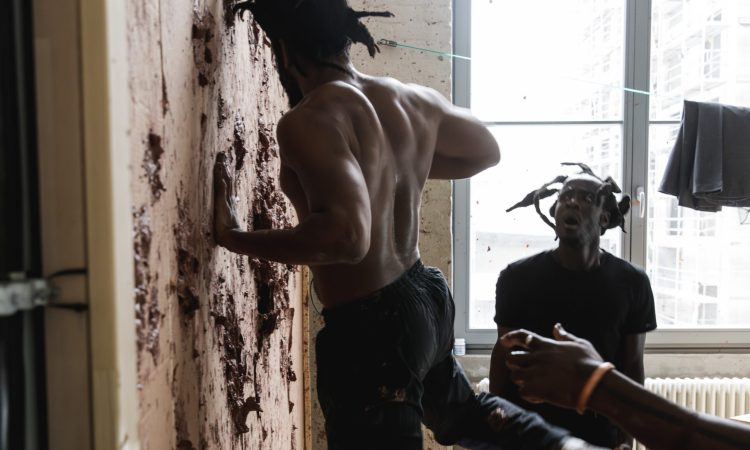
As a longtime admirer of nora chipaumire’s work–its raw power, nuanced politics, rigorous physicality, and distinctly non-Western storytelling–I was thrilled when she agreed to chat about her journey and process as a performing artist. This is an excerpt of our full conversation, all the way from Zimbabwe to New York.
ankita sharma: So, I’m Bay Area born, and I saw you went to Mills College, right? How was that?
nora chipaumire: Yes! Having come from law and broadcasting before immersing myself in movement practices, it was a crash course for me on the politics and industry of it all. The classes I took were mostly the Caribbean forms–Cuban, Haitian, some Dunham and stuff–they were important to me for questioning, what is this? Why do this? I was also the only African I knew and was in another political mindset than my peers; I was talking about colonialism way before it became the trend that it is in the arts world today. I felt very alone, but I was on a mission. Like, if Graham and Humphrey could do this–then shit, I want to tell my story.
as: Did anyone help you through your experience as the only African woman in the program?
nc: Amongst others, Laura Elaine Ellis, a dancer and teacher with Dimensions Dance Theater. She said to me—you’re not Black, you’re African. That was revolutionary to me…like if I’m not Black, what the fuck am I? But she meant I couldn’t latch onto this history of the diasporic transatlantic. That history is not mine. Mine is African. I’m not African-American.
as: How did that sentiment impact how you tell your story and make work?
nc: Since Elaine said “you’re African,” I’ve consciously asked what does being “African” mean? Growing up in Zimbabwe, no one questions what that is because everyone is African. America gave me a distance that allowed me to see my African self from another perspective, which I relish.
So, I went into Mills College trying to tell my grandmother’s story, trying to talk about being a child of an African revolution that we actually won. I knew my trajectory was to build a language out of my Black African body, which meant coming back to Zimbabwe because I can’t be inheriting other people’s language. It was just a matter of–how do I do field research like what Katherine Dunham did in Haiti, or Zora Neale Hurston did in the Caribbean?
as: So how have you done that?
nc: I’ve been intentional about physically embedding myself in what is done at home in Zimbabwe. For the past few years, we’ve been building our yard and workspace, nhereraHUB. All the people you see in my work, all my students, we practice here, outside. This is how I’ve been physically embedded, and then intellectually letting the imagination fly.
as: When you are telling Zimbabwean, land-based stories, how much do you translate to people with different lineages in the rehearsal room?
nc: Most of the team has been to Zimbabwe, and the specificity actually helps us all, rather than trying to make a kind of collage of everybody’s story. And while it may be my story that we tell, the people in the room all have the same ambition towards being free, the same understanding that we are of this soil, and the same desire towards the liberated self in our hearts. We can all be speaking one language, even if we do it with different accents.
as: What does the actual shared vocabulary look like?
nc: With Dambudzo, for instance: Everyone had to read Dambudzo Marechere and other books related to this subject matter; We also all live and breathe this nhaka practice, which is a physical practice of what it means to be unapologetically Black and African; and then, as my collaborator tyroneisaacstuart says: “even if you can’t, won’t, or don’t understand what you’re reading, the room itself is a book.” Meaning, it is important to read the room. We’re in this room with other people, colors, and objects. That also becomes a text. The creation of a space is also a text. The work is being done by all of us in the room.
as: What role does the audience play in creating that space, especially in an immersive setting?
nc: Well, I came into the performing arts understanding that humans are intelligent. I never gave up on that. You need to challenge these life forms–whatever composition they are.
For example, we did portrait of myself as my father in Senegal to a 99% Senegalese audience. The piece is staged in a boxing ring where I’m fighting my father’s shadow, becoming him, carrying him with me. The Senegalese are hearing us cussing out our fathers, and they are cussing back. That performance was supposed to be an hour and a half; it lasted for three hours. When there are people in the audience that are culturally in it with you, they don’t need the translation. They speak back to the work. It’s immersive like that. When that happens, we are like ‘glory, hallelujah.’
And if that doesn’t happen, if even one person walks away saying “damn, I’m gonna look up what this shit is about,” then we are winning. Anytime we are in a room that allows us to reduce the space between you and I, we have won.
as: People often call your work “confrontational.” What do you think about that?
nc: I am wrestling with what it means to have power and agency. The people who call that confrontational know they owe something to someone for their position in life, and they are not willing to give their position up. We can’t actually rip away the wealth they’ve stolen, but we can wrestle them in this very safe space of theater and ideas. When we bring our full intelligence to these ideas, suddenly it feels confrontational. But, like who gives a fuck? Be confronted, then. Just know that who you’re being confronted with is yourself.
as: What language do you prefer using to frame your work?
nc: I’m trying to develop the right language. The African context doesn’t have a history of critiquing contemporary art, so there isn’t language to think about the work. Without our own language, we fall back on Western language, which collapses us into the Western canon–a disservice since the West did not make me.
At the same time, I want to make work that my grandmother would understand. She had, like, one grade of education. Why wouldn’t I want my grandmother to understand what my body is doing? Civilization is making work that is so obtuse that your own people can’t understand you. The West loves that because they think it’s so intellectual, but I’m like, the best philosophers are the simplest. As Gayatri Spivak, who is an intellectual god to me, says: if we are to be read in the Western canon, we must find a way to affirmatively sabotage that shit. We must find a way to be in it, but to refuse it and to make work for our universes.
In the diasporic body, radically different selves grow in the West and at home. Might the West find it confrontational that an African artist and Black, female body utilizes the stolen resources of the West to make work that emboldens her universes? Undoubtedly yes, and thankfully so. As nora’s career proves, nurturing one “self” may make room for radical acts of love, provocation, and change in the other.