When we enter a theater to view dance, we expect humanity: breath, sweat, and gravity delivered physically and tangibly.
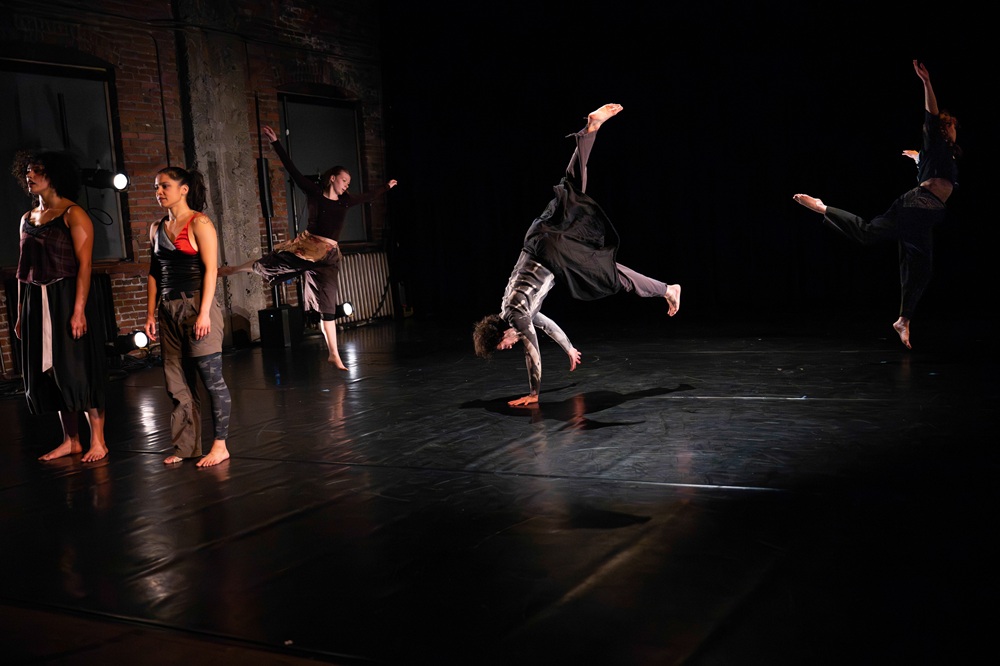
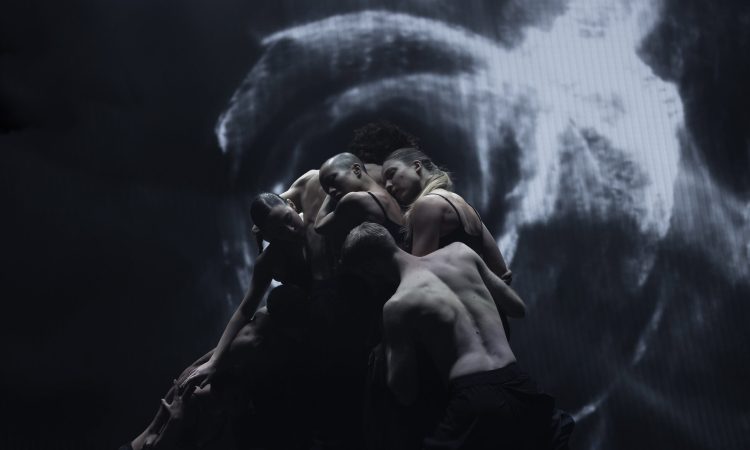
At La Mama Experimental Theater Club in December 2025, Marla Phelan’s Birth + Carnage provided all of that: dancers in dark costumes with mostly-bare torsos and loosely blousy pants executed a quirky choreographic vocabulary of rippling arms, scuffing feet, swirly turns, and effortless lifts. But, in addition, it had science! Astrophysicist Dr. Blakesley Burkhart worked in collaboration with director Tim Richardson and video artists Klsr and reinfected.me to abstract astrophysical data (inspired by stellar birth) into a compelling video installation, creating an everchanging science-forward structure around the movement of the dancers on the stage.
Phelan is not alone in her thinking and strategic collaboration; science has made an appearance in numerous works in recent (and not so recent) years, as both inspiration and an active collaborator. It invites the question: What does the addition of science accomplish in dance? Sifting through various examples, two trends emerge—science lends either an augmenting force, or a contrasting one. As an augmenting force, broadly speaking, science amplifies what we’re already seeing on the stage, giving us sneak peeks into the performers’ physiological processes and leveraging them for choreographic inspiration. Conversely, as a contrasting force, science gives us something completely different for consideration: a separate theory, visual, or even a parallel performance that creates a foil for the performers’ exertions.
Mikhail Baryshnikov’s Heartbeat: mb in the late 1990s brought audiences an early taste of scientific augmentation, capturing biofeedback with wireless telemetry and translating it into the performance’s musical score. This electrocardio-choreography enhances the movement of the dancer, allowing the audience to experience the internal workings of their physical feats as part of the external performance product. Troika Ranch dove into a similar space with their body of work, including 16 [R]evolutions (2006) in which motion tracking software created real-time digital media correlating with the dancers’ movements. Physical signals became not just an accessory, but a co-author for the work. And in a similar vein, Meeting of the Minds, developed by Musiqa and NobleMotion, and premiered in 2024, fitted dancers with EEG skull caps and measured electrical activity in their brains as they moved. By using science for somatic inquiry, choreographers and dancers do not become secondary to technology. Instead, they transcend the boundaries of their physical forms, enriching the performance and crafting a more expansive physical environment for their audience’s perception.
In a different corner, science offers a contrasting or even oppositional force in dance performance. Consider the works of roboticist and choreographer Catie Cuan, such as those described in “Breathless: An 8-hour Performance Contrasting Human and Robot Expressiveness”, developed in collaboration with engineers at Stanford/UC Berkeley in 2023. In a durational exploration, a robotic co-performer shares space with the human dancer, allowing viewers to experience and compare the movements of the breathing and breathless dancers. The opposite side of this coin may well be science replacing human dancers entirely. We see this in Jordan Wolfson’s 2014 dancing robot artpiece, entitled Female Figure which offers the viewer a grotesque and uncanny spectacle. Dance movement remains, but the audience’s reaction to a robotic being is likely quite different, still marveling as one might with a human performer, but with less empathy and more lurid intrigue.
Birth + Carnage could land under this contrasting umbrella as well, albeit with a very different approach, as the scientific visuals are created in parallel and not explicitly from the dancers. As a caveat: I say this in a literal sense, but there are many qualitative or conceptual parallels that could be had about the birth of a star as related to the performing arts. In this particular instance, the heat and friction of stellar birth is handily mirrored in Phelan’s choreographic choices and treatment of the stage. Dancers muscle their way through fast undulations and reaching gestures that carve through space, at times clustering into each other like a burgeoning protostar. Vertical lifts push dancers into the air, with weightless rough-handed grace. The dancers’ exposed torsos serve as a canvas for the elements imposed upon the performance space: shadowy lighting, a piped-in haze, then a sudden flood of blood-red lighting, all backdropped by the swirling black and white video installation. Contrasting the organic (dancers’ audible breath and visible sweat and ambulations) with the man-made (visualizations or artificial elements and entities) allows the viewer to not just see movement, but echoed themes and divergences between the distinctly human and the human-generated.
We could always make the argument for a less poetic catalyst driving the dance collaborations with science: as humankind’s attention span decreases, choreographers are compelled to offer viewers more to look at, in hopes of ensuring their engagement throughout the duration of a choreographed work. (For reference, UC Irvine research clocks a decrease from 2.5 minutes in 2004 to 47 seconds more recently for screen-based focus). Drawing in collaborators creates an extra layer to a performance, manifesting additional elements for the viewers to enjoy, perhaps in the form of screens, sounds, or videos. Dance, traditionally the most analog of the arts, becomes a more complex, tech-enriched experience.
While many variables may contribute, the most charitable and likely correct read is that collaborations of any kind further the dialogue. Awe & Wonder by Donna Sternberg & Dancers, creates an enduring structure for this, as an annual collaborative framework between choreographers and scientists. The convergence of dance and science delivers a way to say something new, and to build a more expansive creative product from that new statement.
Historian Will Durant offers the thought that “Every science begins as philosophy and ends as art,” perhaps supporting the argument that the disciplines are more aligned than we may think. Science is another way to look at dance and vice versa, iterating and testing hypotheses about what works and how to share information. It also pushes the boundaries of viewership by challenging audience members to remain present in our ever-more-distracting world, witnessing and processing the performing body in a multi-faceted creative ecosystem.
Birth + Carnage, Marla Phelan, La MaMa, December 19-21, 2025.