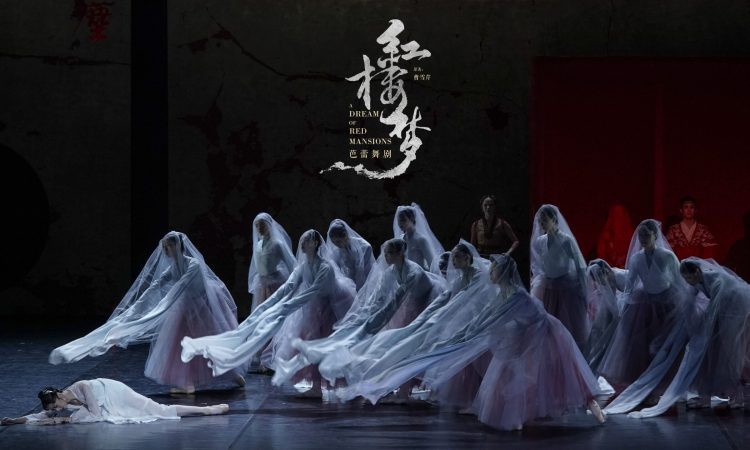
When I saw a group of dancers in bell-shaped tutus, veils draped over their heads, running across a dimly lit stage, I paused: were they the Wilis from Giselle?
Sitting inside the giant durian-shaped Esplanade Theatre in Singapore, surrounded by an audience largely composed of Asian faces, I began to realize how astute the National Ballet of China was to bring its newest production, A Dream of the Red Mansions (2023), to this Asian city-state as its second international tour stop. Singapore’s embrace of Western culture, combined with its large Chinese population, allows audiences to appreciate ballet vocabulary while also grasping the complex story of an aristocratic Chinese family’s rise and fall, centered on the tragic love triangle between Jia Baoyu (Chen Zhuming), Lin Daiyu (Fang Mengying), and Xue Baochai (Xu Yan).
Adapted from the 18th-century Chinese classic Dream of the Red Chamber, the two-act ballet unfolds through Baoyu’s memories of the extravagant life in the Jia mansion and his doomed romance with Daiyu. The stage opens with Baoyu alone before a vast white backdrop pierced by a circular opening. Wearing his iconic red cape and forehead band, he kneels deeply toward the audience. As he walks through the opening, the massive panel slowly rotates as a giant fan, transporting both character and audience back to the family’s prosperous past.
Against the golden surface revealed on the reverse side of the panel, Baoyu recalls his childhood as the pampered star of the household. Flirting with maids, lifted playfully by servants, and bowing dutifully to his mother and grandmother, Chen’s buoyant, unstoppable steps capture Baoyu’s careless innocence and self-centered upbringing. When he encounters Daiyu, however, the bravado softens. Through ethereal partner lifts and lingering eye contact, Baoyu expresses an intimacy that strips away his aristocratic egotism.
Fang ’s Daiyu moves with delicate bourrée steps and a constantly lowered head, embodying the character’s poetic melancholy due to the early loss of her mother. Dressed in a flowing ice-blue robe, she repeats the gesture of covering her mouth with a handkerchief, portraying her fragility, as if illness weighs upon both body and emotion. In contrast, Xu’s Baochai, wearing a coral-tone rope, claims the stage with open, expansive jumps and turns. Her broad arm expansion, lifted chest, and confident smile project composure and social grace, qualities that foreshadow the family’s preference for her marriage with Baoyu.
Despite the dancers’ polished performance, the choreography does not always achieve the cultural hybridity it visually promises. During Baoyu and Baochai’s wedding, Daiyu’s despair leads her to death. At that moment, a group of dancers appears in bell-shaped tutus and veils reminiscent of the Wilis from Giselle, while simultaneously tossing long Chinese water sleeves. The identical costumes, perhaps intended to represent the past lives of girls in the mansion, disrupt the narrative imagery of the Chinese story. The juxtaposition of two aesthetic systems, water-sleeve gestures above and pointed feet beneath the tutus below, feels decorative rather than integrated. Similarly, the lushly orchestrated score offers few melodic moments that linger in memory. Unlike the iconic musical themes that anchor many narrative ballets, the music here functions more as atmospheric accompaniment than as a structural partner to the choreography.
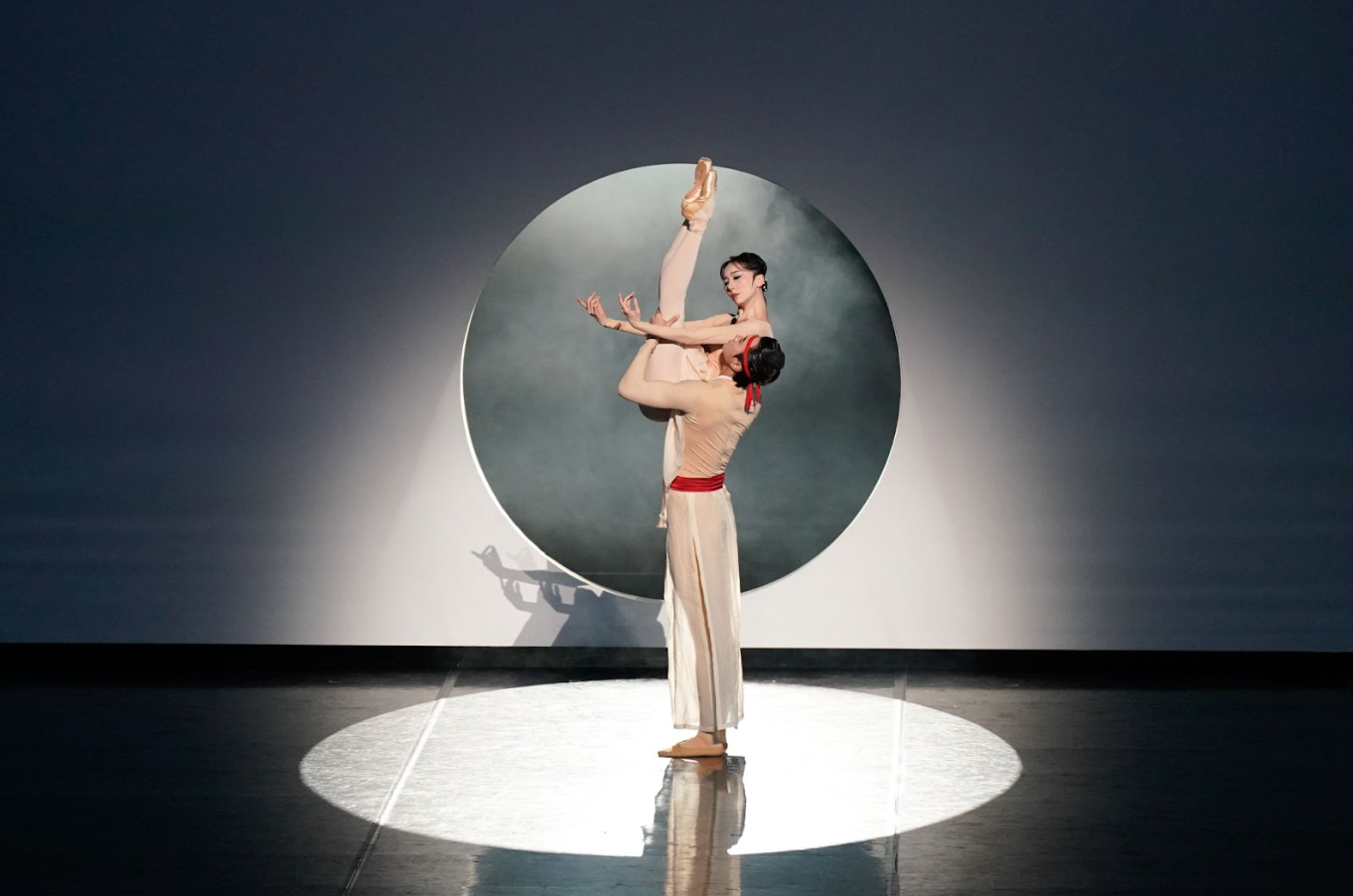
Photo credit: the National Ballet of China
Compared with the ballet-dominated choreography, the stage design and costumes more smoothly blend Chinese cultural motifs with modern theatrical minimalism. The rotating backdrop mediates between Baoyu’s dream and reality, while the golden surface streaked with faint red stains signifies the gradual decline of the family’s fortunes. The circular opening evokes the moon gate of a traditional Chinese garden, allowing dancers to appear and disappear fluidly while invoking poetic imagery of the moon or the otherworldly realm.
Like many contemporary Chinese ballets, A Dream of the Red Mansions demonstrates how effectively visual design can translate cultural hybridity onto the stage. Yet the most compelling site for such hybridity—the dancing body itself—remains less fully realized. Although the company invited guest coaches from traditional Chinese performing arts, including Chinese dance drama choreographer Tong Ruirui, water-sleeve specialist Shao Weiqiu, and Kun opera expert Shao Zheng, the uplifted, ballet-trained bodies remain largely unchanged. The question, then, is no longer whether the Willis costume in Giselle can appear in a Chinese ballet, but how such encounters can be fully realized in the dancing body, rather than remaining at the level of costume and stage image. The limited fusion between Chinese movement aesthetics and classical ballet technique raises skepticism toward the necessity of producing culturally specific ballet works. It also explains why Chinese ballets struggle to achieve the same popularity as the Western classical repertoire. Until Chinese ballet more deeply engages with Chinese movement principles, the dialogue between the two traditions may continue to appear more on the surface than within the choreography.
A Dream of Red Mansions, the National Ballet of China, Esplanade Theatre Singapore, March 12-15.