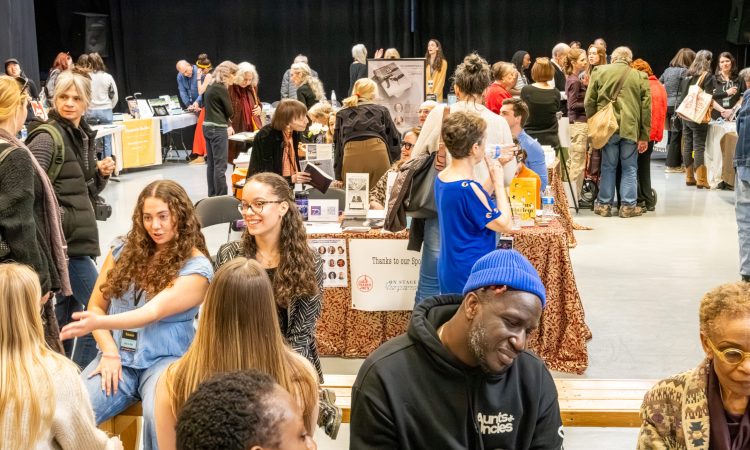
I bet you’ve never said to yourself, “You know what would be revolutionizing and uplifting right now? A book fair!” But that’s what Anabella Lenzu, American Dance Guild (ADG) president and author of two books on dance pedagogy, essentially said during a conversation with another author over coffee a couple of years ago. Last month, ADG’s annual dance book fair celebrated its second year, hosted by Peridance Center in New York City.
It is worth noting that there were no publisher tables at the event. This Book Fair prioritized authors instead, most of whom are practicing dance artists themselves.
So why a dance book fair specifically? According to ADG board member Christine Jowers, it’s because “it’s vital that we write our histories.” At Peridance’s ground-floor studio, many trailblazing artists who cultivated their own distinct voice in New York´s interconnected culture of dance making, theory, and criticism over many years were in attendance, and so were newer voices, the probing and the curious, the ones not bogged down by too much context just yet. Maybe some of the young folks at the fair didn’t actually understand who they were helping out or the Big Name they found themselves standing next to in conversation. And that’s ok. Learning flourishes in generationally diverse spaces, and the informal atmosphere of this event proved to be an asset.
I asked Wendy Jones, author of Choreographing the Curriculum, why this gathering was important. “Because,” she said, “we get to see the range.” We went on to discuss that range in terms of the generations and experiences, but also how the Book Fair housed everything from academic texts about multiple forms of dance to coloring books. Everything here was dance-focused, dance-inspired, or in an effort to highlight a chapter of dance history.
“There’s only so much you can do in your own classroom or in talking to your colleagues,” Nicole Perry said. “The moment you have a book, the world takes you seriously.” Her book points to a need for change and provides evidence-based frameworks for enacting that shift. A professional intimacy coordinator, Perry wrote Care-full Creativity in Theatre and Dance Education: Consent-Forward, Trauma-Informed, Psychologically Safe Movement Pedagogy. She and her work stood out to me as a new voice making a guide for care in the wake of the #MeToo movements, and initiatives like The Whistle culminating project, Disrupting Harm in Dance.
Teacher and performance maker Stephan Koplowitz put it this way—“There’s a different kind of cultural milieu in New York now versus the earlier times. It’s like the resources are different or lacking these days, but I feel like this [book fair] says, ‘this is a model or like a time capsule. This is how we did it.’ I taught for 33 years full-time, and I’m still making dance work. This book is my ultimate giving back, a culmination of my teaching and all I learned as an artist and a person. Hopefully it keeps things alive, in a sense.” His book On Site: Methods for Site-Specific Performance Creation was reviewed in conversation between Leah Stein and Jonathan Stein for thINKingDANCE several years ago.
There was a lot of culmination and hope in this room. One thing that struck me was how many places dance was applied, and how many adjacent fields and ideas are valued at the community’s table. Dance photographer Julie Lemberger made a coloring book that teaches readers of all ages about current women working in dance. Ellen Saltonstall displayed a series of books about yoga anatomy, gentle aging, and body care. The Once Upon A Dance writing team had a number of children’s titles at the Book Fair, including my new favorite, Bellyrina: A Tutu Tale from the Belly of the Beast. Meanwhile, Kristine Bendul offered her delightful book Noodles Needs a Nap, inspired by her years dancing in Broadway’s Cinderella.
Poetry, dance histories, somatic texts, and breakdowns of technique were all there, too. So were dance photography books, as well as inquisitive texts on future dance potentials, life lessons, and neuroscience. In short, dance was everywhere, its stories told by its makers.
The American Dance Guild and its leadership merit our continued attention, especially all of us working within the broad field of dance today. With this Book Fair, ADG demonstrated that they are acting as artists and practitioners, forging very tangible results for our community out of real need. But also, I was delighted to see throngs of young dance students there, too, absorbing it all, poised to potentially become the authors of a new moment.
American Dance Guild’s Dance Book Fair, Peridance Center, March 29.