For decades, choreographer Donald Byrd’s dances have confronted and engaged with America’s inconvenient truths. In The Minstrel Show (1992), for which he won a Bessie Award, dancers in blackface forced audiences to confront racist stereotypes; and in 2019, for his collaboration with Alvin Ailey Dance Theater, Byrd’s Greenwood interpreted the Tulsa Race Massacre of 1921. In these and other examples, his performances draw uncomfortable parallels between the past and the present. Byrd’s dances, urgent as well as artistic, address our unease and attempt to shake us out of complacency. Those who forget the past, he seems to argue, are doomed to repeat it.
The 2025 Guggenheim Fellow has been the Artistic Director of Spectrum Dance Theater in Seattle since 2002, but his connection to New York runs deep. Byrd danced for Twyla Tharp and Gus Solomons, Jr. in the 1970s, before forming his own company in the early ‘80s, Donald Byrd/The Group.
He also lived in downtown Manhattan when, on September 11, 2001, he watched the Twin Towers fall. During the projected video interview which opens Occurrence #14, Byrd describes the profound fear he experienced that day. In particular, he recalls watching people jump out of the buildings to the streets below, unsettled by how they fell through the air “without any struggle.”
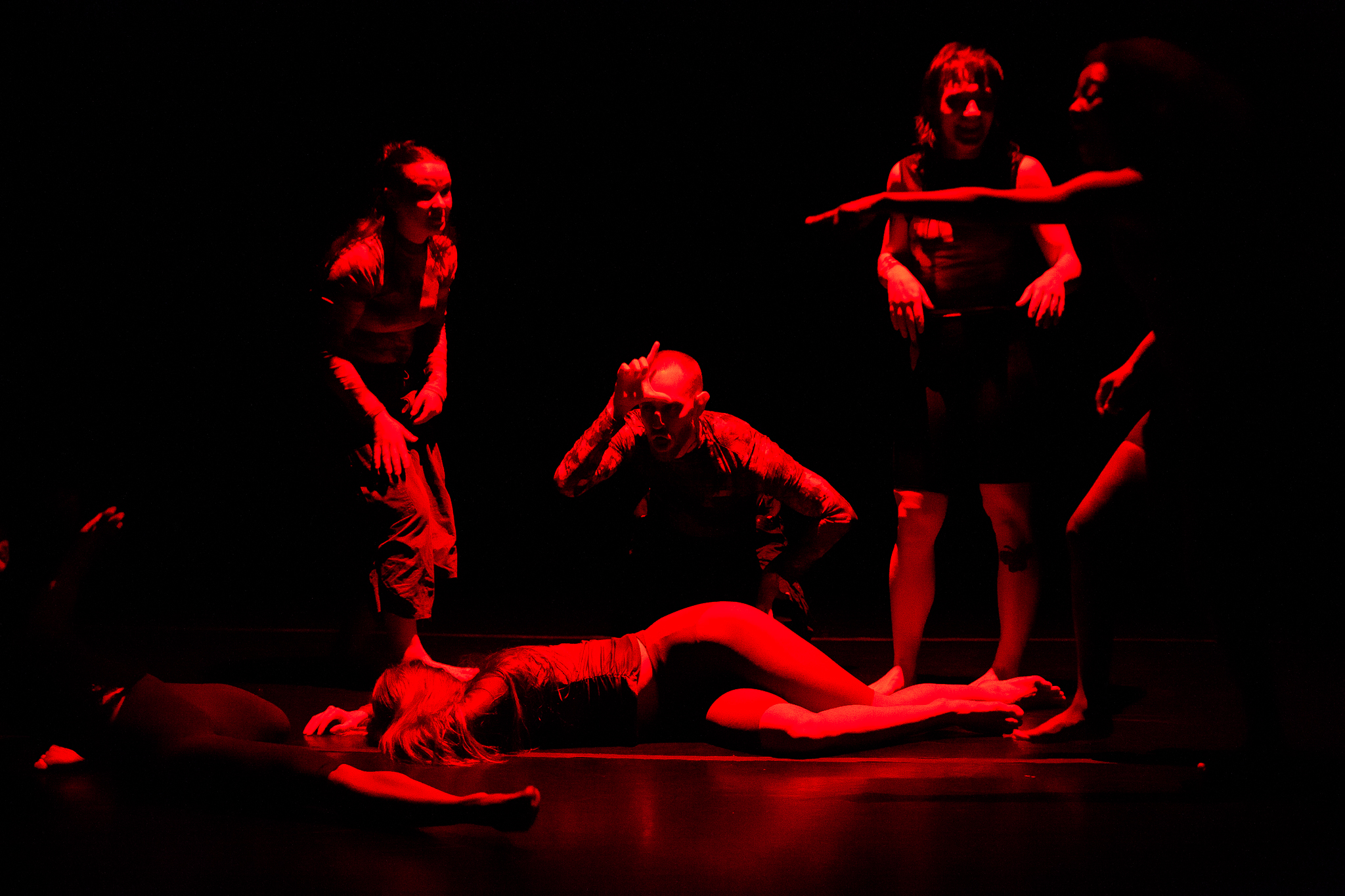
Bearing witness to this horror, as well as bearing the responsibility of remembering, fuels much of the relentless drive of his hour-long piece performed by Spectrum as part of the 21st annual La MaMa Moves! Dance Festival in New York. Save for a few brief intervals to rest offstage, these dancers display formidable stamina and precision in embodying Byrd’s demanding choreography.
Occurrence #14 blends old and new, incorporating solo material from White Man Sleep (2002) with a considerable amount of new choreography woven in. In the performance program which explains the structure behind this Occurrence series (begun in 2016), Byrd says he drew some inspiration from Merce Cunningham, who incorporated excerpts from past works with new phrases and works-in-progress to create an Event. But while Cunningham used chance operations to create dances dense with abstraction, Byrd takes a much more purposeful and emotional route with his choreography.
After the video projection finishes, we see the talented Birdy Adler sitting in a chair, their mouth open in a silent scream, and repeatedly slapping their thighs incredibly fast. Disturbing and intense, it’s a stunning image of movement they return to in their evolving solo, and one that possesses the raw emotional tone which permeates much of Occurrence #14 as a whole. The dark scrim separating the Downstairs Theatre stage from the audience takes on funereal associations, as if the dances are being glimpsed beneath a veil of mourning.
Other members of Spectrum march quickly into place, initiating a new sequence of movement. Byrd’s dancers attack the space around them, thrusting an arm to the side or lunging deep into the floor, before exploding into a new trio or duet. When they embrace one another in Occurrence #14, it’s an act of desperation, a matter of life and death. Some barely exit along a crisp linear pathway before a new duet or group piece begins. Serene Wong’s linear movements are impressive, as when she balances on one foot with her leg extending nearly 180 degrees above. Meanwhile, Cody Krause and Cooper Sullivan dive and lunge low to the ground with a relentless freneticism around her. Byrd delights in forming choreographic contrasts just before shattering them with a new sequence or image.
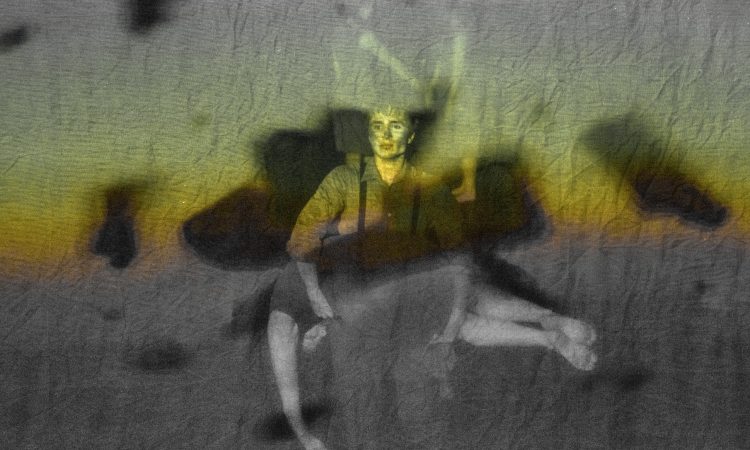
About midway through, Occurrence #14 shifts its dancing into a much more haunting frequency. A projection of the 9/11 “falling man” film by photojournalist Richard Drew plays on a continuous loop, while behind the scrim the Spectrum ensemble lifts a single dancer above their heads in a facsimile of flight. Here, agony and beauty conjoin, and Byrd forces us to look at the combination of these images, and makes meaningful again the “Never Forget” mantra associated with 9/11. A similar strategy is deployed immediately after, when the dancers carry one another slowly in various configurations towards the audience, over and over again. They look shell-shocked, yet their repetitive march is nothing but mesmerizing. Meanwhile, onto their bodies is a new projection of what looks like dust.
Occurrence #14 received a standing ovation the night I saw it, and La MaMa curator Nicky Paraiso was in tears when he publicly thanked Byrd afterwards. He gave voice to what many of us in the audience knew: that this performance is not a “museum piece,” but an embodied trauma for our times. 25 years on, New York and the world are still witnessing incomprehensible horrors.
With Occurrence #14, Byrd seeks more than catharsis for his audiences. As with so much of his work, his dances ask us now that we see how horrible things are, what are we going to do about it?
Occurrence #14, Choreography and Direction by Donald Byrd, Spectrum Dance Theater, La MaMa Moves! Dance Festival, April 9-12.