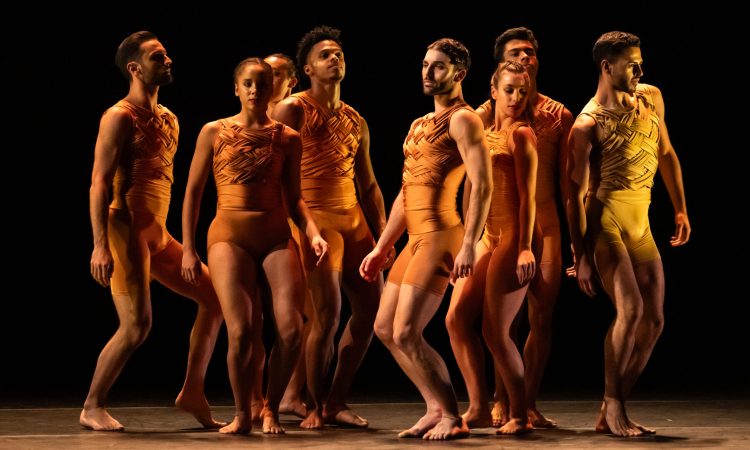
Ballet Hispánico New York’s MUJERES: Women in Motion is in its second season, dedicated to presenting only female choreographers. Program A, which I attended on April 24 at New York City Center, included new works–two world premieres and one company premiere. The company is well known for its versatility and breadth, and this performance is a testament to both.
The program opens with the company premiere: Stephanie Martinez’s Otra Vez, Otra Vez, Otra Vez (2019), inspired by Pablo Picasso’s painting The Old Guitarist. The Chicago-based choreographer often blends ballet with contemporary dance, so it is no surprise to see the work open with four women on pointe. Designer Holly Hyne’s earth-toned dresses are flowy and delicate, as are the women’s rond de jambe en l’airs in perfect unison and sweeping port de bras. Four shirtless men soon rush on stage to join them, and the seamless partnering that is one of the dance’s strengths begins. The men lift the women, whose backs are arched and arms dangling, over their heads. Then the women bend backward around the men’s torsos, and they spin off stage.
The movement vocabulary ranges from graceful duets and trios to a fedora-donning man’s jazzy solo (representing the old blind guitarist, perhaps) to flamenco-tinged groupwork. If it had been performed in silence, it might have come across as pleasantly romantic.
But it is the incredible musical score that brings out the melancholy in Picasso’s Blue Period painting: The songs include 19th-century classical Spanish guitar and castanet compositions, as well as several yearning boleros by artists from Brazil, Mexico, Cuba, and Puerto Rico. And while transitions between songs in longer works are often treated as pauses, Martinez’s transitions are dynamic. For instance, in one silence, the women are thrown into the air and are caught the very moment the drums of the next song begin. In another, a woman slides down a man’s body as the sound rises. You can see the stitching that holds these pieces together, and that thread is one of the most remarkable parts.
Next is the world premiere of the Cuban and Dominican Republic-based choreographer Marianela Boán’s Reactor Antígona, a reimagining of Antigone through a Caribbean and feminist lens. Boán’s style, known as “Contaminated Dance,” blends dance, theater, and other art forms to create radical, collage-style “augmented realities.”
I expected the avant-garde but wasn’t prepared for the emotional impact: The trio features one woman (Antigone) and two men (Oedipus and Polynices). On a stage filled with dry autumn leaves and mist against a backdrop of complete blackness, Dominick Riches’s tightly focused lighting design transports us to another place. Only the front half of the stage is lit, dim and warm like a blazing sunset, creating a sense of timelessness and deep space around it. We could be anywhere, and nowhere. José Andrés Molina’s original electronic score adds a hypnotic pulse.
The dance is narrative and surreal. At one point, a man steps out of the shadows to face the audience and box an invisible partner. He gets knocked out, then worms his way back to his feet. Later, the three carry bulky, black stuffed cylinders on their backs, fall, and roll around in the leaves. Near the end, Antigone stands up all five of those stuffed cylinders (which have come to signify luggage, logs, and emotional burdens throughout) around her and, while crouched and hidden behind them, slides around the stage in her newfound shelter. While some moments, like this and some slo-mo fighting, felt almost cartoonish, overall, the work is refreshingly unique.
Ending the program is the second world premiere: Brazilian choreographer Cassi Abranches’s Trança. After watching the dancers move through questions of life and death, it is a thrill to see them strip off their seriousness and dance. Abranches blends African-rooted Brazilian dance with contemporary technique to create not just a performance but a joyful celebration. The ten dancers pump their chests to the beat and pop their ribs and hips in clean isolations. They lean back and sway-walk, pelvis first, too cool to look our way, as Brazilian composer Beto Villares’s original score plucks and pounds through the theater. Janaina Castro’s costumes add to the fun–shiny gold braided high-neck leotards, soon to be replaced with silver balloon pants and fitted crop tops. They are clearly enjoying themselves, their whole bodies smiling. Ballet Hispánico takes on contemporary ballet, experimental dance theater, Brazilian dance, and flamenco, making versatility look not only comfortable but radiant.
Mujeres: Women in Motion, Ballet Hispánico, New York City Center, April 23-26, 2026