Significantly, the night I saw Putty Dance Project fell on May Day. In fact, before going to the show that night, I stopped by a rally both celebrating how far workers’ rights have come and fighting for more justice in the current political climate. In Philadelphia, I constantly confront the scores of history, and am forced to reckon with the inexplicable pairing of race and class entangling themselves with art. I especially feel this now as this city celebrates a country navigating who, and what, it wants to be through violence.
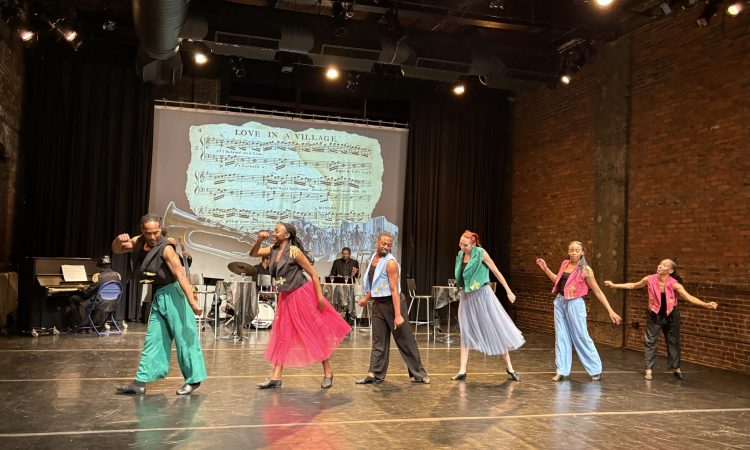
My mind straddled these multiple conversations as I entered the theatre. My 2026 self was transported to a jazz club circa 1829, even though the decor looked more like the 1920s. Three tall black bar tables paired with matching seats were placed upstage just slightly in front of a five-piece jazz band. As they warm up, five dancers saunter in, warmly greet each other, and prepare for a night of jubilant performing. Through Philadelphia Dance Projects’ DANCEUPCLOSE program and in early celebration of America’s Bicentennial, Lauren and Brent White´s Dance Like It’s 1829 reimagines the music of Francis Johnson through a blend of jazz composition and a hybrid choreography of ballet, jazz, and social dance. Johnson was an African American composer based in Philadelphia, and in choosing to resurrect his work, Putty Dance Project reminds us that Black people during the antebellum era were much more than just enslaved laborers. They were movers and dance masters, musicians and composers, navigators and cultural contributors.
During the pre-show, historian and scholar Lynn Matluck Brooks informs us that Johnson was one of the most published native-born composers of the 19th century. He also broke barriers by gaining access to perform in Black social corners as well as white society balls, thus making him a fixture in multiple music and dance social spaces. Keenly picking up on these facts, Putty Dance Project worked in tandem with Johnson’s sheet music, which had specific dance steps (known as calls) embedded in the score. As the accompanying jazz band riffs off Johnson’s main melody, the dancers match it with structured and repeated phrase work, creating a dynamic contrast. At the same time, projected images of the original sheet music flash across the back wall.
“Love in a Village” flawlessly exemplifies the multidisciplinary vocabulary of Dance Like It’s 1829. A unison phrase of ballet-like pas de bourres cut into short springy coupé jumps, the entire cast melts into turns that break out with huge sweeping arms, all gliding to the tune of a heartfelt jazzy melody. When the band breaks off into their own improvisational scores, so do the dancers. At one point, the ensemble begins to move in slow motion as each dancer moves uptempo in their own freestyle. The juxtaposition nods to the rehearsed social choreography of Johnson’s time, paired with the inherent value of individualism and freedom instilled through Black social dancing.
“Alice,” a solo performed by Lauren Putty White, marries the ballet origins of Johnson’s dance calls with the untethered embellishments of jazz improvisation. At one point, she goes through the motions of épaulements and arm positions. Her limbs float up in a round O-shape reminiscent of a ballet fifth, before one arm floats down in C-shape right in front of her chest. Suddenly, she subverts her flow with a series of quick staccato breaks, flipping her hands back and forth in front of her in direct play with the musicians improvising behind her. The notable lack of footwork during this section draws further attention to the mastery of movement in her upper body, which I found captivating.
I later discovered during a post-show talkback that Ms. White has her own movement technique, body scatting. She did not delve too deeply into what this method “means,” but to me, like all things diasporic, meaning is felt and embodied, and freedom is found.
During the final section of Dance Like It’s 1829, the dancers invite us to participate by clapping alongside them. Soon, they enter the audience and pull some of us out of our seats to move alongside them. As a Black woman watching social dance, I feel compelled to clap, cheer, and holler, so I am always a fan when this happens in other performance contexts. What is social dance, anyway, if not active and participatory? So often, the instinct is to watch dance in quiet observation, a tradition underscored in concert proscenium spaces like the Christ Church Neighborhood House. I am unsure what to do with this irony.
Putty Dance Project breathes new life into Johnson’s historic scores, while simultaneously challenging various unwritten codes of conduct. I think about the rallies earlier, of the call for a joyous yet radical reinterpretation of what may be set within composition. Is this a score I and others can improvise outside of this space, too? My guess is that the Putty Dance Project would say yes–yes, absolutely.
Dance Like It’s 1829, Putty Dance Project, Philadelphia Dance Project, Christ Church Neighborhood House, April 30-May 2.
Missed this show, but still interested in experiencing it? Both the performance and the historian talk will be broadcast on PhillyCAM and uploaded to PDP’s YouTube channel later this year.