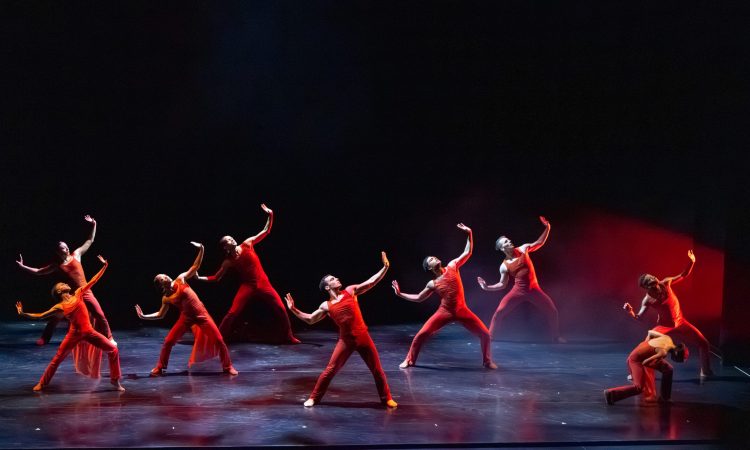
Centered in a white spotlight, two dancers dressed in red fold deeply onto and off of one another. The 1940 voice of Woody Guthrie eerily calls forth: “that golden valley,” and “this land was made for you and me.” The dancers lunge towards the downstage right corner, arms stretching out as if to reach for the long awaited “promise” of land. This is the opening scene of Tommie-Waheed Evans’s world premiere of in case of fire, speak, a part of The Martha Graham Dance Company’s centennial performances at Penn Live Arts, co-commissioned by ArtPhilly. Members of the Graham company as well as Philly’s very own PHILADANCO! make up the cast of in case of fire, speak, igniting the stage with a plurality of technique and cultural identity.
What can be said about the identities of these two companies and what makes their collaboration so significant in 2026? Joan Meyers Brown founded PHILADANCO!, the historically Black dance company, in 1970 at a time when racial discrimination was loud and proud despite being illegal; similar to the issues of our country today. While Martha Graham did not integrate people of color into her company until the 1950s, twenty-four years after it was founded, she certainly noticed and responded to political and humanistic challenges happening around her globally. In 1938, Martha Graham premiered American Document, a work in direct response to European fascism. While there is not much footage of this work, the Graham company has made attempts at resurrecting the work through archival images. Eighty-eight years later, Tommie-Waheed Evans (co-artistic director of PHILADANCO!) dives into the archives to converse with American Document and its relevance to our 2026 political climate. Both artists question “What is America?” in the midst of violent suppression and the redacting of individual rights.
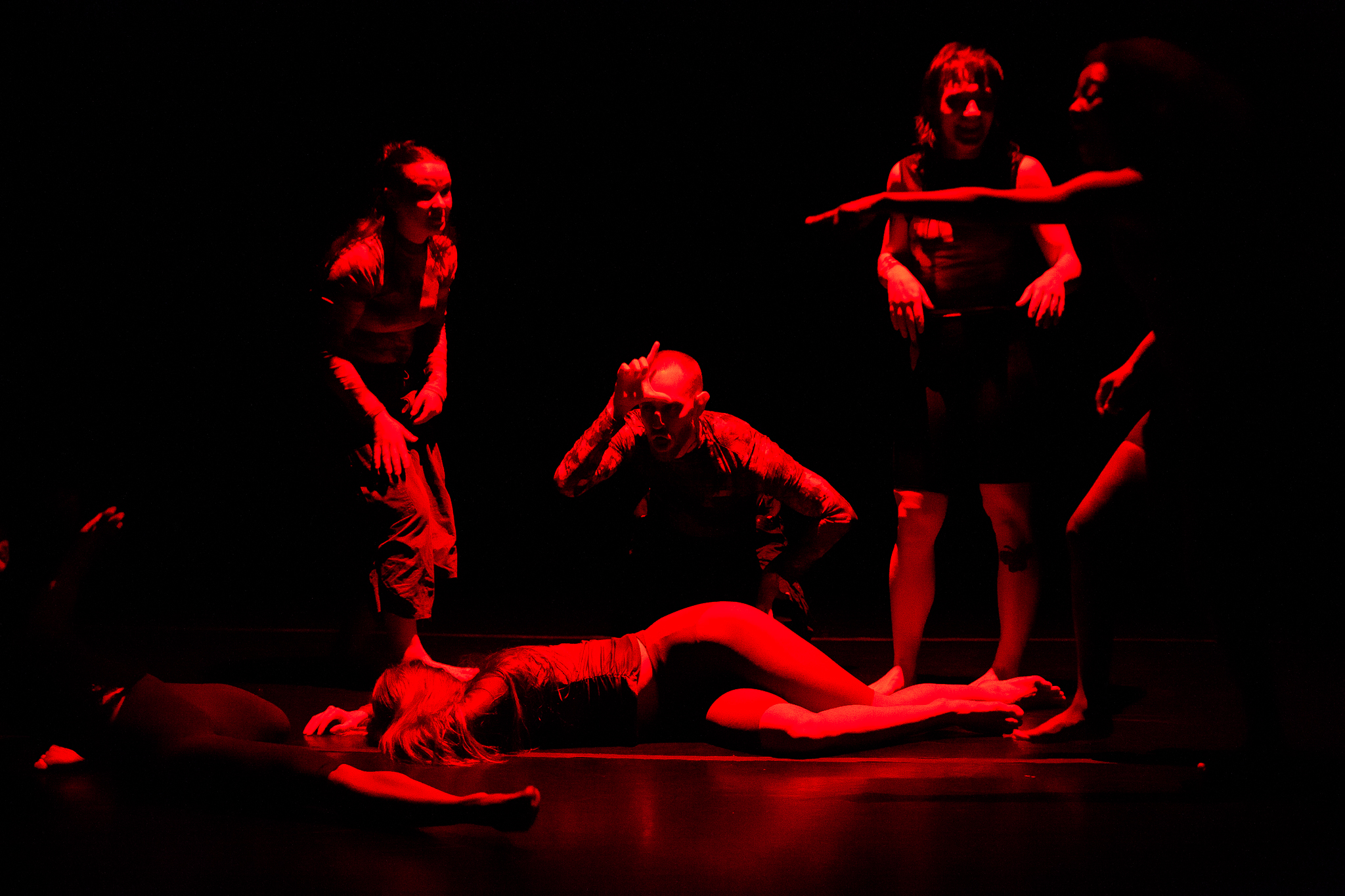
Nine dancers bolt into view, pushing through space with relentless drive, accompanied by a boundless aesthetic often desired in ballet. I lean into the sound of Nina Simone’s voice singing Sinner Man. Uwazi Zamani’s sound design motivates each step. A notable lack of front light falsifies each dancers’ face, minimizing their humanity. The distortion of bodies, personhood and benevolence feels uniquely American. Diagonal lights crossed with haze send a visual signal that cautions the audience; these sights and sounds telegraph danger. Dancers move with their arms stretched behind as if linked together by an invisible chain.One step at a time, they march toward tomorrow.
The music shifts in tone: no longer somber, a sole figure center-stage stomps his foot repeatedly. Rhythmic claps rise in the dancer’s body, swinging with the feel of gospel music. Bursts of quick foot patterns follow as do long extensions, lifts, and complex partner work. The ensemble’s earlier bondage appears to break as the music takes the dancers to a place of brief freedom. Two dancers leap into a stag jump, framing a single dancer lifted to the sky by the collective. As soon as the image is formed, the lights are snatched from the stage.
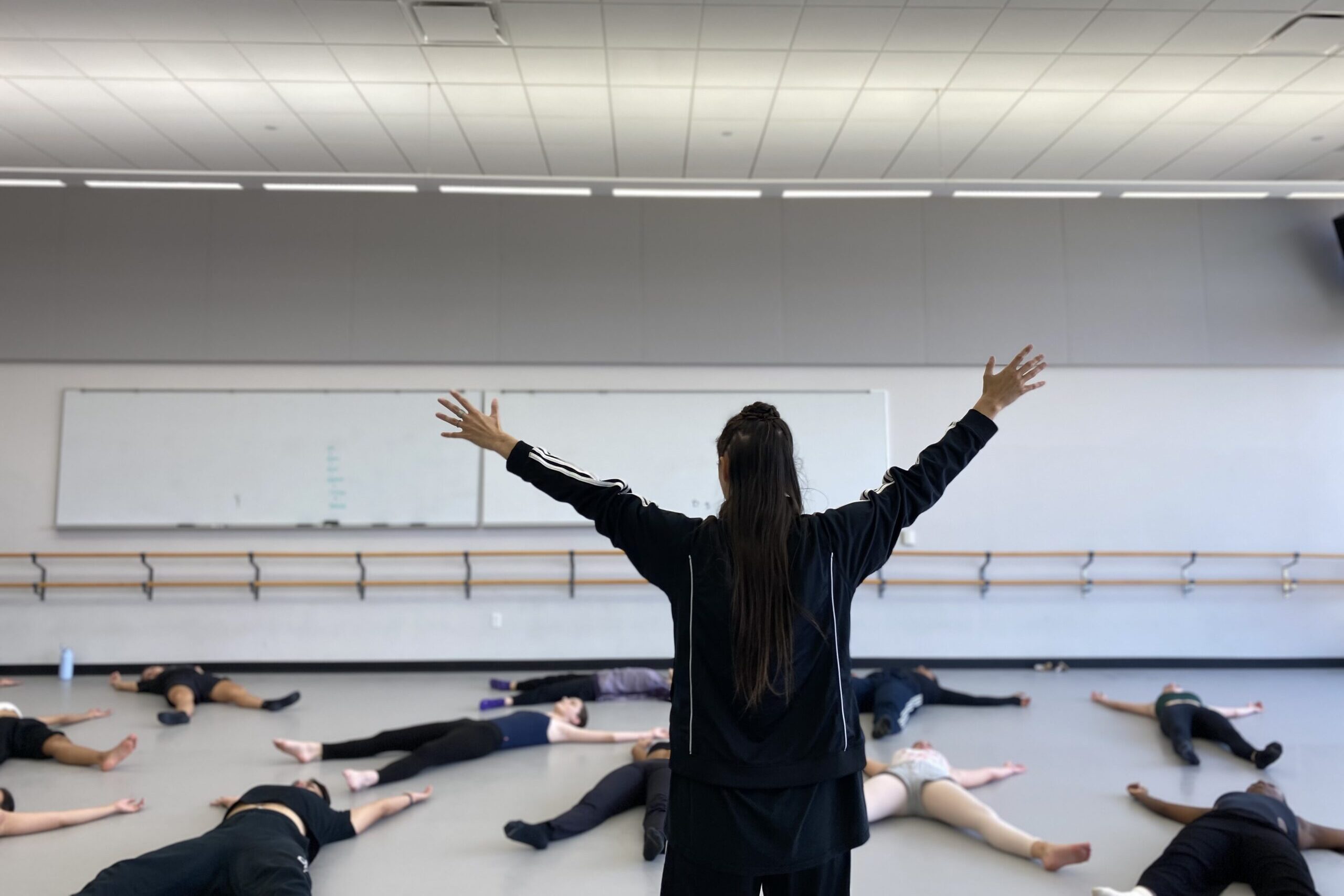
in case of fire, speak is accompanied by two Graham originals: Night Journey (1947) and Frontier (1935) as well as the brilliantly bright commission, En Masse (January 2026) by Hope Boykin. Following the May 30th matinee, I join audience members together for a thINKingDANCE “Write Back Atcha!”– a post show writing workshop with the following prompts:
- Describe an image, sound, sensation or feeling that lingers with you from the performance. (color of the lights, direction of dancers, the air in the theatre).
- Consider what, if anything, strikes you as uniquely “American” about this production?
- Does that answer shift among the four works in the program?
While audience members in the workshop request not to have their writing shared in this article, I will reflect about their relationships to the prompts and the show more broadly: One woman reminisces about watching Martha Graham herself perform; A mother and daughter discuss differences in the works of the evening, pointing out Graham’s commitment to bold and jagged movement vs Evans’s round shapes and continuous movement; A film artist refers to Graham’s work as “stop-animation,” pictures moving from one moment to the next – each a snapshot of intense emotion; One audience member offers their struggle to find anything “uniquely American” about the vocabulary of Evans movement in this particular work. I am awestruck and honored to be in the presence of patrons who have shown up through the years to continue conversing about identity and what it means to be an American.
I think on this question of American identity and offer the following:
Martham Graham is an American icon, an artistic force of the 20th century. The white ruling class of America is built on eurocentric principles of exclusivity and superiority. In 1926, the year the Graham Company was formed, African Americans were still under the social and legal rule of the Jim Crow era. Regardless of desire, access and invitation to practice codified dances such as ballet and modern were prohibited. Today, Tommie-Waheed Evans—a queer, deep brown African American steeped in ballet and legacy modern—creates a nationally recognized premiere in collaborations with The Martha Graham Company and PHILADANCO!
It is uniquely African American to subvert the expectation of white folks. It is uniquely African American to be great despite a history of enslavement and the legal right to own someone as property. in case of fire, speak personifies the American spirit. That is not to say that discrimination and social rule have ended. In fact today 100 years after the formation of the Graham company, racialized laws, eurocentrism, and fascism are wreaking havoc on the lives of Black and Brown people in America. The fact that companies are commissioning diverse voices in the midst of this climate speaks to this one truth: Art is the temperature, the heat that moves the needle. America is a conflict of access and exclusivity, the land of “opportunity” built upon both change and oppression. Evans’s’ work speaks of these facts, and there is no more poignant time in history to be confronted with the question: what and or who is American?
in case of fire, speak, Tommie-Waheed Evans, The Martha Graham Dance Company performances at Penn Live Arts, co-commissioned by ArtPhilly. May 30th.