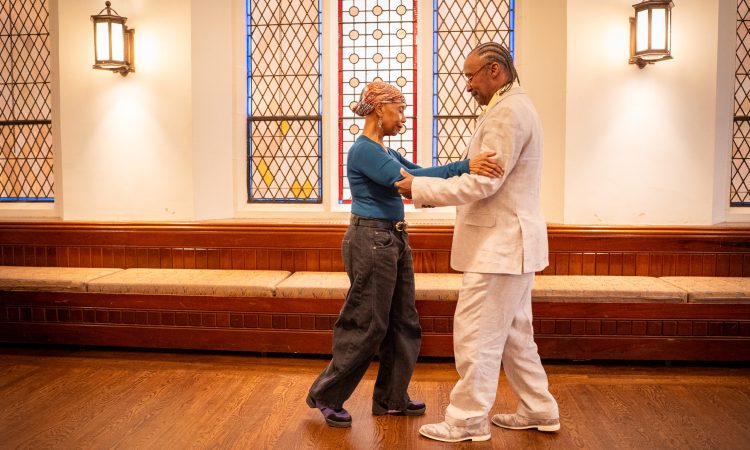
Nestled in the meeting rooms of local Philadelphia-area churches, adult centers, and community arts spaces, Tango Therapy Project (TTP) is offering a different kind of therapeutic intervention for people with Parkinson’s disease – Argentine Tango. TTP’s philosophy and practice are built upon a robust body of scientific research supporting Tango’s benefits for people living with Parkinson’s disease, as well as other older adults and individuals affected by various motor disabilities and neurological conditions. Tango Therapy Project’s work builds upon Associate Professor in the Emory School of Medicine and Research Scientist Dr. Madeleine Hackney’s research to enhance the physical, emotional, and psychological well-being of the communities they work with.
But it isn’t just about scientific research or improved mobility–it’s about the people. And that’s why I was particularly excited when Co-Executive Director and Teacher, Dr. Carolyn Merritt, PhD, reached out to me to share more about Tango Therapy Project and connect me with their community. In early June, I chatted with Dr. Merritt and various TTP administrators, teachers, and participants about their lives and how they first came to Tango Therapy Project. In these conversations, it became clear that while, yes, the physical outcomes of adaptive Tango dance have been life-changing for many participants, what felt even more (or just as) important was the community it built.
Kristin Balmer, an Original Lead Teacher, knew Dr. Merritt long before Tango Therapy Project’s founding. Prior to TTP, Kristin taught beginner Tango lessons, both alongside others and individually, anywhere she could–whether in local bars or dance studios. Kristin has a gift for encouraging people to dance, or as she says, “I could figure out how to ‘trick’ people into going along with stuff.” As one of the earliest Tango Therapy Project teachers and curriculum developers, Kristin was instrumental in creating the first TTP syllabi.
When I asked Kristin about how she came to dance as an adult, she lit up immediately. “[I was] very introverted and shy, and I happened to live next door to dance teachers, and I got tired of hearing the parties next door… and the laughter and the music.” After working up the confidence to knock on her neighbor’s door, Lesley Mitchell answered. When Kristin asked Lesley what her favorite dance form was, so she could teach Kristin a few steps, she responded, “Tango, I think about it all the time.” The once self-described “clumsy and shy” Kristin found confidence in these impromptu neighborly Tango sessions. She says, “I don’t look good when I dance, I feel good.” Awareness, social connection, and relationship with her partner take precedence in her practice, rather than performance aesthetics. “Tango feels like a more intimate private relationship–something with your partner versus for your partner.”
Prioritizing social presence, relationships, and care is not unique to Kristin, but is rather the underlying pulse of Tango Therapy Project. Sage Leland, a Volunteer and Administrative Assistant, is newer to the community. Sage studied dance for nearly her entire life, continuing through her studies at the University of Pennsylvania as a recent graduate from the Bioengineering program. Eager to combine her love of dance and neuroscience, she initially began reaching out to organizations like Dance for PD, but found that they didn’t offer programs in Philadelphia. After watching a YouTube documentary about Tango Therapy Project, she thought, “Oh my gosh, I have to be a part of that!” Sage quickly became a key member of the TTP community through her work as an administrator, but also as a volunteer in the Tango class sessions. “Connection is the backbone of the whole program. It’s easier to make a joke or get to know someone when you’ve danced together.”
This connection is precisely what keeps participants like Neil Godick coming back. Neil was adamant that, despite being a multi-cycle TTP participant and having worked with various non-profit organizations that have presented dance performances and programs, he does not consider himself a dancer. “I’m an enjoyer of the dance, not a dancer.”
Neil’s first Tango class was at the insistence of his neurological medical team. “I was ordered to go [to TTP]… [at first] I poo-pooed the whole idea.” For nearly his entire life, Neil was busy. He worked seven days a week, often working twelve hours or more per day. “I was a horse. [But when] I got sick, everything ended. I went from being on an airplane once or twice a week to Europe, and [suddenly] that all changed.” Once considering himself an optimistic person, Neil felt himself becoming increasingly secluded as he began to navigate his new somatic landscape. “I was isolated, I live alone… I didn’t go out. Tango got me out… Tango brought back optimism.”
Now, Neil proudly states that he hasn’t missed a class, praising both the physical impacts as well as the social effects: “I can now walk backwards–I couldn’t walk backward before! I now have new friends… The socialization aspect of dancing is really important to me.” During our chat, Neil and Sage fondly recall Neil’s first class when Sage approached him, asking him to be her dance partner. Now, Neil finds himself recruiting others to attend Tango Therapy Project. “It’s just been a plus from the moment I got there.”
As Kristin, Sage, and Neil chatted about their experience with TTP, they kept returning to the community–something that has transcended their weekly class meetings. Joining Tango Therapy Project has inspired Neil to prioritize community in other aspects of his life: “I am a proud klutz, and I’m a proud person who has Parkinson’s! I have a strong will… [and] very few things get me down. [Since joining TTP], I set a goal to have one social or Parkinson’s-related activity per day, five days a week.” Sage invited the community to a local dance performance and was surprised when so many TTP members showed up that they filled up an entire row in the audience. Kristin continues to work both in her own practice and with TTP and Dr. Merritt, to innovate new ways to bring together participants, care partners, and community volunteers through Tango.
In many ways, Tango Therapy Project’s greatest achievements are not measured by improved gait or balance assessments, but rather by the relationships formed between classes, in the confidence participants carry into other areas of their lives, and in the simple act of showing up for one another week after week. Through Tango, TTP has built something larger than a therapeutic intervention; it’s a community grounded in connection, mutual care, and joy.
*Dr Carolyn Merritt is a former writer for thINKingDANCE
Rachel Repinz in Conversation with Carolyn Merritt, Kristin Balmer, Sage Leland, and Neil Godick, Zoom, June 3 & 16.