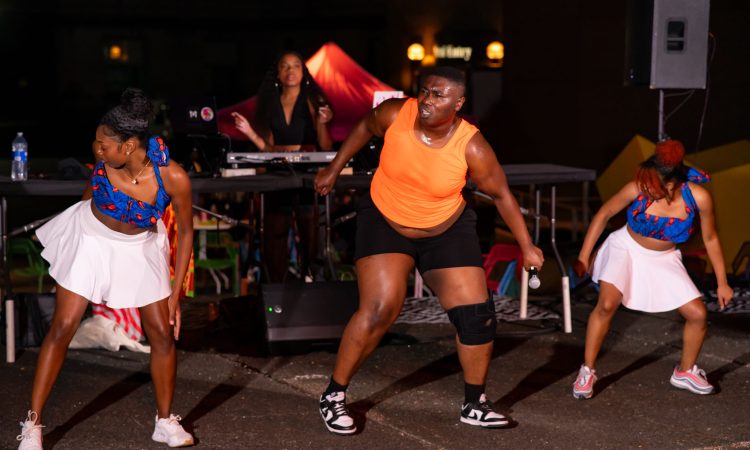
The bright afternoon sky heated up Interna$hional Bounce’s Juneteenth celebration at Spruce Street Harbor Park’s outdoor stage. Unbridled black joy shone on full display as the audience, dressed to the nines, threw down in dance cyphers. Bempa, a local Philly musician, Afro Fusion dancer, and choreographer contributed with a short but energetic music set—a combination of his original music and covers by other artists—accompanied by five short original choreographed vignettes synced to each song, all exploring similar themes of self-discovery and celebration.
“This is not just a performance; are you ready for an experience?” Bempa asked. It was clear from his energetic and bold introduction that he had skill in engaging audiences and bringing out joy. Bempa and two femme dancers, Jules and Eliyana, assumed serious upright poses that focused my attention and prepared me to listen. Suddenly, Bempa’s new song “Inner Work” came on. The trio raised their hands to the sky. They turned slowly to the side with sharp perpendicular arms. I immediately wanted to see that slow-down exaggerated even more. In canon style, the dancers flexed with strongman arms and sharp angled arms along to the lyrics “working harder,” their isolations sometimes hit and sometimes missed. However, as the grooving fluid movement started to pick up, Bempa’s explosive joy and large smile traveled through the rest of his body and stayed there-—infectious from the start.
The strongest parts of the choreography highlighted the text of a song while the trio moved in unison, grooving or hitting poses. The three progressed through the gestures of getting done up to go out. They put on make up, looked in the mirror, and gassed themselves up as they gyrated and slowly spiraled their arms upwards, synchronizing with the text and showing how they were improving themselves. Joy and emotion worked through these gestures as the dancers metaphorically preened themselves. Standout moments of afrofusion technique vibrated joy to the audience, with waist and hip grooves fluttering side to side and hands gesturing to the sky and ground. The dancers stood behind each other, popping out one by one in a continuous snaking body roll that still felt cohesive and lively despite the fact that I had seen the move before in music videos. At the end, Bempa blessed us with an impressive twerking bonanza as the audience cheered.
The choreography did not always nail its intended effects. Sometimes, the hitting poses were not sharp enough; they blended together in a way that prevented them from carrying the same fullness or emotional intensity that traveled through the dancers’ bodies at other times. I could also see the impact of the tiny stage on the dancers, which did not allow them to locomote easily. I was more engaged with the meaning of the songs and Bempa’s singing than parts of the choreography, which felt a bit under rehearsed or lacking variation.
Bempa’s performance played with a queer affect of drag/vogueing while not directly using that style of movement. He brought joy, seriousness, and sass to his performance in his facial expressions and lyrics. The stops and posing were similar to the way a vouger would pose after a death drop, except the trio was not falling to the ground. Bempa never mentioned he was queer in the performance, but as a queer performer myself I saw his songs call out themes of queer experience. This was especially salient in a song where the main character, a pariah, embraced his difference despite difficulty and loneliness. The deeply bent legs and arms as well as the extraverted expression of groove highlighted a call to be perceived, celebrated and enjoyed. Bempa’s over-expressive eyes and smile as he engaged the crowd, his at first low toned voice soaring to higher registers, and his overstating, loudness, standing out, a feeling of freedom in self-expression, all felt queer to me.
Bempa wanted to create an experience, transport us to somewhere he could show who he truly was as a bold, unapologetic black queer Ghanian, and I would say that overall, he achieved that in his performance despite some challenges with time (the performance was too short) and staging (the stage was too small). I thought the movement itself could have been more continuous between songs to create a seamless experience. I also would have liked to see Bempa develop a more equal relationship between himself and the two femme dancers. At times they felt like props to frame him and the movement became repetitive, especially at the end. This is a common trope in music videos with singers and backup singers; the cliche felt disappointing in contrast to other engaging and connected moments throughout the performance. Though there were some lacklustre moments, Bempa’s music, vivacious affect and afrofusion technique shone through. I’m excited to see a longer set with more space onstage in the future.
Untitled, Bempa, Spruce Street Harbor Park, Interna$hional Bounce House, June 21