This article is the culmination of a Write Back Atcha workshop, held following a performance of Kea and the Ark on June 30 at the Sedwick Theater.
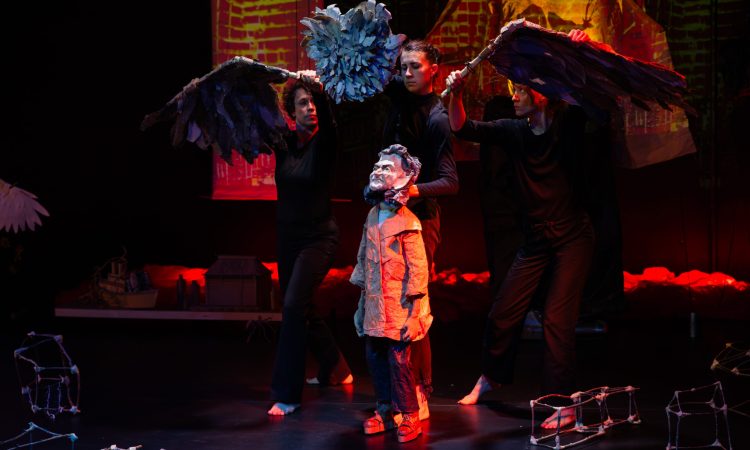
Kea Tawana was an artist, activist, and builder who most notably constructed an eighty-six-foot-long, three-story-tall Ark in the middle of Newark’s Central Ward. In Kea and the Ark, Tawana’s story is captured through a captivating multidisciplinary performance of puppets, movement, song, and narration. As I find my seat with the audience, a muffled voice turns into Tawana’s. Lead artist Sebastienne Mundheim sits stage left with a large tome-like script as our biographer/narrator. Stage right is Daniel de Jesús, the bard of our show, with a red electric cello and stage mic. A mixture of puppets and sculptures populates the space–the sheer quantity of which overwhelms me. Iris flower spiders, their roots in a dirt clump as a body, wire strings as their legs. A giant skeletal rat with a more defined head, as if the bugs hadn’t gotten there yet. A projection screen displays images of writings and drawings by Tawana that are hung on the wall in the lobby outside exploring her life philosophy. A good five (or ten) minutes pass as I witness and sink into the collection, and even more before the puppets move as we listen to Mundheim’s narration. I am in Kea’s museum, and it is about to come alive.
Mundheim questions Tawana from the beginning, noting that the truth of her story is not clear. Mundheim states she is unsure if she even likes Tawana. This puts me on my toes from the get-go; in questioning Tawana’s narration of her life, Mundheim also invites us to question our own, and hers. A biography that could be described as a form of myth-making. It asks: what is useful from the Tawana mythology, and what might be harmful? How do you inhabit a person’s story in an honest, compelling, and responsible way through performance?
A more troubling part of this history is Tawana’s claim of different racial identities throughout her life. Tawana, presumably of at least mostly white european descent, also is claimed as “Hopi”. I hoped that Mundheim could have brought to light the more problematic and complex aspects of how Tawana’s natural metaphors advanced a settler colonial notion of the “disappearing Indian”. Tawana claimed to be Hopi, and in the show she was linked to a giant owl puppet (beautifully crafted) that used “abandoned” nests as a home. This process being framed through natural metaphors obscures how white settlers made “nests” abandoned through violent actions and policy. Tawana framing herself as an animal posits her as acting more on instinct, whereas humans make concrete choices and are culpable for their behaviors. It is a common tactic to talk of the “naturalized” dying out of Indigenous people to erase the reality of forced relocation through murder, imprisonment, and structural genocide. The sympathy generated for Tawana in this moment as a lost girl and skipping over a more concrete critique of appropriation is one example of how metaphors can obscure Tawana’s possible appropriation throughout the show.
True to how I feel about museums, I wanted a significantly longer time with all the creations than I got. The pack rat who gathers and layers things together in their borough was a puppet that I could have watched for longer, disturbing and skeletal. The cello playing and singing by De Jesus shifted from postmodern deconstruction to melodic phrases, creating an eerie mythological soundscape. He accentuated the loneliness, trauma, or fairytale telling through these shifts. The narration and music were an equally rich backdrop that synced well with the puppets without directly narrating what the puppets were doing.
Another standout moment was the suggestion of physical/sexual violence and alcoholism within Tawana’s foster family. Two puppeteers climbed on rocky-looking shoes and gestured at each other while Tawana’s puppet sat in the middle. A poem/song added a frantic urgency as Tawana is called a girl again and again by Mundheim, highlighting her vulnerability within the family dynamic. The rigid gestures and purposefully blank expressions on the dancers’ faces created a disturbing scene of looming, uncaring parents. They abstracted household tasks like washing dishes or feeding the cats, in jerky, sudden movements, speeding up and down in ways that made me feel uncomfortable and off-kilter.
Mundheim, at the beginning, speaks about how puppets take on their own life from humans, and that puppets tell you how they want to move. In a conversation with an audience member after the show, the audience member mentioned how the skeletal puppet figures mirrored the emptiness of the stories themselves, only to be filled with certain viewpoints and life by the performers. Tawana was “puppetized” in many ways throughout the show: as a papier-mache creation that walked slowly and sadly, as a human performer onstage, and as a giant hollow pink coat. Her different forms moved slowly through space, giving space to wonder about her stories and feel the loneliness she must have felt growing up and living on her own.
Kea and the Ark offers a way for Tawana to continue to exist beyond death, to inhabit ghostly forms that are both disturbing and awe-inspiring to witness, and hopefully continue to develop her complexity and ingenuity.
The following writing is derived from the Write Back Atcha writing workshop that occurred immediately after the performance. Audience members had a chance to write about their experience and have it published as a part of a review. I will end with their excerpts.
Rae:
Red owls, cold blue, sad wood. Moaning, Shifting, stretching. Always forward.
I felt a sodden sadness, compassion, and wonder. Wondering what’s true, wondering how we fill in the spaces left in a well documented life affects it all. What we leave behind creates the timber skeleton of our own ships. Ships that take us through the ocean passages of life, ships that guide our finders to discovering what we want them to.
Will they see what we built? Or only see their own?
Anonymous 1 (edited for clarity):
I was overwhelmed with inspiration, awe and sadness. Kea’s ability to persevere in the face of unimaginable hardship – one after another at that. The loneliness she must have felt throughout her whole life.
Anonymous 2:
The need to build from the structures that once kept us safe, to build something else that will keep us safe and totally destroy what we once thought was keeping us safe.
Anonymous 3:
That was as perfect as anything I’ve ever experienced. A meditation, a celebration, a bird in my chest. A flutter that became a roar.
In awe of her brow and the flutter of her coat. The light, the music, the rib cages of the boat punctuating the slow deliberate rhythm of your prose.
Author’s Note: I am friends with performer Harlee Trautman.
Kea and The Ark, White Box Theater, ArtPhilly What Now, The Sedwick Theater, June 30.