On July 4, 2026, as the United States celebrated her 250th birthday, there was perhaps no better place to be than Philadelphia. The city where white men in wigs once declared “Independence” had again become the symbolic heart of the nation.
But instead of signing the Declaration of Independence, I found myself signing a contract for another Philadelphia spectacle. This time, Lincoln Financial Field wasn’t hosting football. It was fútbol. The Linc, home of the Philadelphia Eagles, had been transformed into a global stage surrounding the FIFA World Cup match between France and Paraguay.
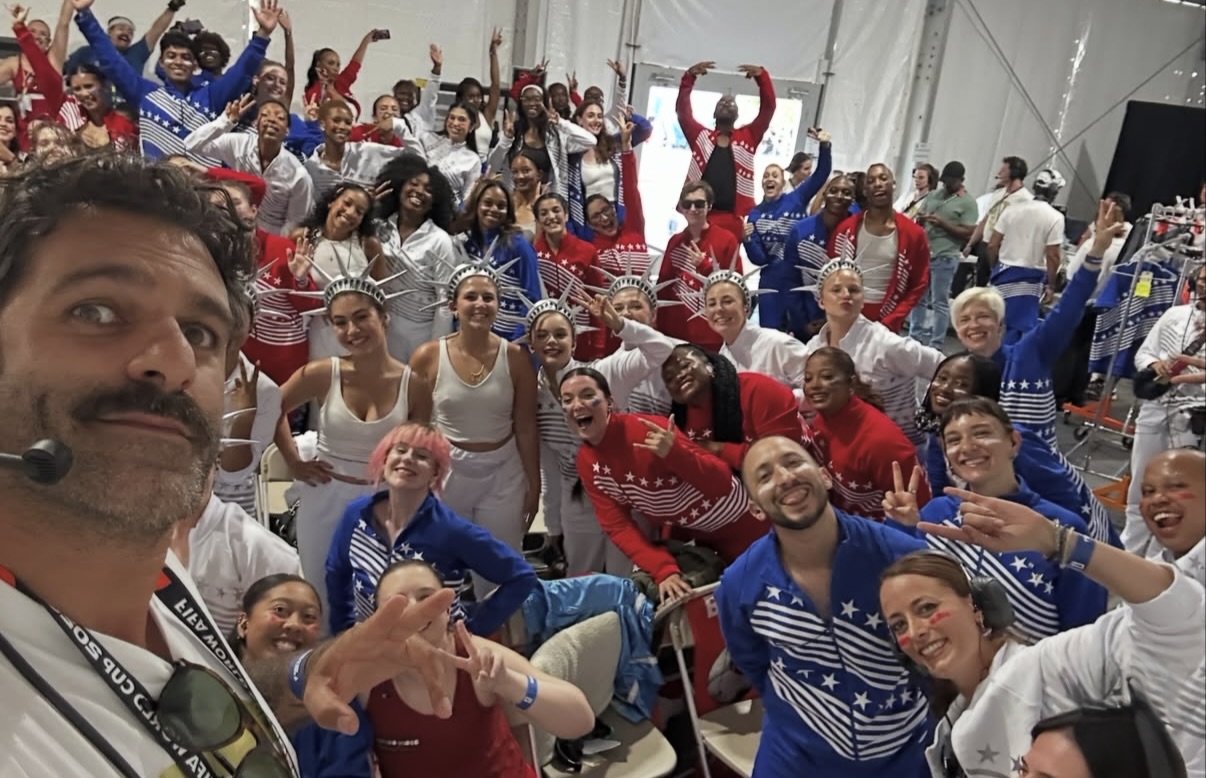
Five miles down the road from where the words that declared a new nation were written 250 years earlier, I stood in an NFL stadium tunnel, sweating in a sea of matching red, white, and blue tracksuits. My earpiece crackled with static. A hundred hired performers, stagehands, and crew members stood poised at the edge of the pitch, while 68,000 shouting fans made enough noise to vibrate the concrete beneath my sneakers.
On television, the production looked like a full-on patriotic miracle in glorious, star-spangled pageantry. Philadelphia erupted as The Roots took the stage in their hometown, Idina Menzel sang the national anthem, and pyrotechnics burst into the clear summer sky. FIFA and Balich Wonder Studio had built a world-class spectacle of supersized, American proportions.
It was a strange cross-section of humanity: veteran union stagehands who had spent decades bringing other people’s visions to life, alongside performers from all over the world. They built the mechanism. We changed costumes, carried flags, and paraded through one narrative after another. Somehow, all these moving cogs became one masterfully choreographed machine.
Italy, Ukraine, Mexico, Australia, Brazil, Haiti, Albania, and every corner of Philly were represented under that white tent, our headquarters leading up to the 4th. Different accents, different lives, different reasons for being there. For nearly ten days, we passed the sunscreen, traded jokes, and waited for our next call. Whatever separated us outside that tent seemed less important inside it. We had one job: hauling giant banners across the turf.
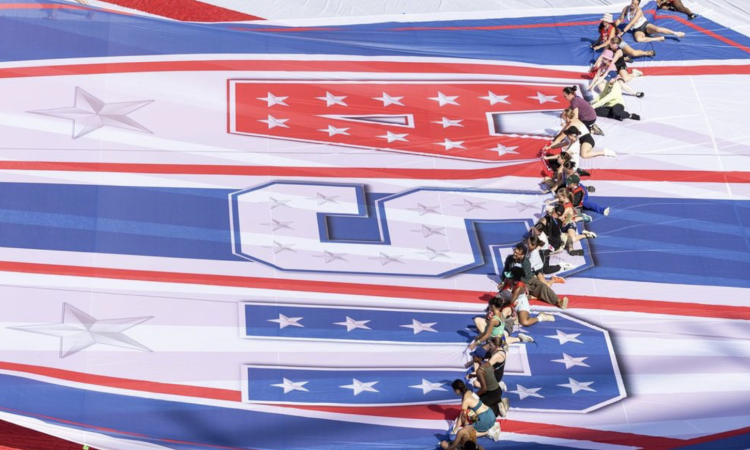
Laid across the fútbol pitch were five massive declarations in block letters: LIFE, LIBERTY, EQUALITY, INALIENABLE RIGHTS, and, at the far end, my group’s assignment: THE PURSUIT OF HAPPINESS.
I had to laugh. Of all five, The Pursuit of Happiness was the heaviest—and it was the one my group had to drag.
Frankly, I didn’t walk onto that field feeling starry-eyed about the republic. In a country this fractured, national pride can feel like hollow theater. I knew my face glitter, plastic smile, and cheap red, white, and blue hairpiece weren’t going to save the free world. Mostly, I was hot, tired, and trying not to trip over my shoelaces or tangle my radio wire in my fake-ass ponytail.
The music and fireworks were dazzling, but the people I shared it with were better. Assigned the same job, we spent hours waiting between calls, and started talking. I heard stories about working Super Bowls and concerts, learned which New Jersey creeks have dinosaur fossils, and got a lesson in frying catfish. None of it had anything to do with the show, which was probably why I liked it. There was something unexpectedly tender about strangers becoming friends simply because we had time to sit beside one another. The conversation devolved into the kind of intimate nonsense that happens backstage. We ragged on one another, swapped embarrassing stories, asked for tampons, and said things to people we had met that morning that probably should have taken months of friendship to earn.
At one point, I turned to my friend, another dancer who, like me, was from the South. Neither of us was from Philly. We were both miles from home. She sat quietly on the turf, looking out at the Philadelphia skyline, seeming contemplative.
“What are you thinking about?” I asked.
“Just existing.”
I sat beside her. We looked out at the city together.
And maybe that was the point. After all the waiting, the rehearsing, the performing, the noise, and the ridiculousness, we could simply sit there. No performance. No purpose. No need to be anywhere else.
Just existing, together.
During our time, nobody asked who anyone voted for, what church they skipped on Sunday, or what language they spoke at home.
You wouldn’t know it from watching on television, but moving a banner this large in perfect symmetry and unison is a surprisingly complicated operation. There is math involved. Logistics. Timing.
At first, my job seemed almost comically simple: run out with a banner. Unfold it. Lift it. Lower it. Lift it again. But the longer we rehearsed, the more obvious it became that every person mattered. We hauled those heavy sheets of rubberized tarp across the turf, hit our marks, and did it again. And again.
Then, finally, we ran onto the pitch beneath the blinding stadium lights. From the stands, the whole thing looked effortless. Up close, it was hundreds of people trying to make one enormous image.
The banner didn’t care who we were. It just had to be held:
“One, two, three. PULL!”
We held up LIFE, stretched out LIBERTY, leveled EQUALITY, and anchored INALIENABLE RIGHTS. At the end of the line, my crew hauled THE PURSUIT OF HAPPINESS into place.
I couldn’t move that tarp on my own. Neither could the union stagehand next to me, nor the dancer from Albania. That single banner required a hundred people pulling in the exact same direction at the exact same second just to keep it from collapsing onto the turf.
And yet there were moments, holding that canvas beneath the weight of the July sun, when I felt how small my role was: one person holding one corner, one face among hundreds in a crowd. Who was watching me, identified as “Banner holder 222” when Idina Menzel was onstage? What difference did one person make when what we were carrying felt so much larger than any one of us?
Maybe that was the trap: mistaking being small for being insignificant.
The banners offered a pretty simple answer. They stayed aloft because all of us were holding it. No one person had to carry the whole thing. We just had to hold our corner.
Maybe preserving the thing we call freedom requires the same thing: the exhausting, collective work of carrying it forward.
Maybe this was the only real way to celebrate America on her 250th birthday, even as she stumbles. Not by pretending we are flawless, but by showing up on the grass, looking at the tired strangers beside us, gripping that heavy cloth with raw hands, and refusing to drop our end of the load.
That day, there were nearly 70,000 people packed into one stadium, from dozens of countries, speaking dozens of languages. Coincidentally, the flags of Paraguay, France, and The United States all are made up of the same three colors. And there we were, all wearing those colors: red, white, and blue. It was absurdly symbolic.
We were small in that crowd. Practically invisible. And, as it turned out, perfectly dressed to disappear. We were through security, indistinguishable from the thousands who had paid handsomely to be there. Sometimes it pays to go unnoticed. But being unnoticed is not the same as being unneeded.
The canvas was heavy that day, but we held it together.