Articles of clothing scatter across the stage. Close to the audience, there’s what looks like a handful of raffle tickets in a bowl. Ella Sommer Martin, the choreographer of Cicada Stories, asks select audience members to pull from the tickets, labeled with titles such as “duet” and “opening music,” randomly choosing the order of the show––along with the roles of the five performers, such as “victim,” “saboteur,” and “vender” (or was it “mender”?). I strain my ears. With each selection, the audience claps. We could be in a game show–what will come next?
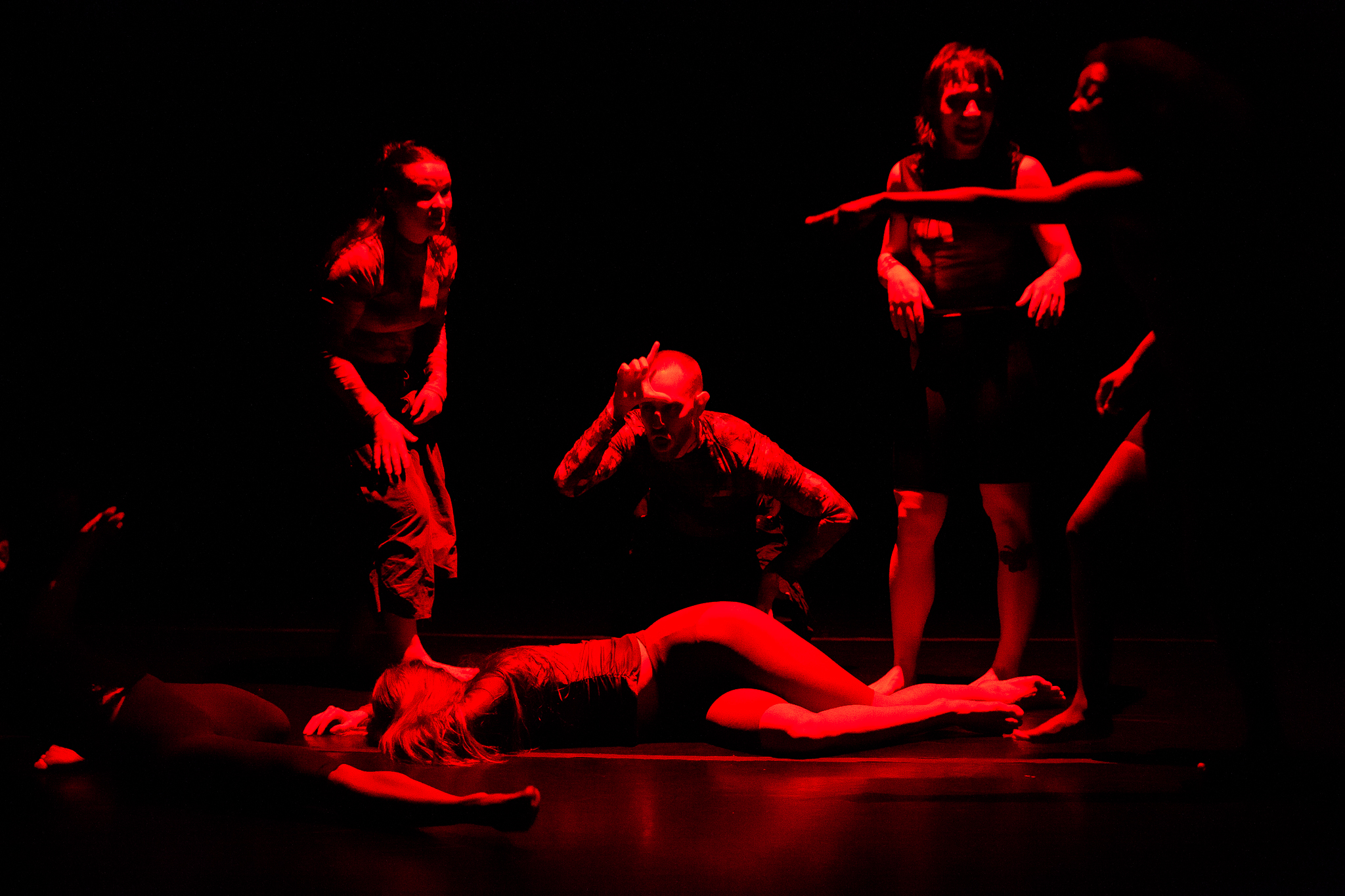
Each of the dancers—Ally Wilson, Kayleigh Morrison, Magaly Gallagher, Kiri Hoerman, and Amanda Rattigan—have a secret mission to fulfill before the performance ends, and no one else knows what it is (and we never learn, although it would have been intriguing to find out).
Fingers snap and slap, slice and dice; pieces of clothes, and pieces of bodies, smack together. The five dancers test out textures and fabrics, which their skin wears like puzzle pieces. I think the clunkiness is intentional, like waiting to see what fits snugly. How much is pre-ordained? How much are we seeing work in real-time? Doesn’t this feel a lot like life?
Sometimes the fabric inhibits the visibility of the movement, such as a white Civil-war era ruffled dress. Other items include: silk emerald green gloves and an ankle-length blood-red lace skirt. How different could the movement look if they choose another item? How different could life be if we choose another path?
Rising to the top is the ensembles’ commitment to play and to one another. Pulling from a pile of paper, they read out the words that may only hold significance to them, audience straining to hear what’s said—(“chin up, queen”/”when push comes to shove”/”Love, Kayleigh,”/”when you read this, Sincerely, Ella”). Even though the audience can’t hear everything they’re saying out loud, it means something big. The murmurs, like cicada sounds, feel layered and far off.
There’s an ambitious accumulation and retrograde phrase, where dancers peel off and back on while saying numbers outloud, taking off and putting on new items of clothing. Visually, it’s a lot to take in, and my gaze is continuously drawn to the person changing downstage rather than the big, energetic lineup upstage.
In stunning silence, the strongest moment of the show then veers everyone off stage: the ensemble runs away, beyond the pre-ordained performance space. They pull like an orbit towards one another; Their full-bodied efforts reach past their fingertips and toes, and it feels like they are finishing one another’s sentences and the richest, most exciting moment(s) of each other’s stories. They slip in and out from center, always locked into what the group will do next. I wonder if and how Mason is offering a new way of being: intimacy and presence with a handful of loved ones. It’s storytelling that is nimble and ready to pivot, should someone (an intimate one) change their mind.
Cicada Stories, Ella Sommer Martin, Icebox Performance Space, Cannonball, Philadelphia Fringe Festival, September 17-20, 2026