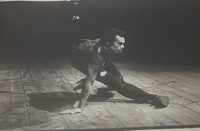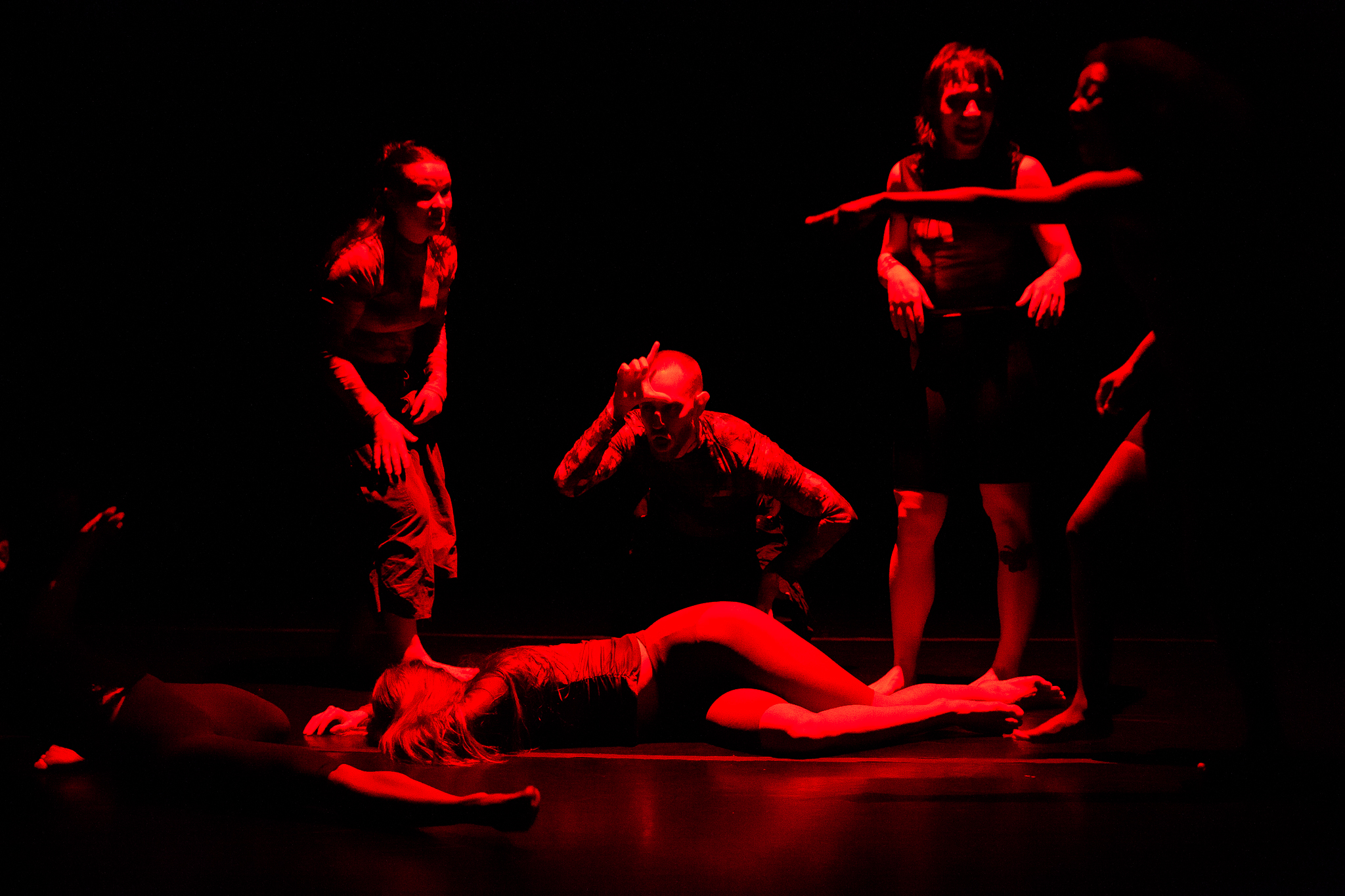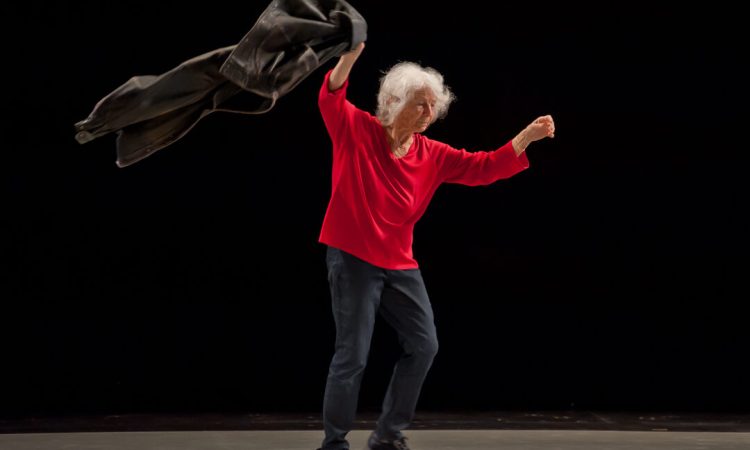
The first time I danced with Simone Forti & Troupe at New York City’s Judson Church, she asked all the performers to take a turn and call their own names into the space. She wanted us to make ourselves present, to feel at home, as if we too counted out of the many people who had performed there. So I call her name now: Simone, Simone, Simone. Dancer. Friend. Teacher. Mentor. Advisor. Choreographer. And, sometimes, Shamanic Priestess.
I had signed up for the post-modern workshop of the American Dance Festival in 1988. For the first three weeks we would work with Simone Forti; for the second three weeks, Steve Paxton. As a Contact Improvisation devotee, I knew all about Paxton. I was less familiar with Simone, except studying about her in dance history classes as a Temple University dance undergraduate. I had no idea the influence she would have on my choreography, my career, and ultimately my life.
I received a partial scholarship to attend ADF, but I couldn’t afford much more than the remaining tuition, so I lived in a tent in a little bamboo grove on the scenic driveway between the East and West campuses of Duke University. I had the men’s shower area at the campus gym all to myself. I lived on peanut butter and brown rice.
I remember the first performance I saw Simone give at the ADF Faculty Concert. The proscenium theater revealed a large, open dark space. I remember the dance in pieces: a long silver flashlight clicks on…light notices newspaper in hands and starts to study newspaper…light turns to audience…audience giggles…light focuses back to organizing papers as shape of Europe…light notices audience again…audience giggles again…flashlight looks at newspaper, begins to unfold sections on floor…Simone crawls on top of papers…paper pile ‘becomes’ Vermont vegetable garden…Simone talks to us throughout this dance about how flowers grow or describes the picture of a soldier in Kuwait in today’s paper.
At ADF, everyone strove for an idealized visual form of dance. As a student, I encountered the modern techniques of Jose Limón, Martha Graham, and Merce Cunningham, then the more lyrical styles of Lar Lubavitch and Doug Varone, and finally traditional ballet. Against that backdrop, here was this lone older woman crawling and rolling through a pile of newspapers in a dark theater guided by a flashlight. She improvised without holding in her belly, using movement and her voice to deconstruct an image of an American soldier first setting foot in Kuwait. Simone was developing her unique movement style called “News Animations”—a daily practice in which she read the newspaper and responded to it through improvisational dance and spoken word. She related, “I’ve been dancing the news. Talking and dancing, being all the parts of the news.”
Steve Paxton told me on a visit to his place in Vermont’s Northeast Kingdom, termed Club Mad by artist residents there (after its name, Mad Brook Farm), that there was a tacit agreement, a kind of ethic, among the post-modern dance scene that everyone should do something completely different. The idea was to find your unique view of what’s possible as dance or choreography, so there’s no room for people to be copying each other. He described Simone when she first joined the New York post-modern dance scene as always completely different from everybody else. In 1959 she arrived in New York, after working in San Francisco with Anna Halprin, an originator of post-modern dance.
I was deeply moved to be seen and trusted by this inveterate and profoundly unique artist. I performed with Simone Forti & Troupe from 1988-1991 (joining others, K.J. Holmes, Lauri Nagel, and David Zambrano, who had been Simone’s workshop students when the Troupe formed in 1986). My memories of first rehearsals are natural force improvisations, where we danced the elements (water, air, earth, fire) in Simone‘s East Soho loft studio. We made site visits together, visiting the Statue of Liberty or Washington Square Park, practicing automatic writing, journaling and sketching, and then dancing and improvising about our experiences in the studio. We also did “still lifes,” where we put found objects into the center of the studio and then took turns dancing that still life.
Like many post-modern performance artists, Simone used chance in her decision-making. The chance process could involve something as easy as pointing your finger randomly in a book, to throwing the I-Ching or casting Runes. Simone believed in the sacredness of nature and recognized spirit in the animals and the smallest leaf of a tree. Simone told me she believed in the “diva” inside plants. She said what we were doing as dancers with the Troupe was “wilding”:
“I’ve been reading a book of Gary Snyder’s essays ‘The Practice of the Wild’. I feel very related to it…He talks a lot about relationships to what is not cultivated, and he brings these thoughts into many realms of economy, spirituality, and language. I think dancing, improvising, and working as the Troupe did last month as a way of being in the wilderness; right in the city, but still touching the sky in ourselves.” (Simone letter to me on 4/29/91)
Once when Simone was touring and performing in Australia, she was approached by an aboriginal shaman who represented a turtle for their people. Simone had apparently danced about a turtle she met there and the shaman was upset. Simone insisted “different turtle, different, different.” But in our work, in trying to be plants or animals, we verged in a shamanic direction.
Simone was one of the most perceptive and egalitarian leaders I have ever met. She continued as my adviser, collaborator, and friend after the Troupe ended around 1991. She gave me my first laptop computer. When I founded the collaborative dance company SCRAP Performance Group in Philadelphia in the early 90s, she served on the advisory board and donated her time and travel expenses to come workshop and develop new work with SCRAP artists in a Poconos residency.
Simone‘s consistent advice to me as an artist was “notice what you notice.” What does this mean? In a sense, how redundant, except that we don’t “notice what we notice.” There are lots of ways we are asleep to ourselves and the things we notice. I suppose Simone‘s first step here is “what you notice matters.” Everyone experiences a unique perspective, and even mundane moments and topics randomly selected are significant.
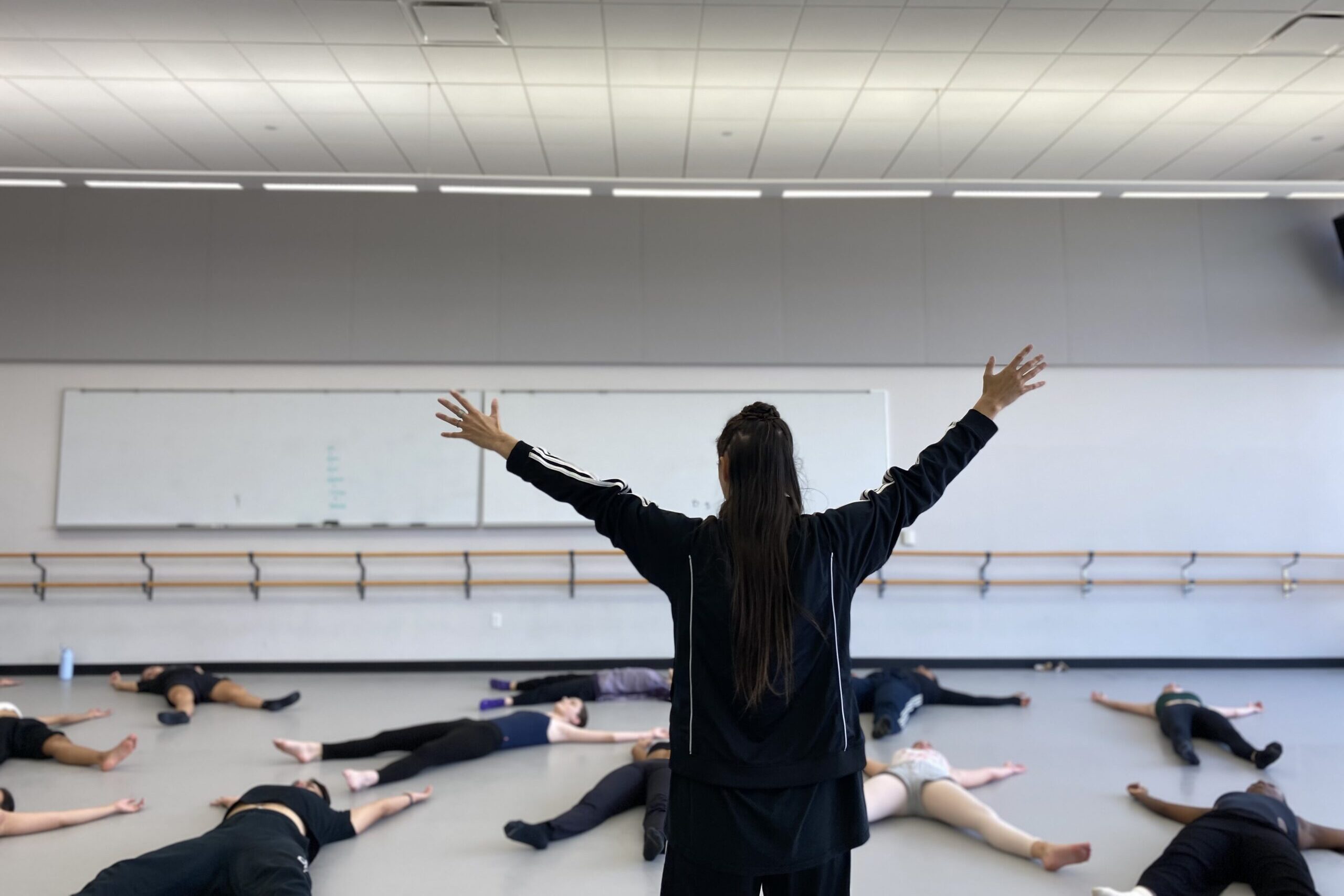
Simone practiced and taught techniques to help you “notice what you notice,” from silent group practices in natural settings to automatic journal writing and sketching. Simone used timed automatic writing and gesture drawing with the Troupe, forcing us to keep writing or drawing to overcome procrastination and self-criticism. We learn we see more in an instant than we give ourselves credit for. All we have to do is get out of our own way and see what we see. I remember a game Simone played with me one evening after a day of dancing and creating with SCRAP. While sitting on a log porch viewing a field, woods, and the mountains beyond, Simone and I took turns noticing two things and their relationship and sharing them.
“Moving the Telling,” or what she later called “Logomotion,” was the work Simone was focused on from the moment I met her, having begun to develop it in 1986. She called it “the work” in a few of her letters. It was astonishing to witness Simone improvise, either in performance or in studio rehearsals. She was open and perceptive, able to achieve a child’s perspective and find mystery in everything.
“I have a sense of movement, a very natural sense of it. And so it very simply is meaningful. And what is said can be very like that too. In a very simple way. Sometimes I feel I can do that. But how to teach it?” (Simone 12/22/90)
She was fascinated at how “the work” grew and blossomed in different directions among artists around the world. She was happy to support artists, grateful to offer her insight for the various pathways the work travelled.
“It’s so interesting to have the work echo back from the world and engage me with new approaches, with new depth.” (Simone 12/22/90)
“The idea is simply to work on the work…I’m interested in seeing how each of us takes this work to an exploration that makes sense to them. And we’ll get a chance to prepare exercises and explorations for each other.” (Simone 5/31/91)
I have been taking walks in the Cresheim Creek valley of northwest Philadelphia every day since I learned of Simone’s death this past July. While I haven’t been journaling or sketching, I have been taking the time to “notice what I notice”: the way the iridescent blue damsel flies contrast from the feathery white flowers of the Japanese Knotweed upon which they land, or the difference between the water striders on the surface of the water and their dancing shadows below. I’ve retired from dancing and performing, so I don’t have some future performance in mind as I witness the beauty and mystery of this small river gorge. What Simone has given me is beyond artistic technique. It’s a way of life that has made life richer and more meaningful.
At the end of each walk at the Cresheim Creek, I cross a small trussed foot bridge. I have made a practice to run my walking stick randomly along the metal uprights and let the tones ring out in honor of Simone.