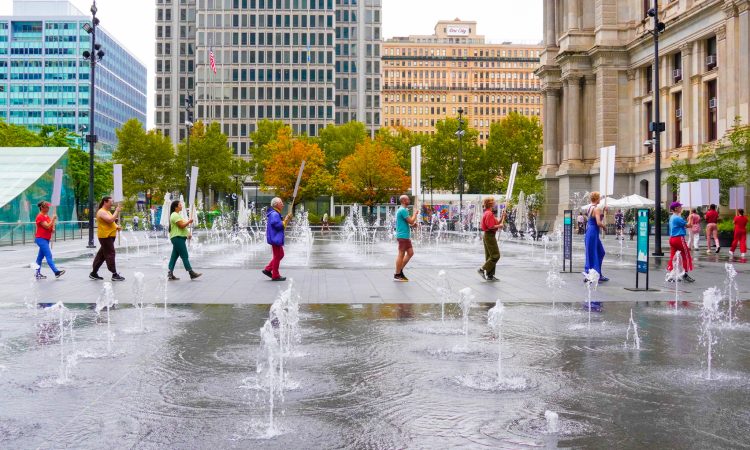
Twenty or more performers splay across the Village of Industry and Arts’ steps, invoking a die in. They cover themselves with blank white posters. The Freedom Band conductor blows their whistle, directing a full marching band who erupt onto the sidewalk with snares and trumpets. Slowly, the dancers rise and begin to walk two abreast. Across Philadelphia, from Broad St. to Race St. Pier, they walk in evenly spaced lines at a measured pace. With both hands, they grip wooden posts secured to large, empty signs.
FringeArt’s well-resourced production of Anne Collod’s Blank Placard Dance, Replay, honors Anna Halprin’s historic work, but fails to meaningfully intervene in 2026’s political crises. While Halprin and San Francisco Dancer’s Workshop marched in direct response to Vietnam War protests and the city’s anti-assembly ordinance, Collod’s minimalistic choreography is abstract and pacified.
I follow a Freedom Band fan whose rainbow-striped jersey matches the band’s vests and says “DADDY” across the back. I laugh and feel at home in this visibly queer procession. This is the closest the performance gets to a politicized affinity, and it’s temporary, as the Freedom Band peels off halfway through.
In Dilworth Park: Pause. Turn. Side by side. Compose a frontline. Jewel-toned clothes, white signs, against City Hall. Stillness against fountains.
In Love Park: Kneel. Lay. Stand. Reach. Walk. Each posture deliberate. Each change as simple as possible. Almost out of reverence, the signs never touch the ground. Line faces line, one rises, one falls. Pause. Turn. Architecture assembles and disassembles.
I stand face to face with one performer, look them in the eyes, wondering if they’ll look back. Their blank face cracks the smallest, momentary smile. The pedestrian movement and simple tasks are very postmodern, and Halprin is called the mother of postmodern dance, but these performers appear far more serious than the people photographed in 1967. There the signs are imperfectly aligned and faces animated as if mid-conversation or laughing. I don’t feel invited to see or interact with the dancers today. They’re Philly-based professionals who responded to a paid call and started rehearsing five days prior. Sherwood Chen, self-titled “choreographic assistant,” leads them, while local choreographer Megan Bridge directs. At one point she grabs a performer by the hips and pulls them backward a couple of feet; at another she says, “They should all be lying down, why aren’t they all lying down?”
Our time calls for leaderful action; many dancers in Halprin’s lineage practice improvisation and responsive choice-making, skills that can serve social movements. However, I see more prescriptive than responsive choreography. The movement score may be contemplative for performers, as one dancer shared with me later, but what would Blank Placard Dance, Replay look like if it developed through collaborative process with local performers? Is it an artistic or curatorial choice to transpose the choreography and insist upon its specificity?
Clipboard-clad FringeArts volunteers in orange T-shirts interact with the audience of sidewalk pedestrians. They approach the curious and disinterested alike, offer them a program, and prompt conversation. In 1967, the dancers asked people directly, what do you want to protest, then wrote it on their blank signs. Today the “voice of the people” never makes it to the signs. Instead, it is written on a small notecard.
Some people are receptive, even spontaneously join the procession. Others are closed off. Volunteers probe them to open up. I walk beside a security guard on her lunch break for a moment, and ask what she thinks of the march. She tells me, “It’s liberating. We need to stop judging each other and love more.” A runner who passes us on Arch St. echoes this sentiment, calling out, “Love you guys!” A volunteer calls back, “Love you too! Spread more love.”
I am reminded of Cornel West’s quote, “justice is what love looks like in public,” but while I hear calls for love and liberation, what I see is a group of mostly white people, a few Black people, and People of Color, making precise, linear, at times almost militant formations.
I lag behind in Chinatown, talking to a friend about the postmodern movement, how the radical act of refusing performativity became detachment, and noting the 250th flags strung across the street. She shares that the volunteer’s question feels assuming, as if she isn’t already protesting. In 2026, asking “what do you want to protest?” is potentially impersonal and unnecessary. A quick Google search (there was no internet in 1967) brings up results of protests in the Philly region against data centers, Ed Sheeran’s tour, Delaney Hall, and ICE.
When I see the performers next, they cluster on the steps of The Philadelphia Inquirer. For the first time (and the last), they touch, torso pressed against torso. They peer up at their signs, figuring out how to turn continuously without colliding corners, while also descending the stairs, crossing the street, and not breaking the clump. For the first time (and the last), they hold up cars crossing 6th St. At every other crosswalk, a FringeArts staff member stops the procession, only walking when the walk sign’s on.
Independence Lawn: West Philly Orchestra plays a wind-instrument rendition of, Star-Spangled Banner? Tourists lined up for the Liberty Bell become spectators. Dancers burst their clump, walk, run, stand. Abstract sculptures against the President’s House where this summer Trump’s administration replaced the slavery exhibit with whitewashed history.
Performers’ shirts are dark with sweat, their butts stained from lying on grass and concrete. Volunteers intermittently offer them cups of water as though they’re running a marathon.
Penn’s Landing: dancers, a dwindled group of FringeArts volunteers, staff, friends, family members, documenters. We squint against the sun. One at a time, dancers turn, compose a blank banner to face west. The skyline becomes their audience, as if they yell into an echo chamber, standing on the edge of the ocean.
After nearly three hours, we finally finish walking. Performers, staff, and volunteers string up the notecards collected from passersby. I approach Chen for an impromptu interview. Anne Collod, who’s choreographed Blank Placard Dance, Replay across France, Berlin, Brussels, and NY since 2016, should be here. But with the cost of visas and the precarity of non-citizens in the US, they needed a US citizen to stage it. That’s how Chen took on the role he calls “transmitter,” noting his responsibility to Collod’s choreography and to Halprin’s legacy. He invokes Halprin, who was his mentor, friend, and collaborator, as an ancestor in the studio, sensing intuitively what choreographic choices she might delight in. He speaks about the Halprinianness of strategic public engagement; the signs are not neutral, but a mirror, a provocation. He critiques binaries and cancel culture, and quotes Evelyn Beatrice Hall, “I disapprove of what you say, but I will defend till death your right to say it,” suggesting a faith in democratic dialogue.
So what’s the strategy? What’s the provocation? The procession’s choice of locations is charged politically and historically, yet Collod’s postmodern choreography diffuses the charge rather than engaging it. I see it provoking curiosity, inviting contemplation, and offering a sparkle of hope that we can still have meaningful conversation with strangers. Yet, I’d be more curious to ask, “what breaks your heart?” or “what would you risk for freedom?” The question, “what do you want to protest?” petitioned to incidental spectators feels like a nostalgic grasp for a time when more people had faith in public dialogue and demonstration driving democratic change in government.
Revolutionary protest confronts the state and takes risks. The San Francisco Dancer’s Workshop performers were arrested for protesting the Vietnam War. Blank Placard Dance responded to those arrests by creating a non-arrestable performance of protest, using art as a tool to continue demonstrating despite government restrictions. FringeArt’s production of Collod’s Replay avoids confrontation with police, federal agents, or counter-protestors by adhering to public sidewalks and parks, and refusing any explicit political stance. But this seems an effect of curated production rather than a strategy for commenting on protest crackdowns. How might more context-specific choreography mirror and provoke resistance to state oppression?
While an artist’s most skillful tool is often their art, art is not often the most effective tool for social change. I do believe artists have a crucial role in revolutionizing culture. Public art especially can reflect our values, impact our belonging, and invoke our collective past and future. In using protest aesthetics, I believe Collod must become responsible not only to Halprin but also to political movements today. In producing Blank Placard Dance, Replay across the streets of Philadelphia, I believe FringeArts must go deeper towards a context-specific performance. I want to see this work grapple directly with politics, its own and Philadelphia’s, and take more risks. What will that require?
Blank Placard Dance, Replay, Anna Halprin, Anne Collod, and Sherwood Chen, Philadelphia Fringe Festival, Sept. 13, 2026.
For a view of this work from the inside, see Jonathan Stein’s article, Notes from Within Blank Placard Dance, Replay