Thanks to Sherwood Chen’s thoughtful invitation to the cast, I dedicated my own performance in Blank Placard Dance, Replay, to Anna Halprin and John Lewis. Both of whom share similar visions of bringing equity and healing to a troubled world. My dual dedication reflects my own double identity. During my 50 + years as a legal aid lawyer at Community Legal Services in Philadelphia, I pursued social justice and civil rights for low-income people and organizations, a condition I view with affection as a “life sentence.” Concurrently, I’ve lived a life in the arts, especially dance. As an 82-year-old veteran of two dozen dance performances since 1989, often site-specific and with improvisation, I look forward to dancing into the future.
Both Anna and John directly shaped my adult life. Anna, a grandmother of post-modern dance, insisted that all can be dancers. John, in turn, with his civil rights movement leadership, inspired me and my generation of legal aid lawyers. On Sept. 13th, for two and a half hours, we performed the embodiment of their teachings across perhaps four or five miles of Philadelphia’s late summer cityscape.
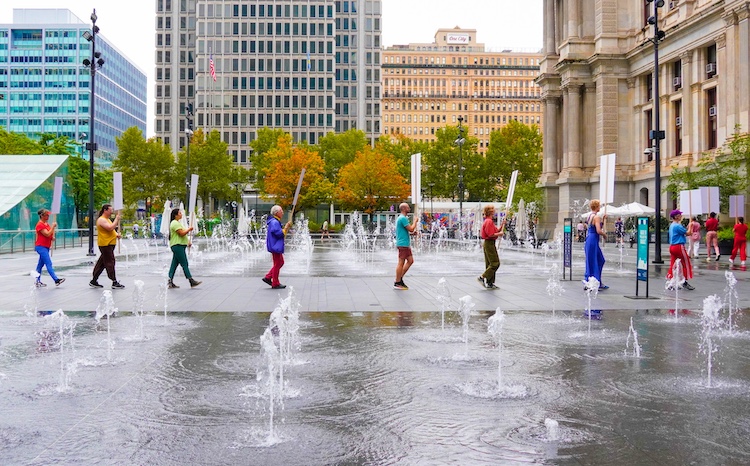
All of us performers embraced Anna’s three principles of awareness–the Physical, Emotional, and Associative (as shared by Sherwood). As we moved across a large expanse of the city, this generated in me a swirl of thoughts and feelings throughout, likely multiplied by the 20 other co-performers with their own histories and lives.
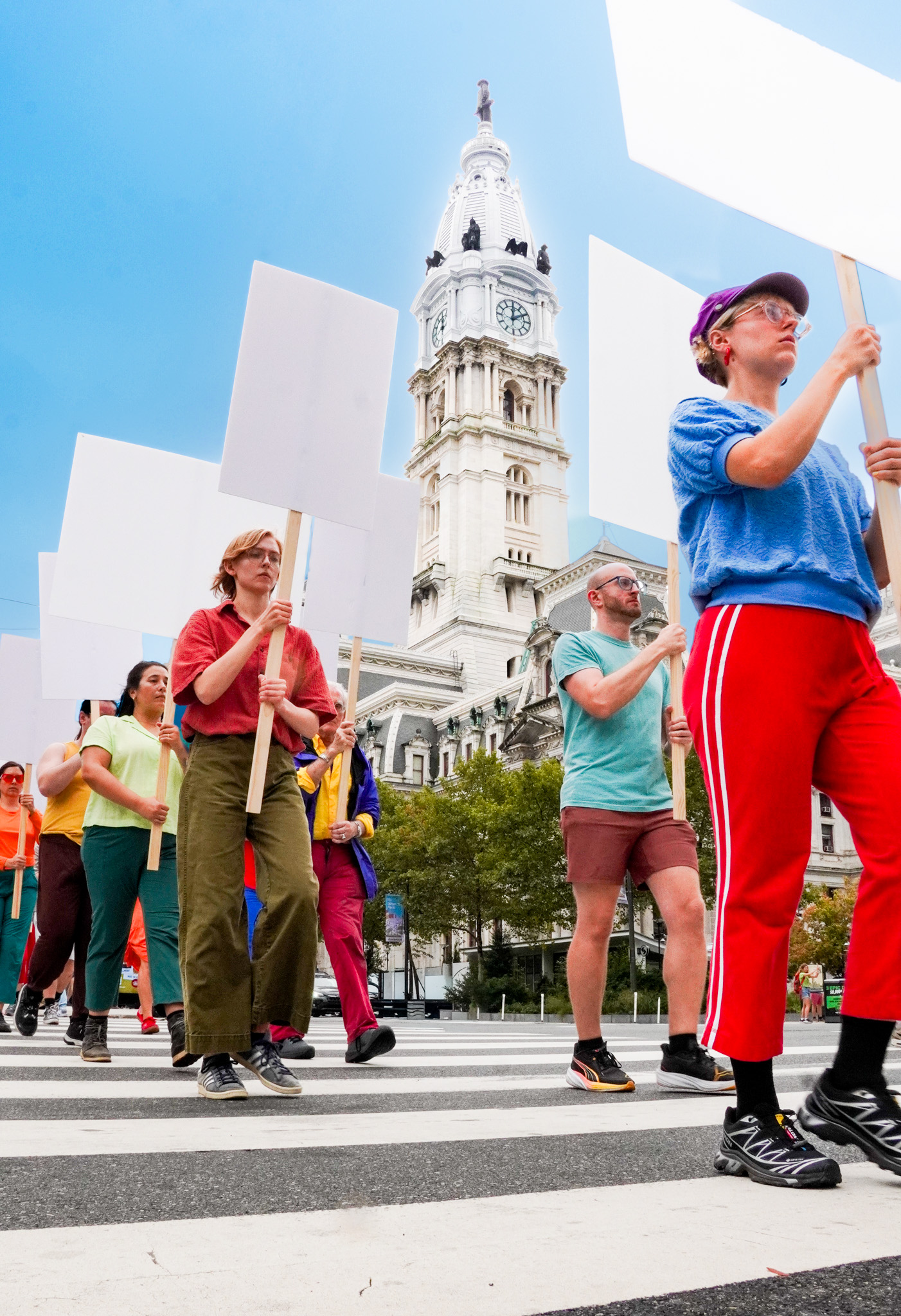
A replay of the 1967 San Francisco original, this choreographed march appeared as a demonstration and an invitation to audience and passers-by to offer their own protest ideas to fill the “blank” signs. The work had me feeling how appropriate this was for our times. Equally blank streets require determined bodies that communicate the disquietude and anger that our authoritarian politics generates.
From the inside, I sensed that Anna’s original concept might not be understood by all in the passing public, and appreciated the role of the co-performing interlocutors, named “connectors.” They engaged in one-to-one dialogue with passersby and collected their protest ideas. This became an essential element for our social media world of limited attentiveness. Perhaps contrary to Anna’s initial concept, our projecting blank signs might be seen as urging an apolitical message or one whose absence of a protest message negated protest. One passerby said to me, “I agree with your sign,” a dissenting voice response I thought appropriate enough to write later on the paper recording the protest messages.
Knowing the connectors’ role and the concept, I felt the importance of our physical manifestation of a collective march. This was especially inspiring in its sense of solidarity, created in just two or three rehearsals with a choreography that bound us together. It certainly connected me to other protests I have participated in or witnessed, from welfare rights rallies years ago to more recent No Kings Marches. Protest, as a living legacy, needs to become a committed practice for us all. Performing in Chinatown on Arch Street, I remembered the very recent protests on the very same street and corners to stop the construction of a major, invasive basketball arena in Chinatown—and the arena was stopped.
Performing amidst an urban environment that I have lived, worked, and walked in for over 50 years was particularly pleasing. Our performance carried us by the two U.S. Courthouses where I spent my legal aid career litigating class actions against city, state, and federal governments and into the US Supreme Court. For the second, newer Courthouse at 6th and Market, built as a fortress to reflect the times of the Weather Underground of the 70s, it was delightful to have its sidewalk included within our four-block anarchic “Instigator” section.
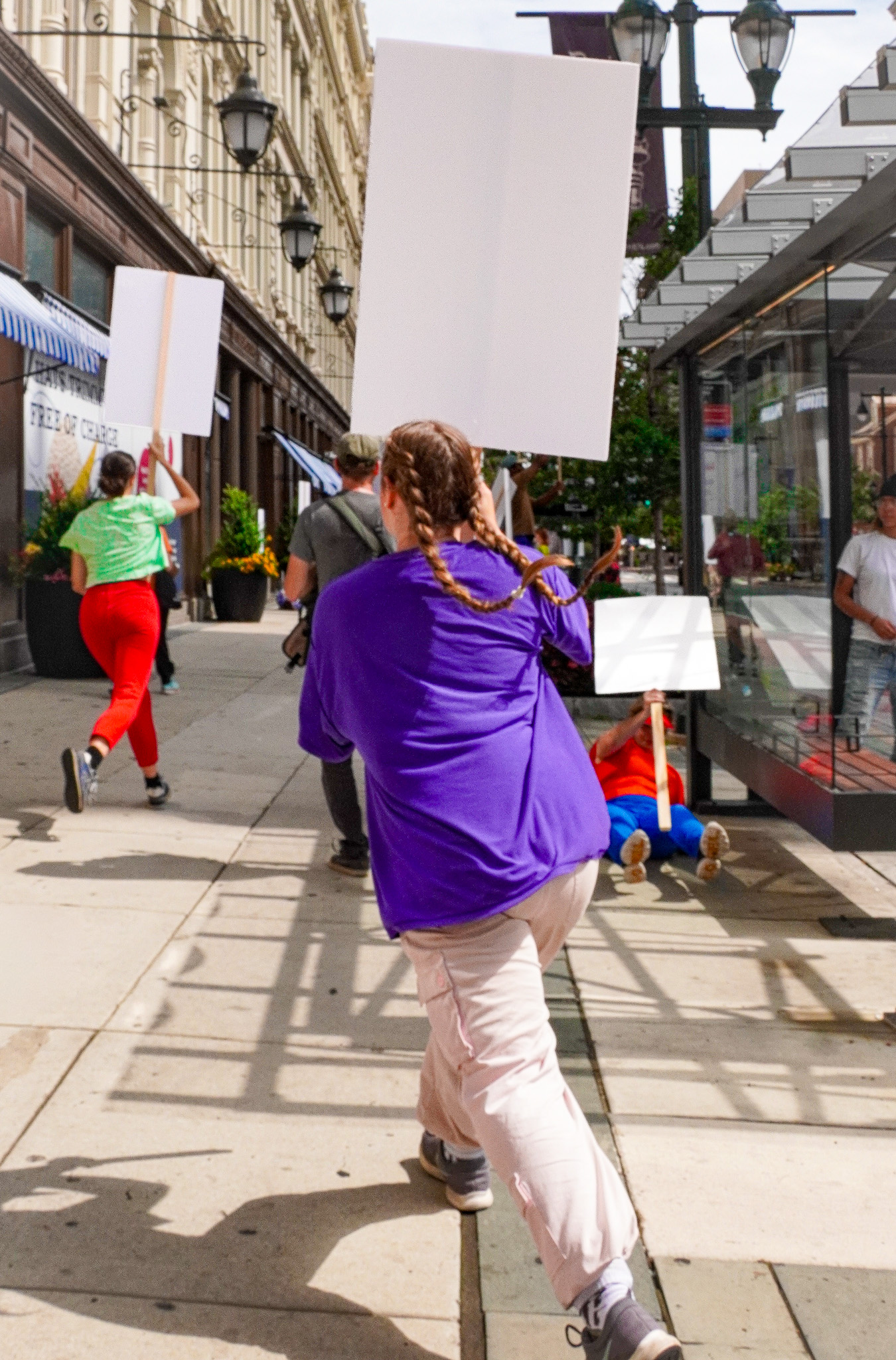
In this section we ran (or walked fast, as I did), wildly improvising with our signs, including around and into the windows of this Courthouse. This improvised section, for me, best embodied the spirit and physical manifestations of protest, giving each of us agency to express ourselves. A memorable moment, which spoke to the artful generative aspect of protest, was seeing fellow performer, Lyra Butler-Denman, sitting with her sign in the middle of a street, which I and others quickly joined as an impromptu street sit-in.
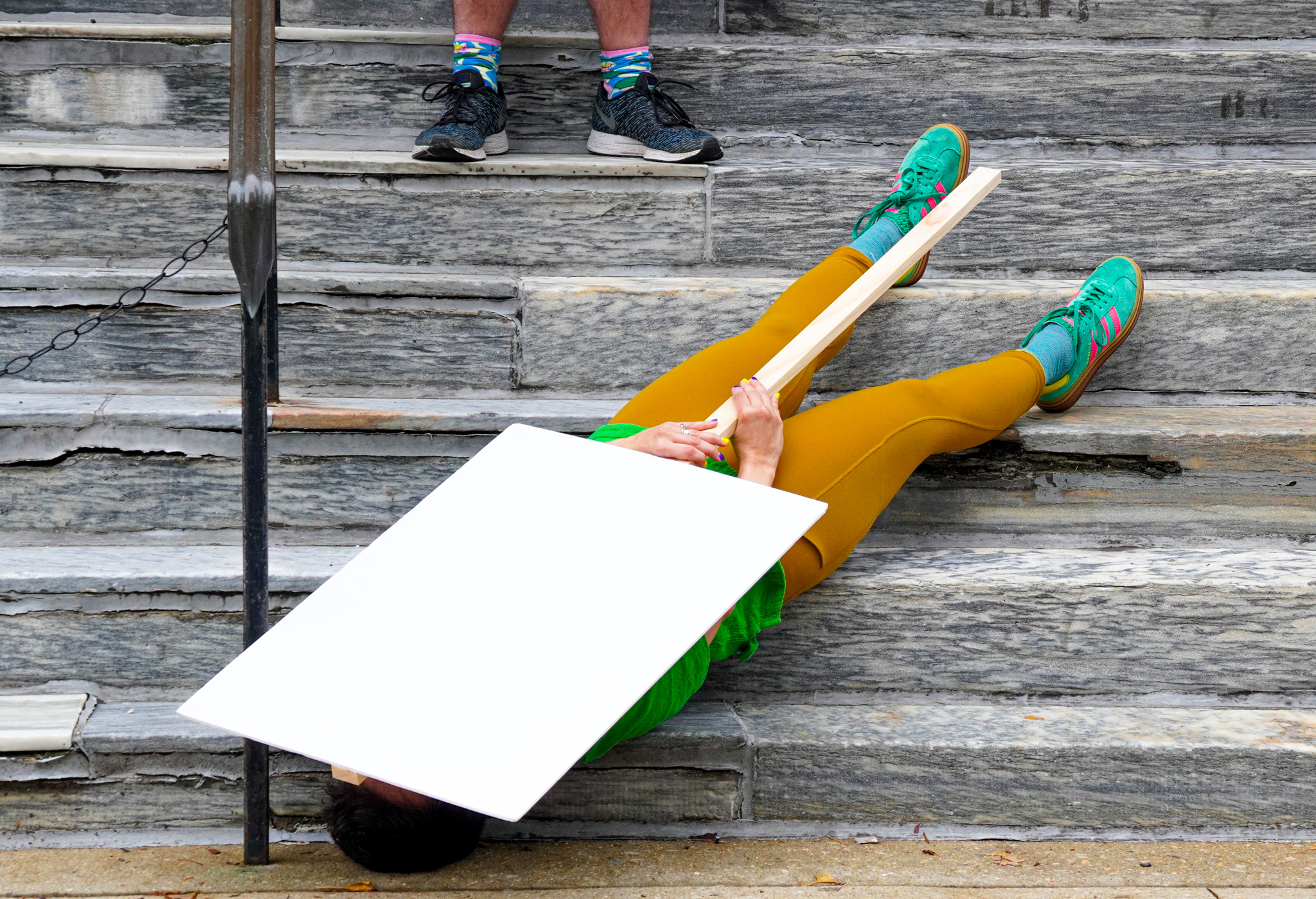
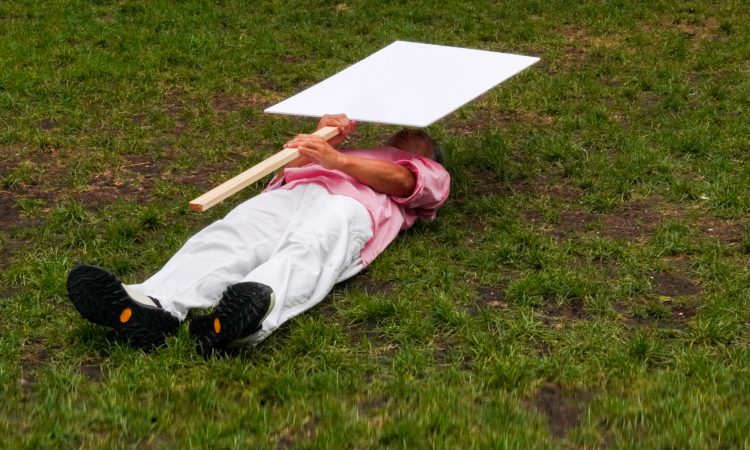
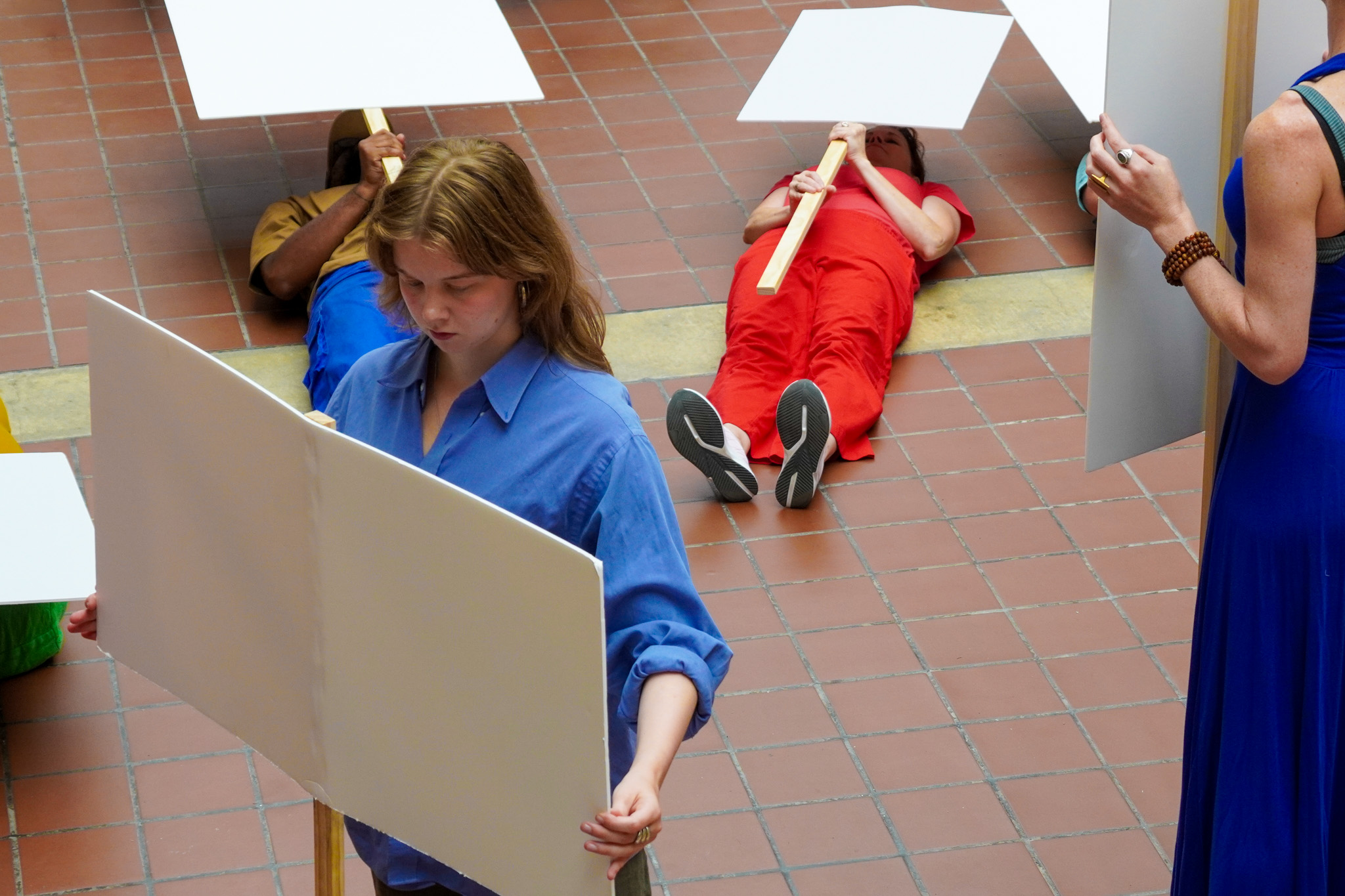
Especially meaningful to me were the three sections of collective and close-together “Lineups” (at Dilworth Plaza, west of City Hall; in Chinatown; and on the I-95 Penns Landing overpass), and the supine positions with the signs upon the ground. These were extended times of silence, rest and contemplation. They brought to my mind memorial vigils–marking space, events, and histories. When we were collectively on the ground with the blank white signs resting horizontally over our torsos, they became our shrouds or blank gravestones inviting memorial text.
I think that Anna and John would have enjoyed joining our performance. And perhaps they were there.
Blank Placard Dance, Replay, Anna Halprin, Anne Collod and Sherwood Chen, Philadelphia Fringe Festival, Sept. 13, 2026.
For a view of this work from the outside, see Xander Cobb’s article, Is Halprin’s postmodernism as radical today as it was in 1967?
(thINKingDANCE has published Jonathan’s article in tD on Anna Halprin in her 2016 collaboration with Stephen Petronio and Janine Antoni, “Taking Off from Anna Halprin’s Dance Deck: Ally at the Fabric Workshop and Museum.”)