“A preposition is a grammatical term for a word that shows a relationship between items in a sentence, usually indicating direction, time, place, position, or exclusion.” (Walden University)
In this way, iLand (Interdisciplinary Laboratory of Art, Nature, and Dance) celebrated 20 years of being in relation to each other, the world, the earth, the page. It was a celebration of research and community through new iterations of scores, new research, and an embodied activation of the archive. During a week of experiential and shared information, I was observer, participator, community member, and interviewer. I come to this work from two places:
The inside
Before: Videographer iki nakagawa shot a good portion of iLand’s archive, all of it open access online, and was tasked with reactivating it. She created Edit Sessions: blocks of time where an outside person could sign up to come in and work with her on the archival materials. In this spirit, I walked into the GMTC gallery in Chinatown on Wednesday the 14th to be an “editor.”
In: Through a conversation on mapping, drawing, and scores, we dug into the Field Guide to iLanding and pulled out the scores used for BIRD BRAIN: A Navigational Dance Project (2001 – 2002). Organized under three of Field Guide’s organizational impulses (Between, Navigation, Orientation) is the Sensory Map score, built for one person to lead another through a physical space, generating a sensory map of the environment and then a dance from that map.
Around: Eventually iki and I settled on using the Sensory Map inside all the archival footage. iki led me through an arbitrary five minutes of the archive while I formed a sensory map, in essence dancing with the archive, and then filmed the dance I made from it. We did this twice: once with my eyes open, and once with them shut during the archive section.
Of: With my eyes open, my dancer-self absorbed bodily movement, inside those shapes and patterns. I was pulled toward the bodies and the sound of the wind. But I knew I was relying mostly on sight. In the second round I closed my eyes and took what I heard, and the textures and touches that I understood from those sounds, to dance again, closer now to the intentions of the Sensory Map score.
With: In our last hour we edited the footage of this work and our conversation into a 12-minute reactivation to be screened the night of the culminating party at the end of this week of programming. As we finished, a dancer who had worked with iLand in the past walked in, curious about the week. She seamlessly joined the conversation and watched the work with us, commenting on the layers and angles created between the archive, the Sensory Map, and my dance.
Between: Sheets with notes gathered on the work table. As we talked about how things moved from one site (archive, camera, floor, my body) to the next, we oriented ourselves around a list of words: transfer, translate, transform, transmit.
Through: I had intended to observe the 20-year iLand celebration project and chat with its founder, Jennifer Monson to understand the scope and depth of iLand over the years. Instead, I found myself diving into the current project of iLand; throughout the week I was reminded of my well-worn copy of the Field Guide at home and the myriad ways it can be used to explore, research, activate, and define.
The outside
Before: Of the founding of iLand, Jennifer Monson said, “It was just this kind of crazy idea that took me into a year on this project [BIRD BRAIN]. It was very important to me to be out in the same conditions the migrating animals were in. A very romantic idea, all of that. And actually doing it really changed my understanding of nature and wilderness, ecology and environment, community, and environmental justice. I’ve always had an interest in science and its interdisciplinary components. I felt interdisciplinary in my own thinking, and I felt our interactions with the scientists were interdisciplinary. When I finished that, I felt this was something valuable I wanted to share with a wider community. So we started iLAND.”
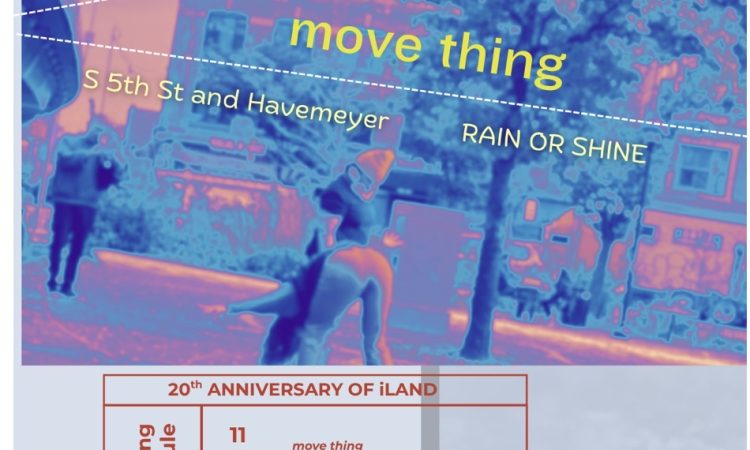
In: I asked Monson, as I usually do, for press materials. There weren’t any; this was just happening. But that is very iLand: to do, to be, to share. “iLAND’s board is very creative and brilliant. The main programs iLAND has done since COVID are the Spanish-language family workshops and Move Thing, a new project I’m doing.” By pulling these together with the archive, new iterations of the Field Guide’s scores, and a river walk for bird watching reminiscent of BIRD BRAIN, the board created a frame for celebrating the orgs 20-year history, one that operated the way most of iLand does: by being present and researching things at hand.
Around: Earlier in the day Monson said “our bodies are going to get us out of this.” I asked her to come back to that thought. “I was just having a conversation with a dear friend and collaborator about a podcast with a theorist. It was about the idea that technology will get us out of this mess, and he was arguing against that, saying bodies will get us out of this mess. It reinforced something: As dancers, we know that. And there’s the tension we were just talking about between my generation and my students’ generation. I’m really excited, because their bodies are really different, and how they know and what knowledge is for them is different. I really trust that. You see it whenever there’s a disaster: people’s bodies, the movement and capacity to sustain and restore.”
Of: There was a remarkable amount of joy and awe in Monson’s words, a sense that the work had grown much bigger than her, reaching farther than she expected, as she let go of the need for acknowledgment or control over its aesthetic:
With: “To be honest, there was a moment when I felt like I was doing it all by myself. And then a woman named Arantxa Araujo, a Mexican performance artist, became a consultant through Dance/NYC. She’s super organized, which I’m not really, and she helped me create the structure [of the organization overall]. Early on I thought, it’s just going to be whatever it is. I’ve sort of given up my need to get a lot of attention, to be acknowledged. It feels like it’s more about communities than aesthetics.”
Like the scores and the activations, pulling together all of the people who have been iLanding for 20 years, is a celebration not a performance.
Between: The work changed as it got harder to get scientists to dedicate long periods of time on a project. iLand moved to a laboratory format, using shorter, more concentrated time together. And then the Field Guide came into being: “When we decided to make the Field Guide, that felt like such a creative act: figuring out a way to archive and document the incredible processes, practices, points of view and worldviews coming out of the residencies and all the other programs. And to think about organizing it with a list of prepositions. It felt really exciting to share it in the biggest, most expansive way we could. Because there’s no specific authorship. It’s all collaborative. It’s all in relationship to the sites it comes from.”
Through: The work of iLand unites a vast network of thinkers, and it asks us to focus on how we exist in relation to each other, to the world, to the earth, to the page. Maybe the sites in which we dwell are the nouns, sitting near the prepositions ‘before, in, around, of, with, between, through.’ And us, the adverbs.
iLand Turns 20!, New York City, October