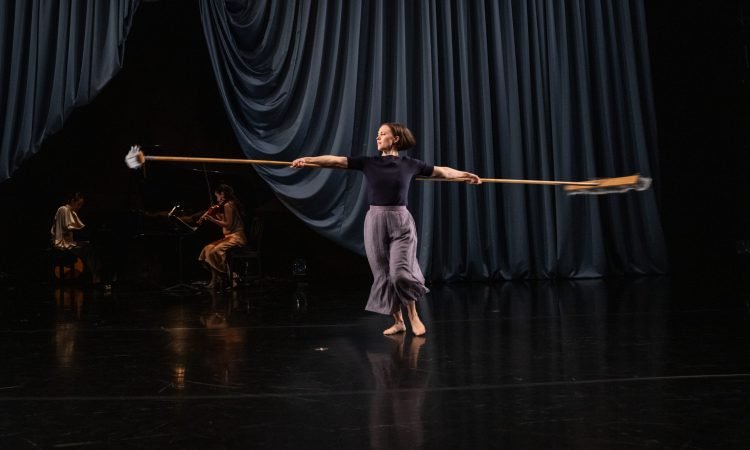
The rear curtain is pulled up like a billowing skirt tucked into a waistline. All the way upstage in the triangle of space this exposes, sits a grand piano with two women on the bench and a violinist. They play a lively, ragtime sway as we settle in to watch Gianna Burright’s as if everything was perfect. When the music fades into something more atmospheric, the second person leaves the piano, stepping forward onto the stage, bringing with her two big push brooms I hadn’t noticed leaning against it.
It’s a quiet trio now, one woman and two brooms in a balletic sequence that is spiral jetty, push and pull, winging over back bends and flying out in a merry-go-round lift and spin. Dancer Piper Makenzie Dye pulls focus with a quiet, grounded control of herself and her tools. She pulls and spirals them around her, a gentle drag in patterns across the floor, melding into a wave of movement, lifting at its peak stage right and lunging into its depth stage left.
I’m tired of object metaphors for women’s work, and at first it got in my way. Then I felt the misogynistic lean here, and my implicit participation. I assumed women’s work, from the program notes but also from the object. I once made a show about the expectations placed on women’s bodies, minds, and attention, and a (cis male) reviewer called it a trope. Am I doing the same now? Interrogating a choice because a woman is dancing that I wouldn’t question if a man were sweeping? Is this misogyny in me, queer feminist that I am? Finding myself questioned is part of the work’s power.
The evening is carried by Shio Tepper’s rich, dynamic score, played live by Tepper and violinist Camille Schiess. The music sets tone and pace and builds environments. It sits so closely inside the work that I can’t separate it from my experience of the piece.
The broom dance’s spell breaks with a film-like smash cut: Ariel Clarke and Alex Rix, having entered the space, inspect their brooms like a microphone, and each tests its uses as a guitar, a cello, a barbell, a telescope, and a lover straddled on the floor, teased and talked to. Costume and scenic designer Olivia Kirschbaum has them in tutus, feathers, and fur coats. “Thank you ladies, you may now begin,” booms over a loudspeaker, and they scramble into a center-spotlight comedy routine with the attitude of vaudevillian showgirls. They introduce themselves and the three sections to come, making the broom dance a prologue.
First, a stage act with old-timey physicality set to songs like Chamillionaire’s Ridin’, Adele’s Rolling in the Deep, and Nat King Cole’s L-O-V-E. Its take-the-silliness-seriously quality holds me for a time. They split off, disintegrating into babbling nonsense, then are back to paddling across the floor with a broom, fencing, playing limbo, or firing a tommy gun. The brooms I immediately questioned are everything but brooms.
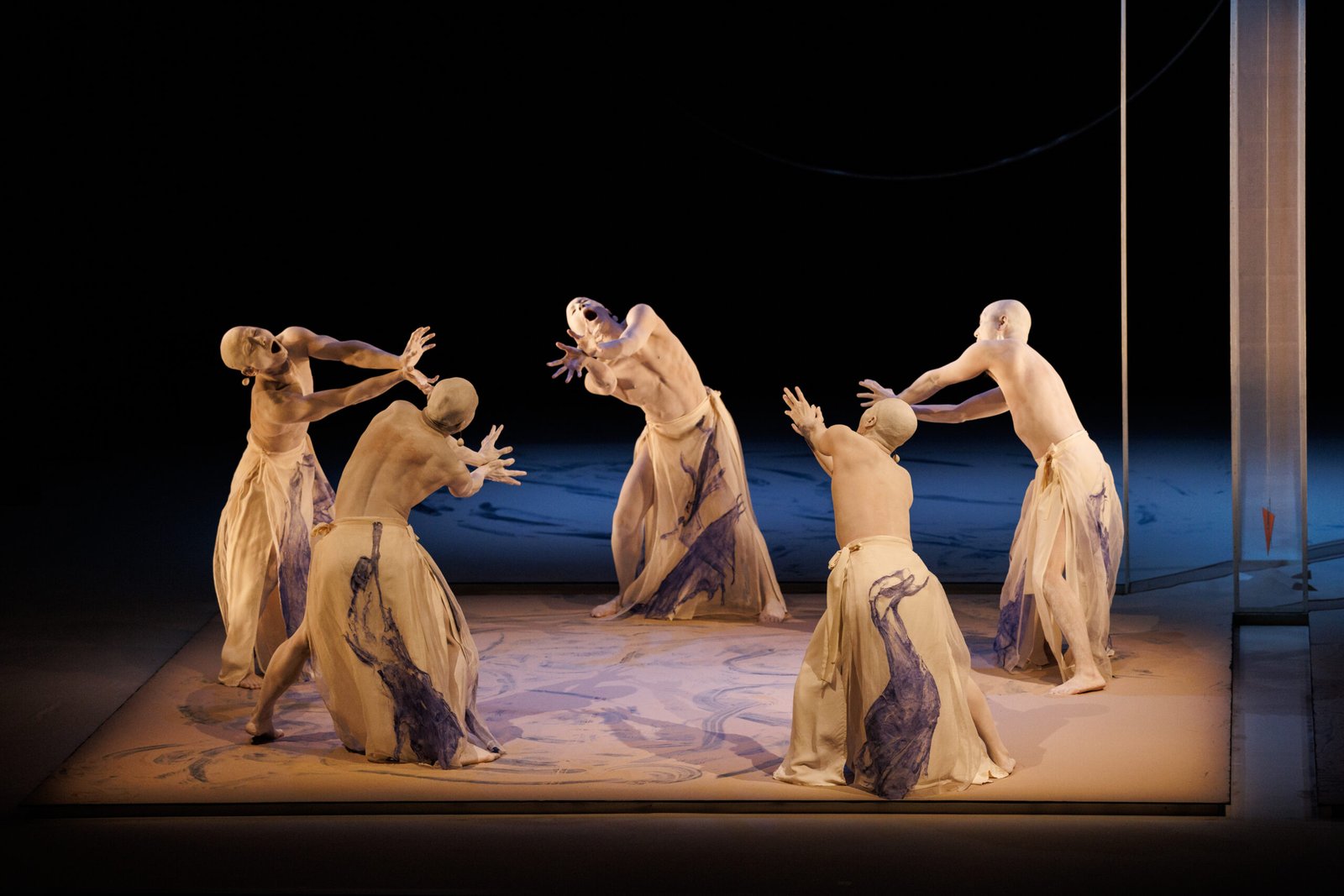
They shed their showgirl looks, and Clarke’s solo, framed by Dye and Rix holding brooms, is a whirlwind of fighting momentum, precise and explosive but nimble. She tumbles into a drooping exhaustion that keeps breaking into spins and shakes. Overwhelmed and tired but always reaching, she whips through turns, dives, melts, is hurled back, clapping so hard we can see her bright red palms. She charges and battles even as she wears down, and ends by wringing out her overshirt and cradling it like a newborn. A shirt falls from the ceiling, then another, then a tutu, faster and faster, until a waterfall of clothing literally buries her. I think of being burdened by domesticity, no matter how precise, how athletic, or how fast you can deal with everything. I think of having to fight for safety and space.
Rix and Dye pick her out of the pile with their broom handles in a masterfully sequenced play on puppetry. They wrestle with the clothes and each other, turning somersaults and manipulating each other’s momentum in a trio of dizzying complexity. Folding clothes downstage, Clarke talks about how often women are asked whether they want children: “I was first asked this when I was 6 years old, 10, 12, 14 years, 17, 20, 21, all my 20s.” Naming how young the interrogation begins was startling, and it catalyzed a scene of reckoning, coming out, female-identified love and longing, leaving behind shoulds and regrets.
These dancers are exacting forces, yet in the movement that followed, the choreography traded its clear investigations for filler, another duet, another trio, that I didn’t need. It was all already there, laid out, clear, focused. The ending sections lost their luster and intention. Where earlier in the piece I was handed questions, and I followed thought threads about female labor and precarity, the later phrases felt like they pointed to less and the movement became vocabulary without much function. While that’s not necessarily a bad thing, in a piece this tight and careful, it did some damage. What was so specific got muddy, the imagery blurred, the ending unclear.
as if everything was perfect talks more about resilience and wonder than reaching heights. My assumptions were challenged, and aspects of my own AFAB identity were mirrored in the ways women are buried, interrogated, and used. But also in the ways women help each other up and keep going. I feel at once proud of this resourcefulness and exhausted by the need for it. Gianna Burright’s work does not paint a perfect world, so much as it scatters across the stage the ways we manage imperfection to find grace, humour, foundation, love, and rest.
As if everything was perfect, Baryshnikov Arts Center, NYC, November 2026