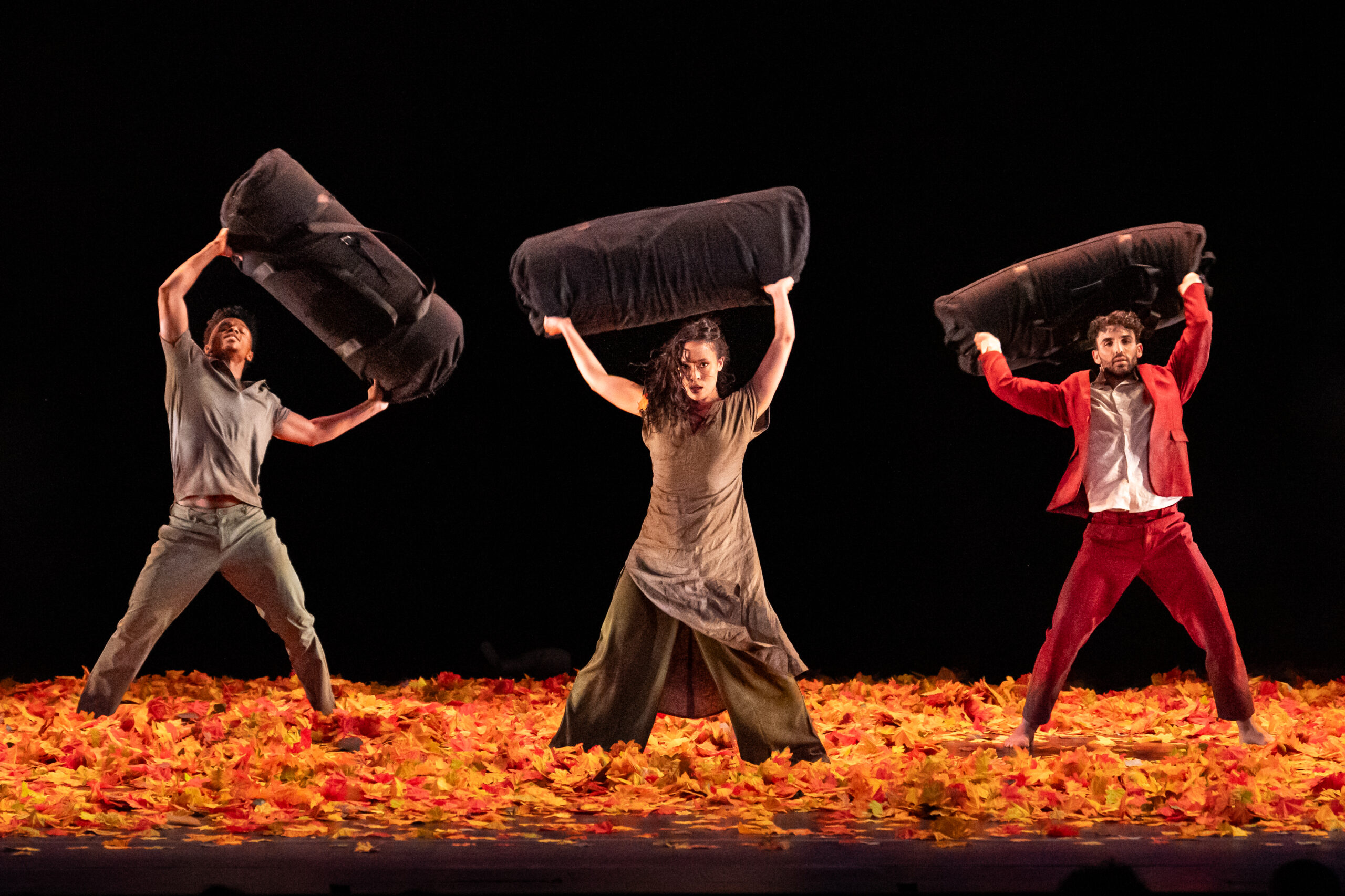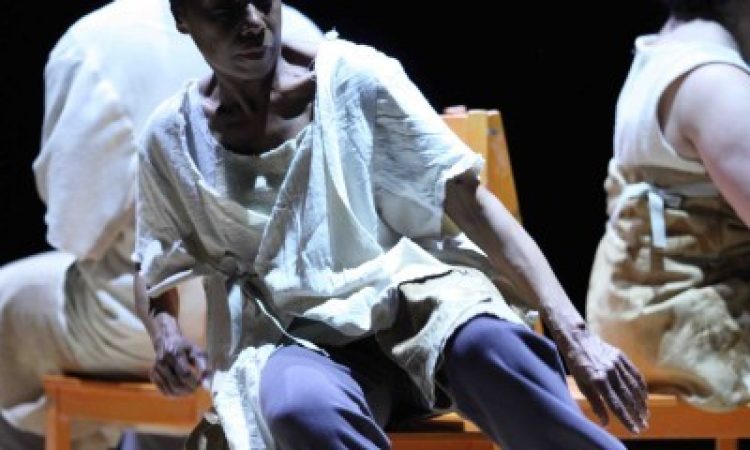
Rhythms burst from bodies everywhere I look. Dancers grip one another’s clothing and lean closer together. Violin screeches, staccato. Ensemble dancers hang by their arms wrapped around one another’s necks, waists, knees. Tap one. Tap one-two. Three pairs of feet tap, one-two, skimming the outside of a lit circle encompassing three wooden chairs. Pause. Rap-rap-thud. One tapping voice begins a new sound. A second beating voice is heard, layering rhythms, building speed. A simple series of sounds develops into a symphony of six feet, six divinely different beats.
In Innovation Studio, below the city street noises, Germaine Ingram presented a collage of personal experiences inspired by history. “The best way for me to learn is in the company of other artists,” she explained. Themes for work within the performance collage were derived from the personal interests of Ingram’s fifteen collaborators, ranging from yellow fever to eliminating white control in religious communities and to Jarena Lee fighting for the right to preach. The program, Where Heaven’s Dew Divides, traveled through time to an era of slavery, specifically the 1700s. Together, the artists incorporated principles of social justice, collective memory, history, improvisation, and rhythm to create an amalgam of responses through movement, music, song, and text.
Ingram referred to a Toni Morrison essay that helped to define her role as an artist, to use imagination to strip back the veils hiding important truths—a deep exploration of layered historical issues still present in today’s society. For violinist Diane Monroe, “sound is … always moving”; her music created pathways that were visually expressed through movement. To dancer/choreographer Khalil Munir, “dance is timeless”; this show granted him an outlet for expressing his understanding of the African American Church movement in the eighteenth and nineteenth centuries. The artistic process drew differently on each collaborator and performer, yet they all connected at vulnerable points.
A male-female duet, Richard/Jarena, pit an African dancer against a tapper. They moved to, from, and around each other, arguing through opposing energy levels and rhythms. Jarena’s ten-year battle of vigor and stamina with former slave Reverend Richard Allen to gain the right to preach was expressed also during She Writes Herself, a duet between Ingram and dancer/choreographer Leah Stein. Projected text from Jarena’s journal was read in Ingram’s sing-song voicing and Stein’s murmuring whispers. Between phrases of small, controlled movement, they interjected moments of frantic scribbling on each other’s skin, darkly shifting the mood from the preceding piece, No Moanin’ and Groanin’, which quoted Reverend Allen’s complaint “of so much noise durin’ service that no one could pray.” Ingram, jazz pianist Dave Burrell, and Monroe set his words to a piano-thumpin’, head bobbin’, soulful jam. No Moanin’ and Groanin’ captured the energy of the show’s eleven pieces so seamlessly that it highlighted the difficulty I had throughout the evening in deciphering when one work ended and the next began. This proved frustrating at times: just when I’d begun to understand the work being performed, it had melted into a new piece and my connections were lost.
More satisfying to me, however, was the assortment of ages, races, and genders that filled the stage and audience—a reminder that Where Heaven’s Dew Divides speaks to all of our histories and cultures, to bygone times and community.
Where Heaven’s Due Divides, Germaine Ingram, Innovation Studio, The Kimmel Center, April 17-19, 2013.