Douglas Dunn´s artistic output defies easy categorization. He danced for both Merce Cunningham and Yvonne Rainer, before co-founding the genre-resisting performance troupe Grand Union (1970-76). For his “performance exhibit” 101 (1974), audiences could observe Dunn lying in a trance-like state atop a maze of cubes. For more than 50 years, he´s constructed a choreographic vocabulary that blends visual art, theater, and personal experience, drawing upon multiple dance styles. Idiosyncratic and unpredictable, attending a performance by Douglas Dunn + Dancers is to embark on a small adventure.
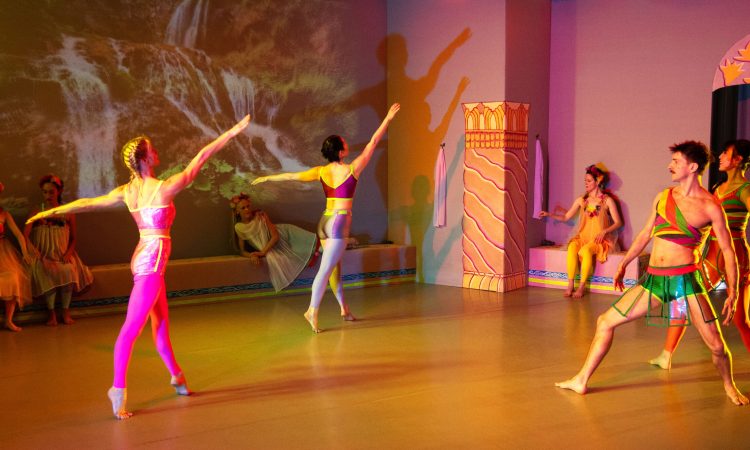
For his latest piece, Hesperides, Dunn transforms his Soho loft into a colorful theatrical garden. The vibrant physical scenery designed by Lauren Parrish works in harmony with Mimi Gross´ costumes of various robes, garlands, and tulle skirts. The projected scenes of nature throughout different seasons, created by Jacob Burckhardt, complement the whole experience. During this hour-long piece, we glimpse a wintry forest as well as a close-up of flowers blooming in spring.
Dunn’s title is a reference to Greek mythology and the “nymphs of the evening,” who tend an orchard of golden apples. In the opening moments of Hesperides, the dancers move in a language rooted in balletic classicism: their bare feet sharpen into pointe, their arms assume various port de bras as they leap and frolic across the floor. However, soon we glimpse dancers casually peering at the action from a doorway, or changing costumes in front of us before assuming a static pose on a bench. What is going on? It´s as if Dunn is filtering classical ideas through a post-modern lens, a compositional strategy that continues throughout Hesperides.
Puck-like, Dunn performs a solo to a pre-recorded voice-over. His gestures are gentle and spry. He impishly improvises his way through the loft with a tiny hop here, a slight turn there. Meanwhile, his original text, read by Paul Singh, talks about Dunn’s creative process. The text describes how he does not like dances where people talk because it “robs audiences of possibilities of interpretation,” which I find ironic. The solo becomes a dance as well as a dialogue about perception, a merging of process with performance. In this quasi-mythological dancescape, Dunn invokes the disruptive power of Pan and invites us to encounter Hesperides on multiple layers at once.
Later, Grazia Della-Terza performs another powerful solo, creating further friction with the piece´s broader classicism. Dancing almost entirely on a wooden chair, she provides more direct and personal expressions. Della-Terza´s movement vocabulary is composed of everyday gestures–the crossing of arms while leaning back on the chair, the removal of gray hair out of her face, the reaching of one hand down to one side. Simultaneously, a voice-over recording talks about “disorganization”, hinting at both a hidden restlessness within the performer as well as a frustrated search for peace. As her dance progresses, her movements grow more explosive and frenetic, giving this section significantly more raw emotional weight than most of Hesperides’ reserve. Is Dunn gesturing to his own angst about living in the city? Outside the artificial representation of this mythic garden, occasional sirens and car horns can still be heard from below.
Again and again, Hesperides refuses to fit neatly into traditional expectations for a dance performance. In addition to these contrasting solos against the ensemble’s more classically-oriented vocabulary, the piece unfolds in an almost timeless, stately tempo. Instead of directing the audience’s eye, Dunn often has two to four mini-choreographies unfold simultaneously. The soundtrack includes “Nocturnes” as well as “A Whiter Shade of Pale,” but each track fades out before finishing, gently jilting us of any dramatic resolution. Like many post-modern dances of the 1970s, Hesperides calmly presents its movement sequences as a series of tasks, no matter how balletic or contemporary.
A couple of dancers from this talented group stand out. Kieran McBride’s limbs flow with precision during her unison balletic vocabulary with others, but in a solo midway through, she cuts loose with the sinuous articulations of her torso. Her spine ripples like a river and is a welcome jolt of fluidity within Hesperides’ controlled atmosphere. Deniz Sancak, though never given a moment to dance alone onstage, is irresistible to watch. He inhabits Dunn’s classical vocabulary with extra depth and presence, to the point that even his moments of stillness seem to breathe with subtle lyricism. More than the others, Sancak seems to grasp richer meanings within the choreography and follows each mysterious line of thought.
But what, ultimately, is Hesperides about? I´m not sure if that´s how Dunn and his collaborators wish audiences to engage with this work. He is old school, and moments in this piece might feel challenging if one seeks dramatic catharsis from a contemporary dance performance. Instead, this piece quietly welcomes us into a momentary respite from the tensions of the ordinary world. Hesperides is intellectual and beautiful, woven together with gentle wonderment, and possesses plenty to reflect upon once it is over.
Hesperides, Douglas Dunn + Dancers, Douglas Dunn Studio, April 25 – May 2, 2026.