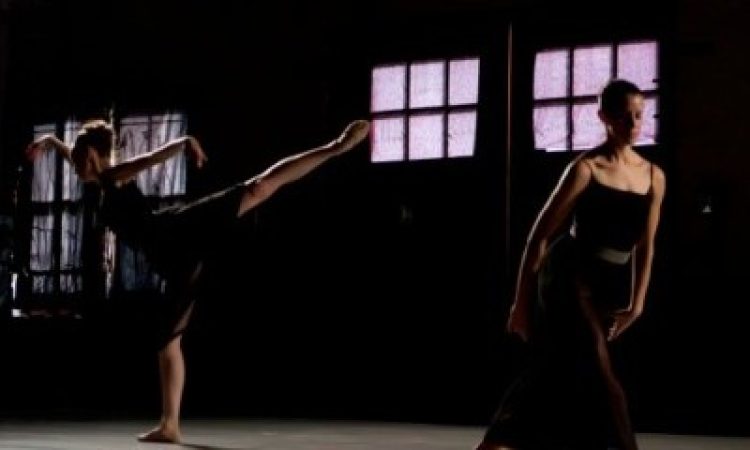
Nora Gibson basks in long diagonal reaches, the classic first position stance, turns every which way—staples of the ballet lexicon. Her work Temporal Objects makes use of this language while sharing the formalism, precision and fascination with repetition seen in the work of Lucinda Childs, with whom Gibson recently worked.
Her five dancers, in sheer black skirts and variations on black tank leotards, have the unfrilly look of Balanchine ballerinas, but with a physical variety Mr. B would not have accommodated. They are different in affect–the one more open and lush, the next more brittle. In all, they execute the motions of the dance rather than getting pulled in, never seeming to sink in too deep. Compounding that sense, the turns upon turns, lunging arcs and sweeping leg circles shaped into solos, bits of unison duos and one trio nearly all get cut off, remaining fragments.
Moments of formal beauty recur—a long stepped diagonal where dancers assume poses in decreasing heights, radial symmetries in some of the unison sections. Some shapings of stage space stand out, as when one duo shares the space with another, on different movement pathways. When the movement becomes continuous, as opposed to shifting through poses, it has a waltz-like buoyancy. But set as it is to iconic Beethoven (the “Moonlight” Sonata), I’m surprised that the dance seems not to inhabit the music but rather dance on top of, or even in spite of it.
It remains a mystery to me who composed the variations on the Beethoven. No program note credits either the person who played the piano, or who unhinged the original by electronically altering the sound with reverb or slowing. I wonder too: Why have poorly recorded music played so loud and so fast that it feels punishing (Beethoven as torment)? Why does lighting designer Clifford Greer choose to shine those cold quartz lights directly in the eyes of the audience in an intermittent, undecipherable pattern? Why cut nearly every movement segment before it has the chance to develop into something that feels complete?
The one insight I came away with had to do with contrast. At times the action melts into satisfying slowness, the light shifts to incandescence, as when Gibson herself steps backward away from a dramatic spotlight to begin the final section. The light transforms from the cold and forbidding to the warm and settled. Perhaps the Morse code-like signals transmitted through the flashing of harsh quartz light, blasting Beethoven and tightly-held dance fragments were translatable into a cohesive whole that reflects on these contrasts. But it was challenging to glean even that much significance, and I’m not sure what about these contrasting states I was supposed to understand.
What makes me unable to simply see the work as series of viable choices within an abstract form? Perhaps even more than narrative work, to my mind, abstract pieces need to indicate the world they are moving in, to reveal the workings of the choreographer’s choice-making. When no patterns are evident, I hope to see some readable stance in regard to the use of the materials, perhaps even a determined non-patterning. If the work is disjunctive, I hope to be left with a quality of watching a parade of changing images that sit in some interesting relationship to each other. In this work, neither of these hopes was met. Of course people’s responses differ. The young boy in the audience who was there with his dancer mom told me he was excited about the piece. He loved its intensity and dramatic changes. That’s another way to see it.
_ _ _ _ _ _
Philadelphia Dance Projects, presenter of the evening’s works, often pairs Philly artists with out-of-towners. In this case, Gibson’s counterpart, Irish choreographer John Scott,inhabits a different aesthetic universe. In his Body Duet, the dancers touch, talk and get messy with the real stuff of relationship. It’s an easy read—two people playing out connection, conflict and ultimate give-and-take—but its humor and compassionate rendering of what people do to each other make for inventive, compelling theater.
Michelle Boulé is a force of nature. She dances like a volcano and I can’t take my eyes off her.
I need to let you know how much I appreciated the ending. After a suite of sections detailing the vagaries of a relationship—hot, cold and in between–Michelle Boulé and Phillip Connaughton end up in a back and forth dance of support. She tips fully onto him. Hold. He’s lifted by her. Hold. And so forth. What a superb (and obvious) metaphor for how it goes between intimates. It’s durational. It’s caring. It’s real.
The piece is chock full of laughs. Holding an iPad the two read sentences one syllable at a time, bouncing the sound back and forth like a tennis game as they shiver and quake in one section or roam sloppily through the space in another.
The thing about that sloppiness is that it isn’t, not really. Managing to corral fierce energies into set choreography is no mean feat, like the choice of some painters to have the frame of a canvas barely contain the explosive energy of a slashing brush. It’s a treat when it’s masterfully channeled. Here Boule’s thrashing hair and ready limbs spring up at a moment’s notice. There’s vocal energy too—audible breath and screams and searching-for-tones warbling.
How many gazillion relationship dances have I seen over time? Love and death are of course the biggest and most recurrent of themes. You might have thought that it is no longer possible to be fresh in making such a duet. But Scott pulls it off with elegance, sprightly humor and welcome truthfulness.Nora Gibson- Philadelphia / John Scott- Dublin, Ireland presented by Philadelphia Dance Projects at the Performance Garage, February 27-March 1.