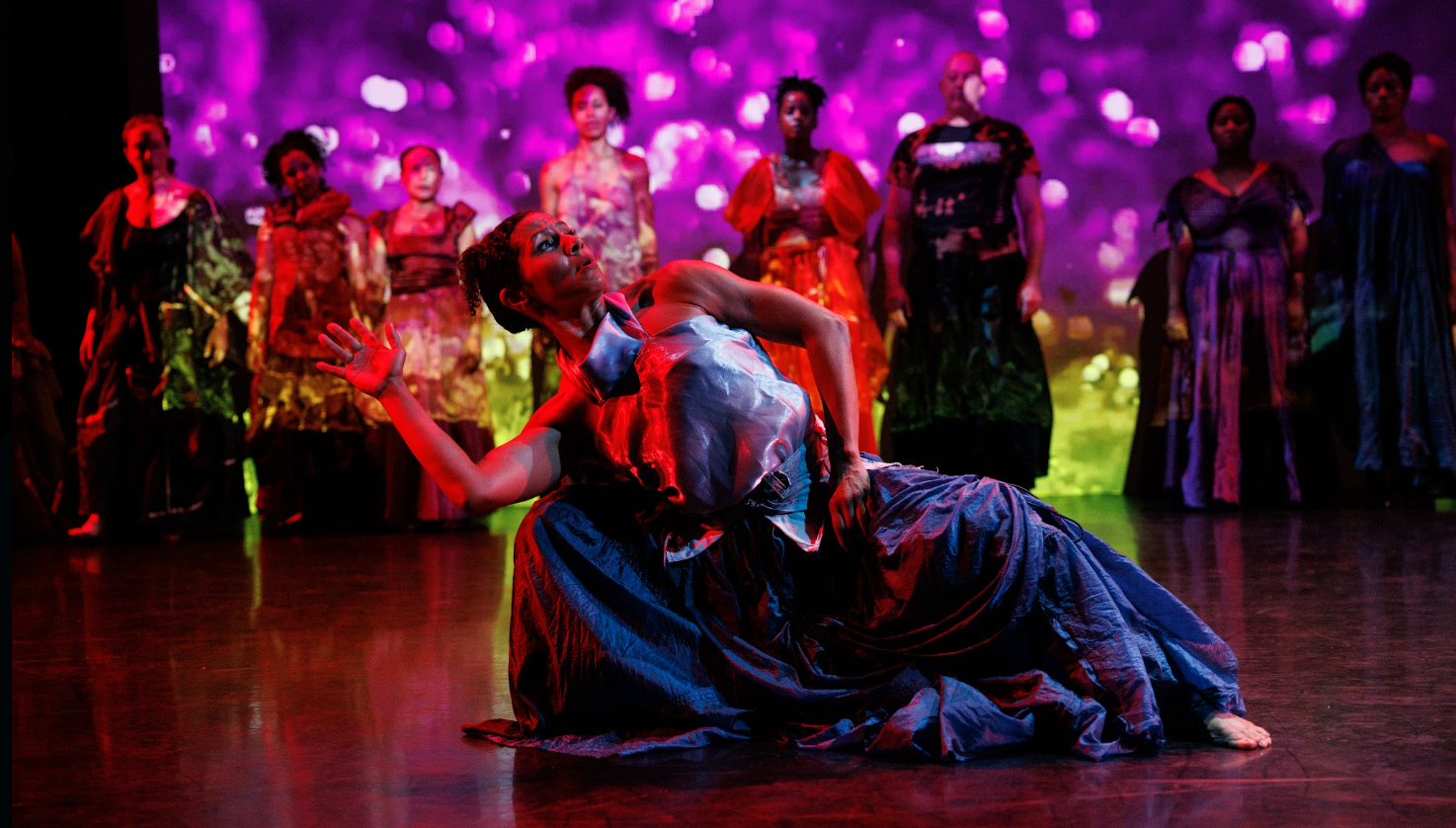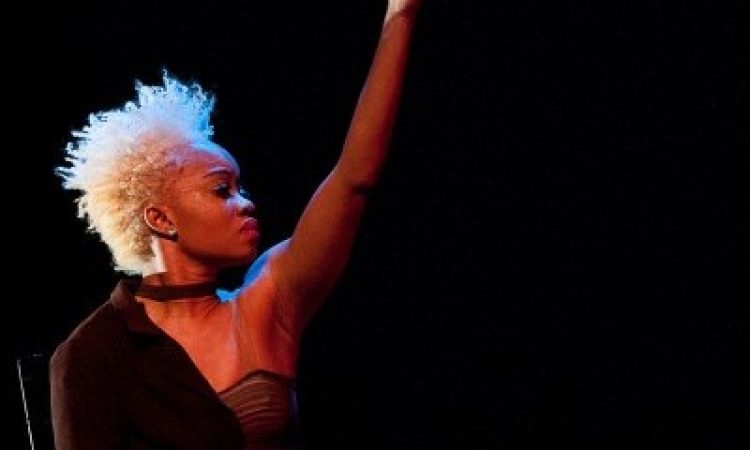
Camille A. Brown’s notably virtuosic and politically charged work takes on a palpable urgency today in Goodhart Hall at Bryn Mawr College. At a time when our country is in a state of trauma over racial injustice, her work could not be more relevant. Grand Jury decisions in Ferguson and Staten Island to not indict the police officers who killed Michael Brown and Eric Garner have torn the flimsy sutures from the American wound inflicted by human traffickers when their first slave ships arrived on our shores.
During this evening of three dances with a mixed gender company, Brown decides to devote one of the pieces to the six women. Black Girl: Linguistic Play, a work in progress, is described in the marketing as: “…an ongoing investigation of the identities imposed upon and often lived out by black girls moving into the dangerous neighborhood of American womanhood.”
Two tough women, Catherine Foster and Brown tap in sneakers on square platforms. They duplicate, ride on top of and counterpoint Scott Patterson’s piano and Tracy Wormworth’s electric bass. The two dancers percuss the treads of their shoes on the mic’d platforms in exact unison. They stand with their heads down and arms held aloft like wings for a period of stillness that sharpens the moment and brims with a sense of expectation and mourning.
In another duet, Beatrice Capote and Fana Fraser undulate and extend their spines precariously on a ledge against a crimson wall. They thrust themselves and each other against the wall, sometimes supporting, sometimes undermining the other’s balance. Moira-Amina Parker and Chanel DaSilva emerge from the darkness. These two roll on the floor and spiral their arms around each other’s torsos. Each pair disappears into the shadows as another becomes illuminated, like short, distinct studies in the versatility of Brown’s dancers.
Half of the audience remains glued to their seats through the 40 minute Q & A–moderated by Norma Porter Anthony, Editor of Black Dance Magazine–presumably because Brown describes this part in the program as “a verbal extension of all the works presented.” Perhaps people also remain because they are hungry to come together with this cast comprised entirely of people of color to consider the current surge of unindicted police brutality and to reflect on how institutional racism contaminates our society.
Brown replies to a question about the news: “I certainly feel more anger in my steps today.”
The conversation veers from judicial to identity politics. Several audience members voice how they see themselves in Black Girl. Brown describes how this piece portrays and challenges the common cliché of the strong, angry black woman which is evident through the ferocious stomping and moments of sorrowful pause. A performer discusses her experience of embodying the attitude and defensiveness of the stereotypical fierce black woman. She questions her complicity in perpetuating this erroneous conventional image both in her life and in her dancing. Brown and performers alike say they want to render the full depth of human experience in the piece, including vulnerability and laughter. This iteration of Black Girl juxtaposes the strong with the vulnerable but has yet to include joy.
Each of the breathless and unabating duets depicts the struggle and exhaustion of maintaining the resilient black woman persona. Black Girl might be dance in its most humanistic form: the embodiment and questioning of cultural norms that manifest in muscular holding, posture, gesture, and breath.
Camille A. Brown & Dancers, Goodhart Hall, Bryn Mawr College, December 5.
Note: Several thINKing DANCE members attended this performance as part of a writing workshop led by Elizabeth Zimmer. You can read Becca Weber‘s review here.