When choreographer Jasmine Hearn voices the word “fleet” in their new work, Memory Fleet: Beloved, Let’s Cross, they reference not an armada of ships but a convoy of memory, one that is indeed fleeting, that bespeaks elements in swift currents, that can vanish in the mist, that are nimble whispers, and also dashing spats of urgency.
In the same way it embraces multiple definitions, Memory Fleet does not respect the boundaries of any one art form. The complex cinematic dance work held gaze and focus for the full 75 minutes. I want to unpack the rich layers of this work and how they moved together.
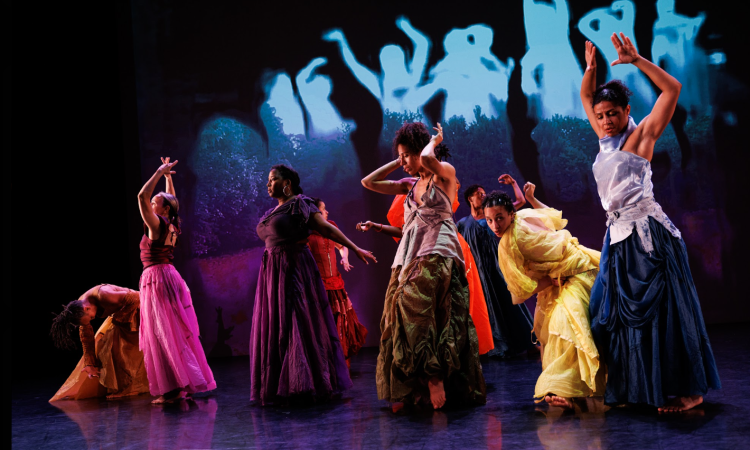
One layer is the footage shot by Jasmine Hearn, Hayden Hubner, and Myssi Robinson, projected against the back wall: There’s a tunnel, earthen walls, lowlight, then silent footage of Hearn themselves laughing and talking somewhere outside at night. Throughout the evening, there is a flow of images, flashes of fields, Hearn walking us through a landscape, dance studios, and movement. It returns again and again to a close look at the surface of a body of water. Film maintains its role as a contextualizer throughout the work, even as Myssi Robinson carries a camera and moves through the performing space, projecting silhouettes of the dancers and the stage onto, into, and against the filmed imagery. We see Hearn walking down a path in what we learn is Texas, and the silhouettes shift to obscure them with the bodies we are watching onstage. The documentation and the live mix on and off the screen.
Now the dance layer: bend, reach, lean in, open, look, lift an arm behind, fold, plié, step, send feet into the air, turn, land, watch. The work begins in a quieter, maybe solitary way, each dancer in their own rhythm, and their own phrasing. There is a collection of energy, a camaraderie of movement choices that, over time, find ways to sync into unisons and canons. They fuse into a shared joy and a communal space, more liquid than the start, and find common ground.
Sound design by Hearn and Ashley Teamer was threaded throughout. There are samples of texts, live vocalizations, Hearn speaking into a mic on a few occasions, and songs like “Balm of Gilead” woven together. The text is largely about home (Texas), family, and the place Hearn grew up, a land purchased by a former slave–one of their ancestors. About midway through the piece, a DJ booth is brought out for Ashley Teamer, who remains there for the rest of the performance, live mixing sound samples from what has come before alongside commonly known songs and voices. When Teamer takes the stage, the presence of the dancer constantly shooting with a camera becomes even more pronounced, somehow more visible because the two share the same task: taking what is happening live and translating it into different registers—sound, image, memory, and archive. Each creates a parallel version of the performance, one through audio and the other through video, layering documentation and composition onto the unfolding event.
The costuming by Wunmi Olaiya are gowns of different constructions and bright colors, all referencing the kind of skirt and flounced ruffle from turn of the century dress.
A total work of art, Memory Fleet operates in its own time without regard to hegemony. Hearn’s approach to duration feels cyclical rather than linear. The work resists the forward-driving, goal-oriented sense of time that so often structures Western performance—a temporality rooted in productivity, climax, and resolution–the masculine. Instead, it returns, loops, accumulates, plays, and breathes. Moments reappear altered by what has come before, not as repetition but as deepening.
There is something profoundly feminine in this relationship to time—not in an essentialist sense, but in its embrace of cycles, recurrence, and transformation. It evokes lunar rhythms, seasonal returns, and the body’s own patterns of change rather than a straight line from beginning to end. And in this way, it offers a different experience of time: one that privileges relation over conquest, return over arrival, and becoming over completion. It mirrors its matriarchy.
Memory Fleet: Beloved, Let’s Cross, New York Live Arts, June 11-13.
Performances by Jasmine Hearn, Nora Alami, Maria Bauman, Dominica Greene, Melanie George, Jenna Hearn, Jennifer Newsom, Pamela Pietro, Angie Pittman, Kendra Portier, jhon r. stronks, Wayne Smith, Charmaine Warren, and Tara Aisha Willis, with additional sonic collaboration by Jo Stewart and Ashley Teamer.