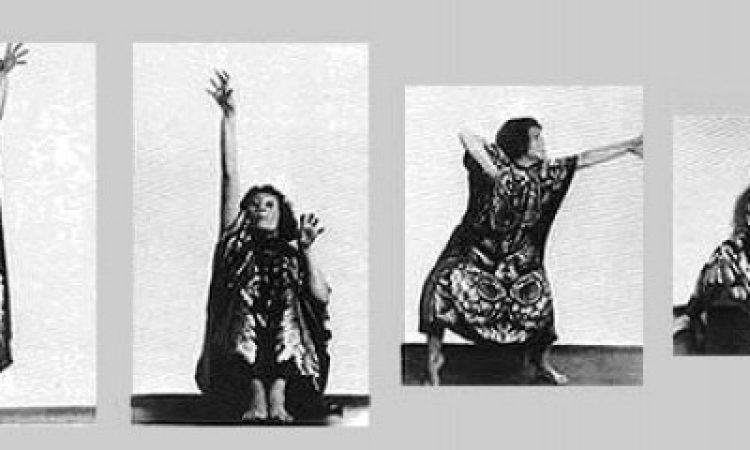
Photos on homepage and above are of Mary Wigman in Hexentanz.
Gwendolyn Bye’s bio makes her mission clear: she “founded Dancefusion in order to carry the rich history of modern dance into the 21st Century.” Training dancers, offering educational outreach, and creating performance opportunities for young dancers go hand in hand with Dancefusion’s mission, but the most public face of her organization’s activity are the concerts by her professional company, seen for the last several years in the FringeArts Festival.
To see a restaging of a work like Mary Wigman’s Hexentanz provides a jolting reminder of the power and intensity of early modern dance. This 1926 solo by the German pioneer can be seen in a flickering two minute black and white YouTube clip. But to see it full length, in living color (with red costume!) danced convincingly by Jennifer Yackel is a rare thrill. The seated opening makes high drama of sideways shifts, with Yackel’s clawing hands and jutting elbows accompanied by simultaneous cymbal crashes. Her masked visage and black wig turn her into the ur-sorceress, stomping and thrashing before settling back in her starting place.

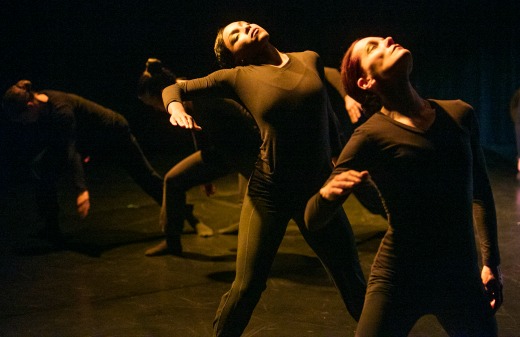
On the contemporary end of the concert’s spectrum, Masad Qawishabazz’s Articulated Reasoning, for eight dancers, is a dystopian grab bag of movement qualities, including a sinuous, slow rippling of head and spine one might trace to Qawishabazz’s work with Shen Wei. Other sections are staccato, robot-like. Clad in black, the dancer’s silhouettes are often strikingly edged by austere lighting. Outstanding in this piece was Brittney Dunbar, a dancer of stunning elasticity and fire.
Stephen Welsh’s Swing Vote equates playground games and squabbles with a political race, alternating mimed scenarios with robust dancier sections. Its seven dancers initially wear identical vests, mixed turquoise and orange, later switching into one or another sole color as they split into warring factions.
Set to one of Schubert’s most tender piano works, Kalila Kingsford Smith*’s Ever Angled was reminiscent of another modern dance great—Isadora. Duncan’s Three Graces was echoed in the supple, breathy fullness of Smith’s three dancers. Beginning and ending in a gracious circle, they also performed moves Duncan would never have envisioned—sweeping their legs into high formal arabesques, tumbling and rolling into the floor and inverting their weight, springing off their arms. The concert was, in part, a tribute to Smith, now leaving Dancefusion after years of connection with the orgainization. We were all invited afterward to a reception in her honor.
Making Dance, Dancefusion, Performance Garage, September 17 http://www.philadelphiadance.org/calendar/index.php?eID=8547
* Smith is a thINKingDANCE writer, editor and Communications team member