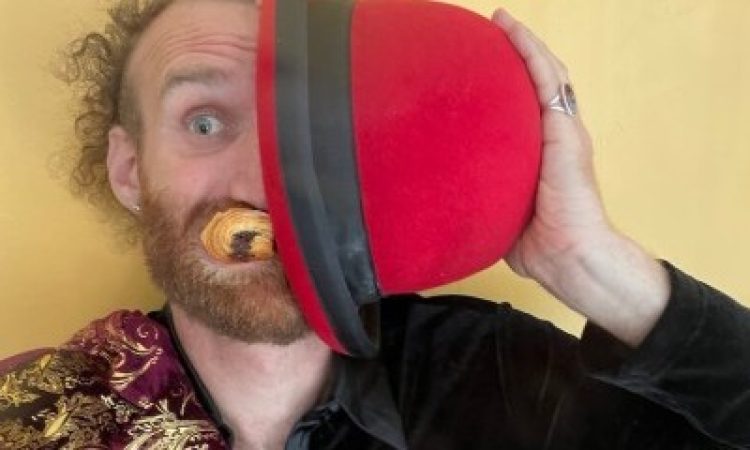
Janoah the Jester’s body is on fire. Half of it, to be specific. Chronic pain in zir right forearm radiates from neck to foot in different qualities and quantities, fileting zir body in two. With disarming vulnerability and self-awareness that accompanies circus acts and character-based storytelling, Janoah brings us into zir world, delivering comedic punches that let audiences swim in the deep end of zir world of pain.
CHRONIC PAin au chocolat begins with Janoah rolling in on a unicycle. Ze performs a treacherous one-wheeled striptease, the audience cheering throughout, acutely aware of the difficulty of the endeavor. By the end of the sexy spectacle, most audience members hold a piece of zir clothing. While the work retains the striptease’s humor and circusry throughout, CHRONIC PAin also promises a turn to more sensitive topics. In preparation, the audience pinky promises each other to not feel bad for zir juggling fuck ups, ze pokes fun at zir usage of ze/zir pronouns, and ze takes us through an appointment with zir osteopath. The osteopath asks ze to mark areas of pain on zir body, and we see that one half of Janoah’s body has five large sharpie-d Xs drawn on.
What follows is a story about a bifurcated body––a good and bad side, a good and bad person. Ze juggles balls, discs, pins, and knives while telling stories about zir exes, each toss a rhythmic dance visualizing sound. In a passionate original song, Ze laments that “pain might be with me till I die, sigh.” With expert fruit ninja skills, Ze slices fruit and pan au chocolat in half, the food resembling zir own painfully halved body. Ze invites audiences to take a bite.
Then, the lasting visual delicacy of the performance: a fan billows a piece of mesh cloth in the air, which takes the shape of a ghost wearing a white dress. Inside, a red cloth dances, a haunting image of pain––or life––in a body. We see a video of an unknown hand shaving off half of Janoah’s facial and body hair while ze sits in a corner listing all ze must complete, enjoy, and avoid in zir little life. Pain-filled profundities: “Performance is useless. Performance is the most important thing in the world.” And, “Maybe pain is not always a bad thing. Maybe––”
Maybe that’s all there is to life-changing, useless performance. A gentle look at a person, in all their joys and pains, struggling. Janoah tangles zir body up in threads of sweet sensitivity, contemplating pain, disability, and queerness in a way that invites people in rather than keeping them out.
CHRONIC PAin au chocolat, Janoah Bailin, Louis Bluver Theater at The Drake, September 27.