What happens when our curious drive to pick things apart and classify becomes a science of obsessive madness? When a scientific dissection merges with an artistic one, what or who is the real specimen? And when the possibilities for cataloguing and display offered by the physical body alone are exhausted, what remains to be dissected? These physical and metaphysical questions are invoked by Subcircle’s newest work Seed, choreographed and performed by Niki Cousineau and Gin MacCallum with design by Jorge Cousineau and direction by Carol Brown.
As the audience enters the space, MacCallum perches bird-like atop one of two large curio cabinets, feet crossed shyly, tilting her head in curious observation or concentration, the sounds of birds chirping around her. As the house lights go down, and the bird song intensifies, Cousineau enters, wheeling a metal cart and lays out onto a large table what appears to be a dead bird and various tools. An overhead camera captures the “birds eye” view of her ornithological post mortem with images projected onto the back of the wall. Her dissection yields some clearly non-biological objects, all removed, examined and labeled. MacCallum enters as Cousineau’s foil, the bird incarnate, poking, winding and insinuating her presence into the investigation. Cousineau concludes by tacking the dissected bird onto a wall, serving as a totem for the remainder of the piece.
Seed unfolds episodically yet seamlessly, with continuous transformations. A laboratory dissection becomes a gypsy-inflected funerary rite. A scientific travelogue folds into an obsessive display of flesh and feathers. Costumes and set pieces morph as well, providing a shifting frame for the action: library, laboratory, dining room, cabinet of curiosities.
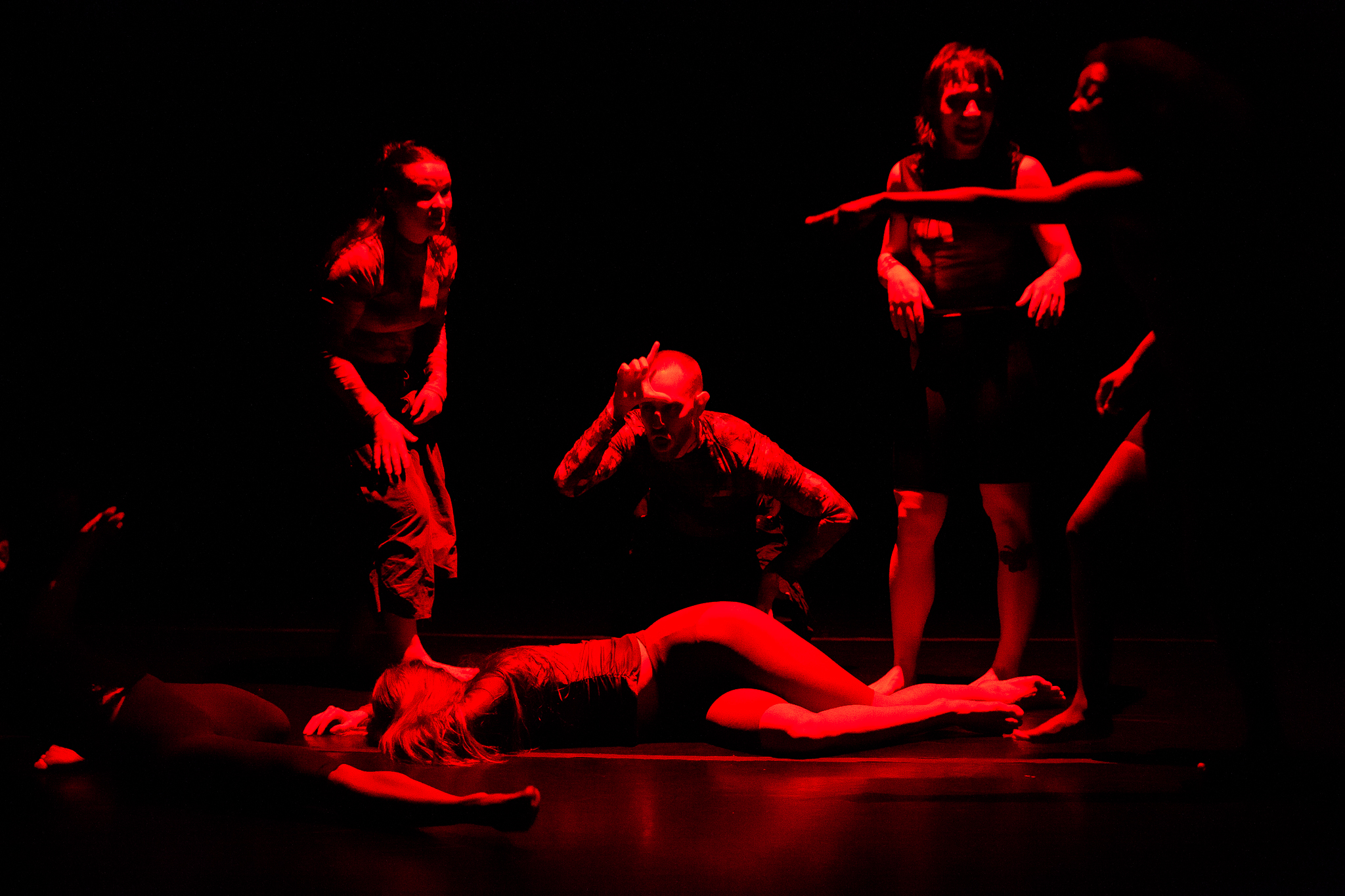
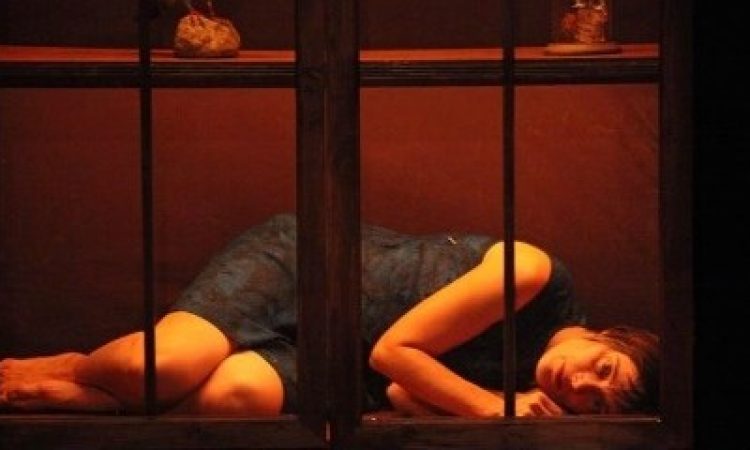
At one point, what was the table transforms into a tilted ramp up which MacCallum climbs. As Cousineau unzips MacCallum’s dress pulling it off her body, MacCallum lays her bare and starkly lit body upside-down on this slab. Arched and on display, with light and shadow accentuating her ribs, morbidly visible through her skin, MacCallum scoots downward, wrestling with a body too tightly contained by her skin. I experience this body with the same mix of clinical detachment and obsessive curiosity with which Cousineau had earlier treated the bird. Will MacCallum become a totem, too? When Cousineau appears again, she is herself a curiosity on a shelf inside the cabinet, fetal and still, before twisting and twitching her way out.
Cousineau and MacCallum traverse their human and bird selves with percussive jumping and flailing, seemingly jointless undulations, and perching and chest puffing. Their movement phrases or even single gestures are often repeated, enhancing the sense of obsession. In one of the most poignant moments the dancers, downstage, angled and side-by-side, flap their arms, slapping them against their chests in propulsive repetition. The sound score by Rosie Langabeer, Russell Scoones and Jorge Cousineau shifted in tone with the piece: bird sounds enmeshed with dynamic percussion or haunting accordion melodies.
As the house lights come up to performer bows and audience applause, I ease up out of my seat, and poke my head around. I jut my shoulder blades outward and my elbows creep up. My body asks how it too might contort and shave its clunky human bones and transform them into the delicate skeleton of a small creature in flight? Such a feat might require the precise combination of obsessive dissection, morbid display, and agonizing tenderness I had just witnessed.
Seed, Subcircle, Christ Church Neighborhood House, November 2-6, 2011. No further performances.