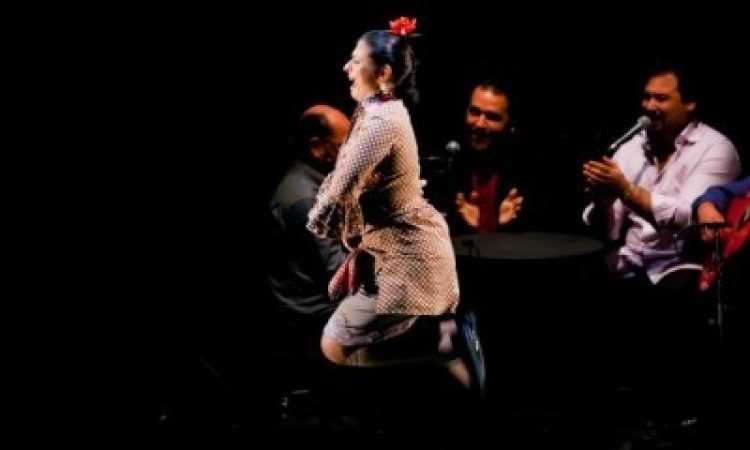
Flamencos, the really good ones, exert a special magnetism. After seeing Pastora Galván in her solo exposition of the flamenco styles and personalities that helped form her, I kept thinking about the force that drives her so fiercely. Is she stamping out a fire when her feet pound the ground, or are her feet the fire? Does it burn in her heart, and the only way to live with it is to proclaim, with every cell, that it is this rhythm that must enter the world now, or this triumphant arching shape?
Neither Pastora nor the singers express doubt. Misery, yes. Or more precisely the kind of rueful world-weary knowledge that suffering exists and transcendence may be possible. I hear in the music and see in the dance loss and resolve. Tender aspiration. The voice of the cantor a cry of pain touched with the wistfulness that all may come right, as the minor key shifts into major or as his vocal flight, buffeted by gusts of melodic inspiration, comes to a temporary resting place.
The program note indicates that this essay on flamenco is, in part, a send-up. Otherwise the beginning with the amply proportioned Pastora dressed like a farmwife, with a red flower in her hair, flats and rolled-up stockings on her feet, and leaning into the bawdy side of her dance, might perplex. Still, this initial portrayal of a stolid auntie dancing in the kitchen, or something like that, immediately reveals her facility and range.
The tight choreography, by her brother Israel, never dwells too long on any one movement motif. Instead Israel Galván relishes variety, throwing in tiny shoulder shakes, or quick directional shifts or zooming in scale from the grand gesture to the miniscule. The movement keeps refreshing itself; through the performance Pastora shifts into multiple personas—the elegant and slippery black-clad one, the one in the classic polka-dotted dress with an over-the top ruffled train and voluminous fringed scarf, and finally, the contemporary colorful floral one. Each has a particular dancing character (and steps no doubt nameable by flamenco cognoscenti), from the most restrained to the most raw and fleshy. Pastora’s face too shifts in its quality of reserve or bold grimaces.
Israel Galván is especially skilled in crafting each section’s ending. He comically sends Pastora shuffling offstage with a radically arched back, or, another time, covered over with the fabric of her giant dress and shawl.
The piece’s finish recalls a collection of photographs. In short sections we see Pastora duet with the lanky guitarist/dancer Emilio Carafe, or sitting at the musicians’ low table, drumming the rhythms and singing alone (is this the child at the very beginning of her flamenco journey?). So when the ending of Pastora comes, it’s as though we’ve been privy to a complete album of memories, with each page holding a special place in her dancer’s heart.
Pastora’s other excellent musicians, heard in multiple combinations throughout the evening, are Ramon Amador, guitar, and David Lagos and Cristian Guerrera, vocals.
* * * * * *
I don’t generally look back at the notes I scratch in the dark while watching a show. But it stayed with me that not far into Israel Galván’s La Curva I wrote, “ROCK STAR.” And that there were lots of moments when writing anything seemed ridiculous—why take my focus away for even an instant from this performer whose facility, speed, invention and outrageousness top anything I have seen in years and count among the great highs in my fifty-some years of dance watching?
Galván seems to have eaten flamenco whole—his and Pastora’s parents were Sevillan dancers—then digested it and moved on to a place where it is the prime, but not sole, language he speaks. He can be the sultry alpha male with chest thrust forward, arms tossed high, asserting his dominance in rapid fire foot strikes. He can also tap out unpredictable rhythms with the same astonishing accuracy and playfulness as Savion Glover and let movement ripple through his torso, exiting now at this extremity, now that, like the best pop and lockers. He can cause the whole audience to guffaw with a well-timed verbal or physical joke (the image of hailing a taxi popped up more than once).
His post-modern weaving of disparate forms calls on collaborators whose depth of practice and skill are a fine match for his own. Inés Bacán, the singer he has collaborated with on several of his productions, is of a gypsy lineage that imparted to her how to source her voice from the deepest recesses of herself. She sits throughout, solid as a mountain, and is the last one left onstage at the piece’s close. José Jiménez Santiago “Bobote” provides the rhythm accompaniment (compás) through clapping, stamping, and shouted admonishments, at times a playful foil for Galván. And Sylvie Courvoisier, the composer/pianist, attacks her concert grand with the propulsive crashing chords of Stravinsky, or strums, plucks or distorts the sounds of its strings in the manner of John Cage. Although challenging to classify, her music could be called contemporary jazz.
The stage picture of La Curva evokes a club, with stacked chairs, with singer and rhythmic accompanist seated at a table and the pianist at her gleaming instrument. The original La Curva was a Paris club of the 1920s where experiments with flamenco, which inspired this work, may have been performed. In keeping with the momentous art happenings of those times, Galván channels Nijinsky in flattened poses and hands held à la Afternoon of a Faun. The harmonic predilections of Stravinsky are intoned early in the piece; later, Rite of Spring serves as the basis for a musical improvisation and, when rendered straight, Galván dances atop the table, pounding out the music’s famous rhythms. To this I found myself emitting an involuntary “AMEN!”
The contrast of musical styles, one traditional and the other the farthest from, is what sets up a tension in La Curva that keeps Galván gliding between two poles. He sits or stands still between piano and table for extended segments, as the two musical forms take turns, initially with hard boundaries dividing them and later growing more porous as the styles find more or less of a counterbalance.
There’s both a serene timelessness and absurdity in the string of La Curva’s events. Galvan dances with a chair around his neck, playing its seat like a washboard. He tosses his leather jacket over his head, crouching and skittering through space like a Bosch monster. He makes sound with anything and everything—the table tipped upward and dropped back on its feet, stacks of chairs toppling and his own fingers thrumming on his jacket or his head. He morphs into a standing flamingo, or a fish, and, following the torrent of dancing he unleashes in a rectangle of white powder, a dust-caked survivor. This last unsettling image may contain in it a death. Is he finally past it all?
With both performances of La Curva (I had to see it a second time) the audience literally leapt to its feet and cheered. What does Galván bring us that prompts such gratitude and energy? He shows how technical brilliance can be used in service of both entertainment and a profound personal search, a path charted seemingly without hesitation or fear.
Pastora, performed by Pastora Galván with Choreography by Israel Galván, Drexel University, Mandell Theater, March 13 & 14.
La Curva, performed and choreographed by Israel Galván, Drexel University, Mandell Theater, March 15 & 16.
Both productions appeared as part of the 2014 Philadelphia Flamenco Festival presented by Pasion y Arte.