March 16, 2014
Dear thINKingDANCE readers,
I opened the morning modern class I was teaching today at the Northeast Regional Conference of the American College Dance Festival Association by saying that one of the best things about being a dancer is that we remain students for our entire lives, and as students we (for the most part) can only learn by watching and listening to each other. Our art form is largely folkloric; we rely on each other as a community in a more tangible way than artists in more solitary forms. This is a huge relief because what we create is so darned intangible.
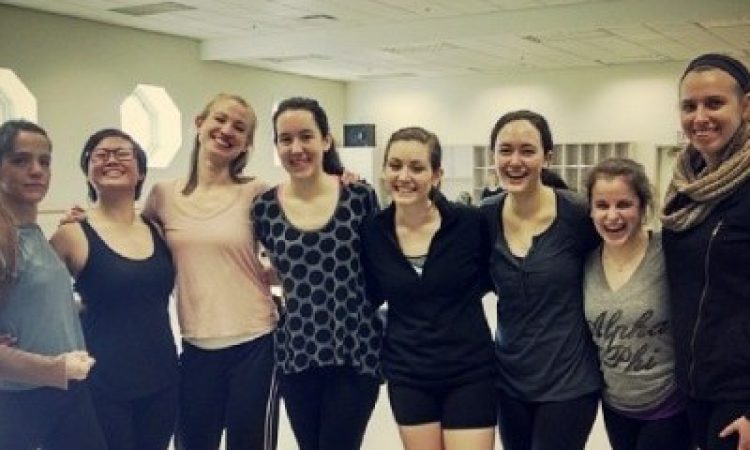
In The College at Brockport’s sunny studio at 8 a.m. on a Sunday, there were about forty students in the circle, engaged and hungry even after three full days of master classes, adjudication concerts, subsequent feedback sessions, and late nights in hotel rooms with friends. As you can likely tell, I was also energized—that, and feeling surprisingly sentimental about collegiate dance.
This is not at all the letter I had planned to write home to you. I went in thinking that my correspondence would follow this line of inquiry: What dance world are we college educators preparing dancers to go into? Does the dance world we are teaching for even exist any more? In terms of technique: are dancers being trained for jobs that don’t exist? When we teach classical forms, both traditional ballet and early modern, should we just call these classes dance history?
I did overhear another teacher asking her students what they plan to do after graduation and three out of four answered with: Audition. I hear this quite a bit from my students at Temple too, and for reasons too numerous to go into here, it is a naively narrow idea of what going out into the dance world is (not to mention a less than a foolproof way to job search, even if your plan is for performance to be your primary income source). Luckily, the students’ responses started a good conversation about researching companies and integrating yourself into the dance landscape of various metropolitan areas (props to that teacher).
Though I do often feel cynical about what we are teaching young dancers and whether or not the tools we attempt to provide will equip them for the professional opportunities (or lack thereof) they will find upon graduation, I am also a sucker for the highs of a dance festival like ACDFA—the adrenaline of performance, sweating in class, making physical contact, finding balance, getting goose bumps when a juicy theoretical line of questioning comes up, nodding vigorously at something the adjudicators say, or jiving on a phrase with a stranger.
In some ways, I am still a hungry undergrad ready to drink in the elixir of dance (which can be a little embarrassing, especially in our current Philly culture of extreme cool). I even recall a particularly saccharine moment during a jazzy little number during one of the festival performances when I thought about how it might be enough for these awfully cute and friendly dancers to go out into studio culture, teach children and thereby allow the next generation to move out from behind iPhones/Pads/Pods even for an hour or two a week. I can only hope I am also a mature adult dancer and teacher ready to mentor students into the dance world they will be entering into: a world of freelancing, multiple jobs with little to no rehearsal pay, paying (or cleaning floors) for class; a world where proscenium dance may just be on the way out; a world where no one is requiring you to get yourself into the studio and you are not automatically given feedback by a room full of generous/interested/invested peers when you show your work.
This is my sixth ACDFA: I participated three years in undergrad and two in grad school (one of which we hosted at the University of Iowa). This year, I attended with the Richard Stockton College of New Jersey, where I currently teach ballet. I was happy also to be reunited with Temple students I had taught in modern classes from their freshman through junior years, and with Franklin & Marshall students I taught just last semester. Many of these students were in the opening circle this morning and I felt proud of them and their growth. Who knows if any of them will go out and successfully audition themselves into a company with a paycheck and in-house physical therapy? Then again, is that really the goal?
Thinking back, many of the dancers with whom I attended previous ACDFAs are no longer involved in dance as a career. I came away from this festival thinking about how that fact may not make the experience any less valuable. Maybe there is value in simply spending spring break dancing with and learning from friends, and in helping to build and nurture an engaged dance community.
Earnestly,
Eleanor Goudie-Averill
American College Dance Festival Association Conference, Northeast Region, March 12-16, 2014, hosted by The College at Brockport School of Dance, Brockport, NY