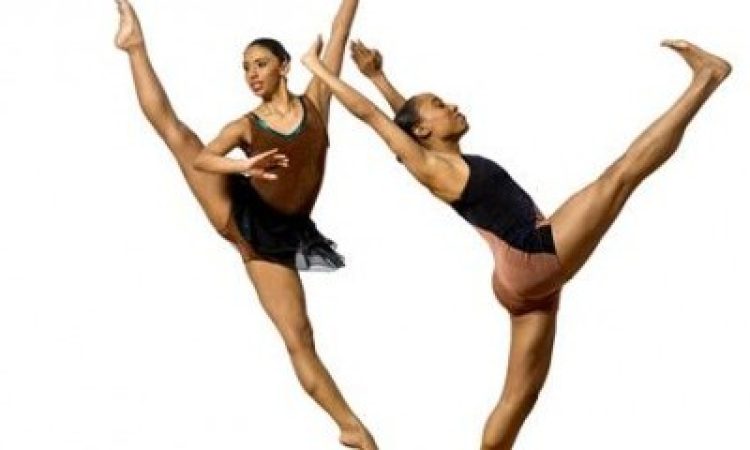
It has been many years—too many, indeed—since I’ve seen Philadanco (The Philadelphia Dance Company) perform. When the dancers took the stage at the Kimmel Center’s opening night of ’Danco’s spring season, I remembered the sense of full-body commitment their performances always expressed and their apparent joy in dancing for their audience—in this case a full and enthusiastic house at the Perelman Theater. What struck me this time, however, is the dancers’ precision and elegance—placement of each limb, clarity of focus, intricately exact partnering, and silent landings from soaring leaps.
The four works on Danco’s, “Blood, Sweat and Dance” program demand pretty much everything from this company—speed and stillness, technical mastery and dramatic investment, joy and anguish, ballet and hip hop, and huge outputs of energy. As I commented to a friend upon exiting the theater, I was both energized and enervated watching this powerful group perform.
The most striking work is Bad Blood (1984) by Ulysses Dove, a company premiere, restaged for Philadanco by Debora Chase Hicks. The dance opens with a single white-clad man, performed by Victor Lewis Jr., seated on a long black bench upstage center. He breaks into a strong solo that carries him downstage with striking gestures (pointing, grasping, looking), and precisely articulated turning, falling, arching, spinning, and watching. A group of men and women, also in white, enter, drawing on the same movement vocabulary the soloist established. A series of interchanging, interlocking duets and trios ensue, with swift and subtle emotional changes suggested by the embraces each couple moves through, pushing and pulling, parting and reconnecting. As the landscape of emotion subsides, one man is left alone, draped in an arch over the bench, his face obscured from us as the lights fade. The music by Laurie Anderson and Peter Gabriel matches the stark, mysterious set and movement, creating a cohesive and engrossing work.
Donald Byrd’s BAMM (1995) has a similar atmosphere of alienation and angst, but its colors—pink unitards with bright orange accents—and pounding music by Mio Morales heightens the emotional stakes. So do the angry stares of the dancers, and the groupings that pit many against the one as they march, circle, lunge, and kick aggressively. Is this a new take on Martha Graham’s Heretic of 1929? Certainly, the theme is age-old and, likely, universal. As the dance progresses, the choreography becomes increasingly acrobatic, drawing oohs and ahs from the audience. The originally defiant soloist, danced by Roxanne Lyst, becomes, at one point, exhausted and pliant in the grip of an imprisoning partner, while the group dancing frenziedly around the stage seems oblivious to her struggle. She preserves her inner will and emerges from her jailer’s grip, defiant still.
The program closer is a guaranteed crowd-pleaser—Rennie Harris’s Philadelphia Experiment (2007). The cast of fourteen, led by Tommie-Waheed Evans, has to compete for audience attention with a slide show of street scenes, trash, people, and sneakers. The live dancers’ small figures are overpowered by the large-scale video, but the chanting recorded voice, urging the audience to remember the times of slavery, makes sure its message is not missed. Nonetheless, the dancers seem in the thrall of sheer joy as they step, shimmy, stamp, pulse, and torso-roll through the dance, often in unison groupings, but with plenty of room for individuality in focus, arms, and attitude. Moments of acrobatic brilliance drew enthusiastic applause from the opening-night viewers, who joined in energetic rhythmic clapping to support the dancers in this unbridled outpouring of Philadelphia hip-hop love. The original sound track for the work was produced and edited by Darrin Ross. While the work’s coherence is, for me, questionable—text, video images and movement don’t hang together—the audience delivered a hearty standing ovation.
Also on the program is Suite en Bleu by Philadanco’s long-time choreographer-in-residence, Gene Hill Sagan, whose 15-year association with the company endured until his death in 1991. To the music of J. S. Bach and George Frideric Handel, the dancers, clothed in sparkling blue, display the balletic foundation that undergirds their precision and range. The dancers sweep across the stage in joyful, uplifted postures, leaping, spinning, and holding occasional elegant balances.
Philadanco, “Blood, Sweat and Dance,” Perelman Theater of the Kimmel Center, Apr. 17-19, 2014, http://www.kimmelcenter.org/events/?id=4807.