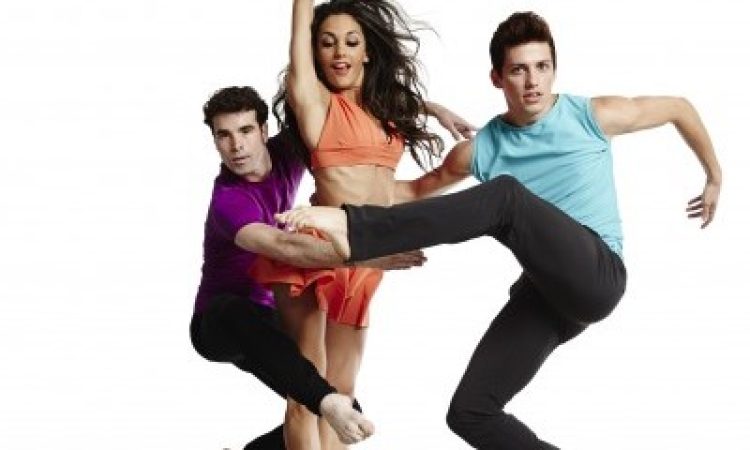
If you want dance to be music made visible, Parsons has created the show for you. The dancers, virtuosic and athletic, execute grand leaps, surprising shifts of weight, and daring moments of partnering. But every move is made right on the beat, and every grand gesture performed with a smiling façade. The pleasantness, so precise and demure, exacerbates the largely frontal-facing, performative, coy, linear, saccharine dancing. I want more than a literal interpretation of the music alongside predictably heteronormative partnering—the women delicate, the men brawny and grandiose, there to support the pretty female props.
In Bachiana, the full cast appears, decked out in red dance dresses and black leggings or velour pants. They chug and leap in canon, hitting the apogee in X-shapes, reminding me of jumping jacks. Their thumbs twiddle in a petite allegro. In an adagio, a woman sits atop a man’s shoulder, mimicking his arms as they open and extend. Moments like these point to the staged quality of a series of arabesques and tendus, phrases that feel more like a classroom exercise than a fully-fledged and physically researched piece for concert. In the midst of this work, a young girl behind me audibly whispers, “Mommy, when’s intermission?” and I empathize with her.
Before the show opens, we are subjected to a call for donations from Annenberg representatives, a pamphlet in our program, and a request from David Parsons himself–a common occurrence in the sad state of the arts world today. In Parsons’ plea, he mentions that the company is 30 years old, and watching the tired formulas in Bachiana, I wonder how much the work has progressed in that time. It is refreshing, then, that the next piece in the program is the Philly premiere of Trey McIntyre’s Hymn—one of only two works that fully uses the performers’ athletic and artistic capabilities.
This piece, set to the static-y technological twitter and chatter in CocoRosie’s “Noah’s Ark,” while still clearly musical, uses the dancers’ sense of timing and their precision in surprising configurations. A swipe, a stillness, an extended port de bras–even the canons seem fresh. At last, the choreography is fully integrated through the core, not presenting dancers as just a collection of limbs. In opposition to Bachiana, Hymn feels embodied and connected: little kicks and an undulation evolve into a quick balance on a kneeling partner’s calf, a jump morphs into a triple pencil turn. The dancers’ arms circle their torsos during a turn segment which leads to a surprising catch, one dancer supporting the other’s neck–a real weight-bearing, and not the illusion of one. Another bright spot (interestingly, the oldest piece in the program) in the evening is Elena D’Amario’s dazzling execution of Caught, an audience favorite in which the dancer, lit only by a strobe light, appears suspended in the air. Her explosiveness and timing are mesmerizing, even though the concept of the famous piece is familiar to me. Though not the first time Parsons has cast a woman in the role, it is refreshing to see a woman perform the piece, looking like Sporty Spice in her white sports bra and track pants, floating through the space as agile as any male dancer.
More upsetting than the dated repertory and my sense that these performers are underutilized is the stylization in Whirlaways, Untitled, and Kind of Blue—floppy, foppish wrist flicks, coy smirks, parallel pirouettes and pivot turns. The dances feature music by African American artists (Nina Simone, Allen Toussaint, and Miles Davis, respectively), and jazzy moves reminiscent of diasporic forms (such as swing-era social dances, Pan-African techniques, and more current social forms like afro-cuban or hip hop) but are performed without the depth of those forms’ histories. Their bodies are all sass, hypersexualized, grins a-blazing.
It is jarring to see these forms reduced to caricature by a suspiciously light-skinned cast. Their put-upon groove falls flat for me, especially after having seen Camille A. Brown & Dancers the previous night at Bryn Mawr College—a company whose execution of the steps draws on a generational knowledge of the forms and whose dancing comes to life through their own personal experiences. Brown’s mission to connect history with contemporary cultures educates audiences of the profundity and breadth of dance in the African diaspora through their authenticity and reflective performance–something I didn’t sense in this show. The Toussaint lyrics during the Parsons’ concert “Now is the time for all good men / to get together with one another / iron out the problems / and iron out the quarrels / and try to live as brothers / and try to find a peace within / without stepping on one another” echoed in my ears, and I wondered why it is so difficult for David Parsons to recruit gifted movers with dark skin in a city like New York.
Parsons Dance, Dance Celebration at the Annenberg Center, December 4-6.