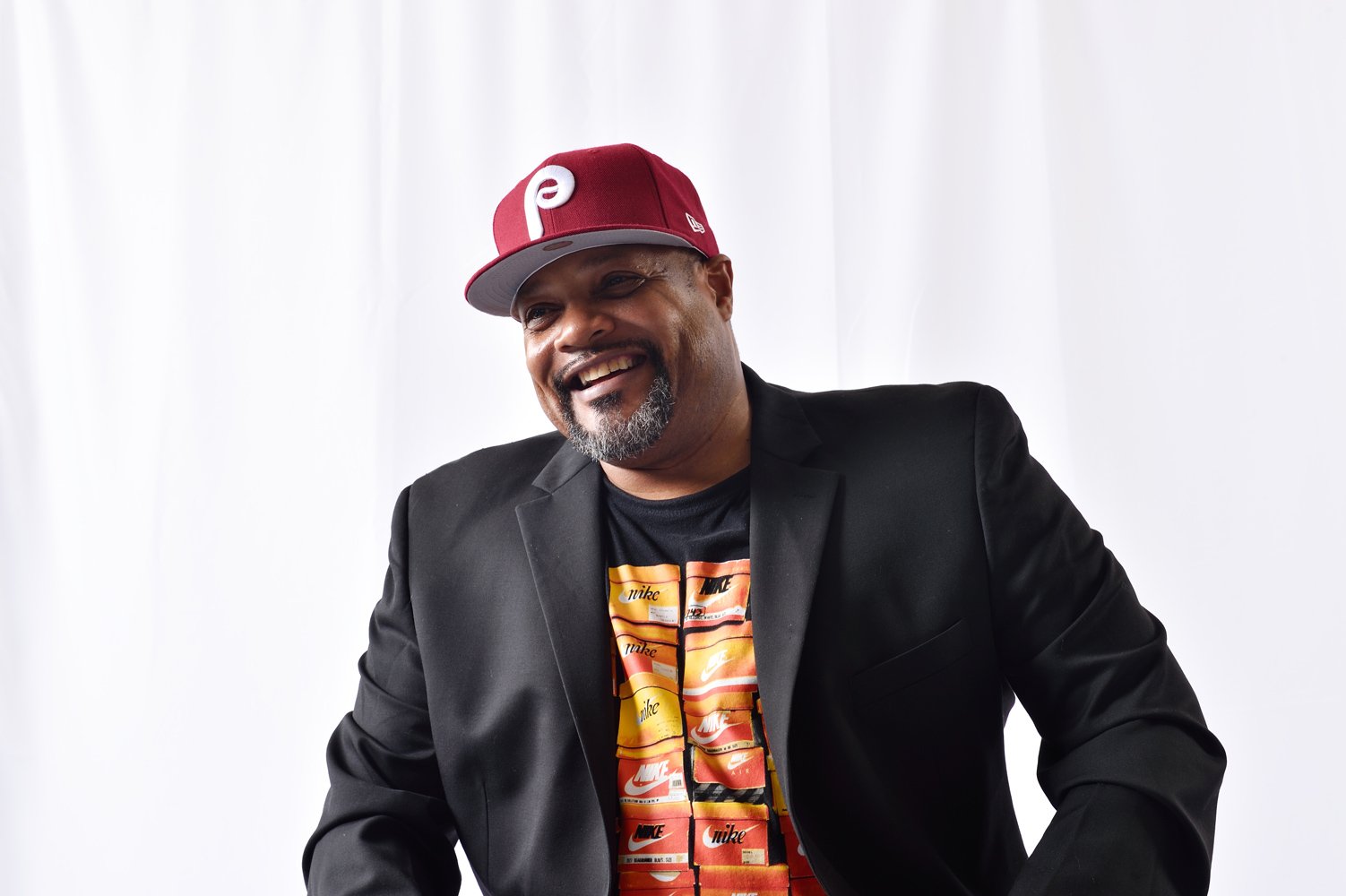
You’ll notice the Phillies cap. Rennie Harris loves this city. Raised in North Philadelphia, he helped bring hip-hop from neighborhood dance circles to concert stages around the world.
There’s something of a preacher in Harris. He speaks with the conviction of someone who has spent his life defending the movement’s history. He lived it. He was there.
I wasn’t. Which is why I wanted to talk to him.
Lost in Translation
Harris remembers sitting in the Free Library of Philadelphia, reading about Martha Graham, George Balanchine, Merce Cunningham, and Mark Morris.
“I wanted to know why this movement-based form they called dance was important to them,” he tells me.
In 1992, he founded Rennie Harris Puremovement. Even today in 2026, 32 years later, street dance’s vocabulary remains widely misunderstood.
“You have to know something before you can critique it,” he says.
Much of what audiences call hip-hop, he argues, barely resembles what he grew up practicing.
“What they’re seeing is a watered-down, redefined, regurgitated interpretation of what they think they’re seeing, or what they’ve been programmed to see.”
I mention the Step Up films. Let’s be honest, Hollywood helped teach a generation what a street dance battle supposedly looks like.
“No one battled each other with choreography,” Harris says.
He remembers dancers improvising in nightclub circles. Owners weren’t delighted: dancing meant fewer drinks sold.
Harris points to the 1983 films Wild Style and Style Wars as records of early hip-hop culture, one blending fiction with real participants, the other documenting graffiti. Commercial attention was growing. Who got credit, claimed expertise, and profited?
The Business of Movement
There’s an irony in hip-hop becoming a global industry while its movement vocabulary remains misunderstood. We recognize the image. Whether we recognize the dance is another matter.
By the 1990s, hip-hop was on studio schedules alongside ballet and jazz. Students memorized combinations, counted eights, and rehearsed for competitions.
I was one of them. Talking to Harris made me cringe. I knew the counts. Whether I understood what I was dancing was another question.
He distinguishes commercial choreography from breaking, popping, and Campbellocking, each with its own history. He also names Al Minns, Big Bea, and Shorty Snowden, figures in Black American vernacular jazz.
Learning a routine and understanding a dance tradition aren’t necessarily the same thing.
Who Gets to Tell the Story?
Harris remembers critics describing his dancers as “passionate, dynamic, exuberant.”
All compliments, technically.
“The problem wasn’t so much what they said; it was what they didn’t say.”
His objection wasn’t about praise but a praise that revealed little understanding. Calling dancers athletic tells us almost nothing about their technique or musical choices. Imagine reviewing ballet by calling the dancers energetic and flexible, and ending there.
Harris wrote newspaper editors, questioning why critics unfamiliar with hip-hop were reviewing his company.
Rennie asks: “If we’re going to write about dance, shouldn’t we understand what we’re looking at? Otherwise, whose story are we telling?” I’ve been turning that question over for weeks. Dance journalism carries a responsibility that extends beyond aesthetic interpretation. It shapes public understanding and, ultimately, the historical record. Without sufficient knowledge of the form, at what point does criticism become misinformation?
When I ask who gets to define hip-hop, Harris doesn’t hesitate:”The creators. If you created it, you get to decide. That’s a no-brainer.”
Today, as arts coverage shrinks and professional dance critics become increasingly scarce, artists are often left to explain, promote, and document their own work. But artists and critics serve different, equally necessary purposes. Both have a responsibility to understand and preserve the language of the forms they practice and write about.
After all, language shapes how history is told, who gets to tell it, and whose knowledge survives. When we lose the vocabulary of a dance tradition, we risk losing more than words. We lose the histories, distinctions, and cultural knowledge those words carry. And if you ask me, that’s tragic.
Everybody Dances
Harris calls street dance community dance. The street might be a church, a cousin’s house, or a block party -wherever people gather.
He compares dancing to walking. Children learn by doing. Mastery takes years, but participation comes first.
In a cipher, dancers enter a circle and respond to the music and each other. I admit the prospect terrifies me. After years teaching dance, I’m afraid of exposing everything I don’t know.
“I’m going to get made fun of, Rennie.”
“That’s part of it, though,” he says.
I laugh.
“In hip-hop, you’re encouraged to move forward,” he explains. “This is about humanity.”
In his neighborhood, everybody danced. Harris didn’t consider himself special for doing it. Eventually, somebody offered to pay him. So he kept dancing.
More Than a Body
Professional recognition came with a catch.
“You weren’t paying me for my intelligence; you were paying me for what I could do physically.”
Presenters admired his body without considering his mind. As though decades of knowledge could reside in muscles alone. He tells me he was in his forties or fifties before fully recognizing himself as a choreographer.
The work demands punishing hours, physical endurance, and often miserable finances. And still, people do it.
When I ask what he wants audiences to feel, Harris answers, “Nothing at all.”
“What you get out of it is your story, not necessarily mine.”
He’s firm about who can define a tradition’s history, yet generous about what an audience may find in his work. And hip-hop’s future?
“It will create itself and do its own thing.”
A Different Kind of Prayer
I keep picturing Harris at the library, studying dances outside his experience because he wanted to understand them. For those of us writing about dance, that’s a reasonable place to begin.
For all our talk about criticism and commerce, he returns to why people dance. He compares worrying to praying: both direct the mind toward something repeatedly.
Listening to Harris speak about his work and watching his choreography come to life onstage, I recognize a gift in him that is spiritual in nature. He has a way of getting us to the heart of something, though what that something is may differ from person to person. There are choreographers whose work I admire aesthetically, and then there are those who do something much deeper, who reach a part of us that perhaps even language cannot access. Harris is one of them.
I ask whether some of his choreography might be understood as prayer.
“All of it,” he says.
Interview conducted by Lauren Berlin with Rennie Harris via telephone on October 21, 2026.