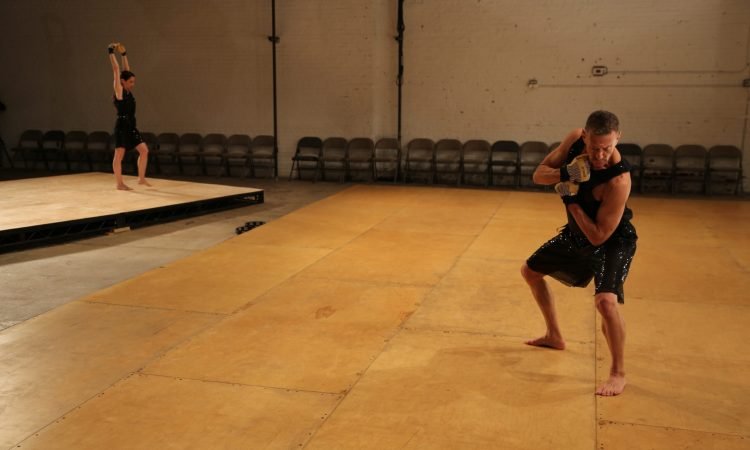
Neil Greenberg, Jennifer Lafferty, and Owen Prum pass in and out through a side door with a push bar that makes clanking sounds. The entrances and exits are exacting and deliberate, the kind of walk associated with being busy with a task and very focused. The three dancers are all in the same loose shorts and tank tops (black with sparkles) and gardening gloves.
The performance space of the Chocolate Factory Theater is lined with chairs on three sides for the premiere of Greenberg’s Next Dance. There is a dance floor against the far wall that runs almost the full width of the theater, and another, smaller square floor set at an angle downstage right that is lifted on stilts at one corner to manage the slope of the concrete floor. There are two tambourines.
Greenberg has described this piece as a duet for three dancers. This is visible, not hyperbole. Greenberg and Prum change places; Lafferty holds things down. Their duets are often spaced out, danced far apart from each other, so that when they merge closer together it’s more impactful. They run, charging at us in our seats. They charge empty seats and the wall. They let themselves work close to us, though they ignore us. But every now and then they glance at us or at each other with a small smile, like neighbors passing in the hallway of their shared building.
This is more a construction or assemblage than choreography, or at least that’s how I’ve often understood Greenberg’s work. He places multiple elements in relation to each other over and over, playing with these physical fictions and telling pieces of multiple movement stories. Throughout the work, one dancer is just behind another in the phrase, leaving a canon of movement in their wake, picking up ideas and following them, then abruptly discarding them.
Different muscularities and rhythms weave through the three bodies. There are moments of disco with a radio blaring, there’s sweet phrasing and pointed feet, there are big stumbles and rolls, and there are lateral shuffles that push hands into space, push air around. There’s a sense of a frontal, chest-forward, clear-cool-air inhale in Greenberg’s body and choreography. And large, long arches, as if he could levitate and dive over his own back into cold mountain springs. It’s often all bilateral phrasing, mimicking us—babies, animals, bodies. So little twist in the torso, so much pressing into space. So much reaching up.
The sound score by Zeena Perkins and James Lo is a matching collection of random-but-not-random, played with such craft that it’s exactly right. It has the same sense of someone picking ideas up and putting them down. Sometimes the dancers react to it; at other times it feels more like the atmosphere.
And then there is the serious drama of goofing around. There are whoopee cushions and their sonic flatulence. Straight faces and sternly composed choreography that activates the cushions. The audience giggles while the dancers remain serious. The stage is littered with these now empty rubber inflatables and those gardening gloves, tossed off somewhere along the way.
To describe this dance as “scattered” feels risky here, for it is not at all messy. It is a precise, focused, composed blend of movement modalities. Greenberg’s work is of a particular lineage, reflecting his seven years dancing with the Merce Cunningham Dance Company. His history allows for something to be about nothing and everything all at once, for something to be serious and silly, to be crafted and be imperfect.
Perhaps this piece, with its smart layers of compositional choice-making and careful study of performance, exists largely for other dance makers researching their “next” dances. After so many years of an abstract dance practice, he is a master composer, one definitely worth learning from. And as you study, if you’re lucky, he’ll catch your eye and smile at you, palms wide open, pushing air around, arching up and over, diving back into the mountain springs.
Next Dance, by Neil Greenberg, Chocolate Factory Theater, Long Island City, NY, Nov. 12-21