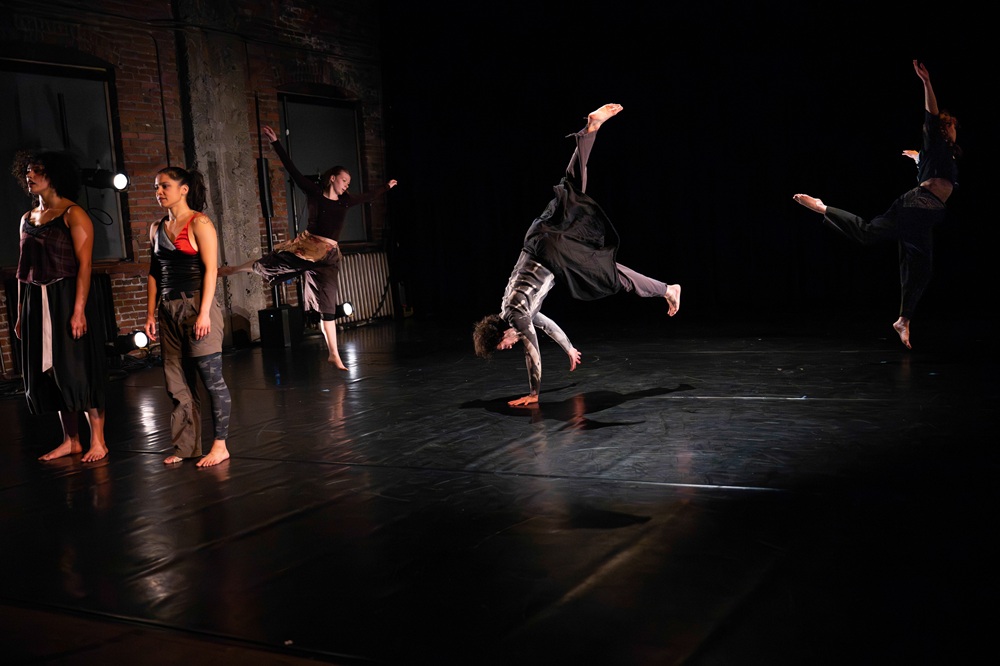
If you have ever seen a group of kids play “whisper down the lane,” you’ve probably noticed a suspended, anticipatory quiet that soon explodes into giggles once the original words are revealed. I got that same feeling of play from Antonia Z Brown’s One Dancer, Six Choreographers. Allowing her original choreography to be simplified, manipulated, reorganized, inverted and embellished, Brown relinquished the authorship of her movement so as to experience the aesthetics of five other choreographers.
Inspired by Annie Wilson and Susan Rethorst’s Remix Festival, Brown created a solo for herself and invited five choreographers into her process to remix her original material. In a pre-show announcement, she mentioned that she chose to work with established local choreographers whose work she admired. The choreographers originate from post-modern and contemporary dance backgrounds, but their varying aesthetics are visible within the natural evolution of the dance. Like a game of “whisper down the lane,” the choreographers only worked with the previous iteration of the solo, taking a different approach to what was offered by the choreographer before. Brown originally danced with full-bodied movement, virtuosic and “space eating”; David Brick stripped this down, encouraging stillness and repetition; Christina Gesualdi added a chair, which provided a context; Nora Gibson added seriousness, a lifted sternum and technical specificity; Gina Hoch-Stall added voice, humanness and comedy; and Jumatatu Poe added ambiguity, jumbling up the words added by Hoch-Stall and inverting the choreography.
I could imagine Brown and Brick together in rehearsal working on this material, Brick giving her a new prompt: “Now repeat that gesture, but change your focus.” This was apparent in Brick’s “Section Two.” (Brick was the only of the choreographers to work with Brown’s original material). Brown walked into place, lifted her hip and pointed her fingers on the low diagonal, her focus steady and strong over the audience. After a moment of stillness, she walked back to the “beginning” and repeated the movement. The only change was in her eyes, which shifted from side to side as if unsure of herself.
After seeing multiple iterations of the same material, certain phrases and shapes became familiar, like old friends returning to the stage. Brown curled her upper body up and over the space around her in a contraction, as though sheltering someone from the rain. Gesualdi placed this shape onto a chair, providing height and accentuating the protectiveness of the gesture. Gibson chose to create this same shape horizontally, so that Brown’s body curved upwards in a half sit-up. Hoch-Stall inverted the shape further and brought Brown’s legs over her head in a shoulder stand—still with the same curve in her back. Poe, the last choreographer, rotated the shoulder stand, conjuring the image of a slow-motion back spin. Balancing on her upper back, Brown used the fingers of one hand to push her body around in a circle.
As a choreographer myself, this was a fascinating piece for me to watch and an inspiring approach to creative process. The familiarity of the material displayed each choreographer’s personal aesthetics. Brown’s strength as a performer allowed her to fully embody the transitions between each section, switching intention and affect in an instant. I would be curious to know if each choreographer felt “finished” with his or her work. Could each “section” be presented as its own isolated solo? Perhaps so, but it was certainly fulfilling to see them all in sequence. My understanding of authorship was challenged, and the work itself became a “collective collaboration”—very fitting to the mission of the Mascher Space Cooperative. *
*Also on the program was Chapter 1: Cathy//Madonna the Femme by Ann-Marie Gover.
Antonia Z Brown and Ann-Marie Gover, SoLow Fest, MascherSpace Co-op, June 20-21.