Choreographers usually start with nothing. The creation process begins in an empty room, and audiences show up to an eventual performance, evaluating what they see based on what the choreographer created from that blank canvas of a starting point.
The Remix Festival throws out that premise, and instead the choreographers start with someone else’s dance. The work of their peers becomes their raw material, and they are free to remix it however they choose. The fun part of the festival is that the audience is there at the start as well as the finish. In the first half of the evening, audience members take in the original works, and in the second half, they watch a new dance based on the original. Each choreographer has received only nine hours to develop their new version, a much shorter timeline than usually goes into work created for a paying audience. In between the first and second halves of the evening, food is provided, giving the festival a near-ideal format for both attention spans and community-building.
Co-curated by Annie Wilson and Susan Rethorst, and co-presented by Mascher Space Cooperative and < fidget >, The Remix Festival had packed houses and a palpable sense of excitement. I attended the opening and closing nights of the festival, as well as dropping by for a bit of Saturday night’s show. (Jen Rosenblit’s performer Addys Gonzalez suffered an injury during Saturday’s performance, and her work and the remix by Greg Holt were not performed at the Sunday performance that I attended.)
There was a rare sense of collectivity and focus on the part of the audience, especially while watching the remixed versions of the works. Everyone carefully tracked the changes that had been made, laughing when we noticed a clever decision, or appreciating a certain clarification or tweak to the original. It felt remarkable to be in the midst of that collective concentration, with the craftsmanship of the choreographers made visible in an unusual way.
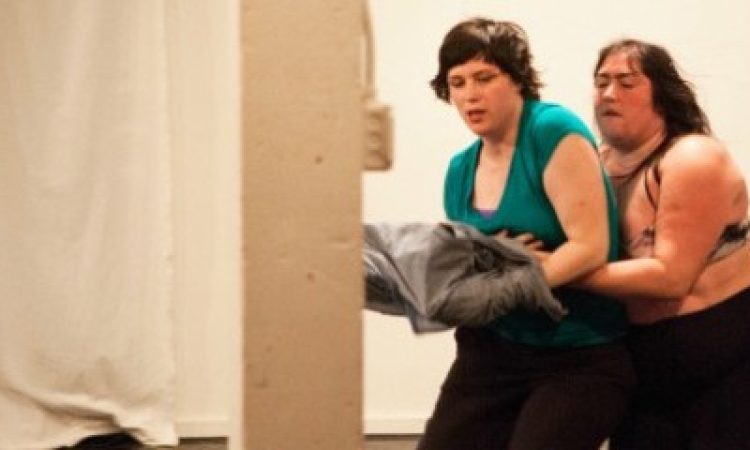
Since the audience watched many of the same elements and ideas twice in the same evening, it felt especially important to have strong performers and reliable curation in place. The Remix Festival delivered on this score, for the most part. Highlights included the performance of Meg Foley in Susan Rethorst’s seeds of a new dance, currently untitled. Foley tapped into an alternate universe of energy and became a force of nature. When remixed by Jen Rosenblit, who chose to join the performance as a dancer as well as remixing as a choreographer, Rethorst’s solo sketches became the base for a raucous duet, with Rosenblit attacking Foley with her long, dark hair and the two women engaging in a wrestling match over a shirt that seemed to have a life of its own.
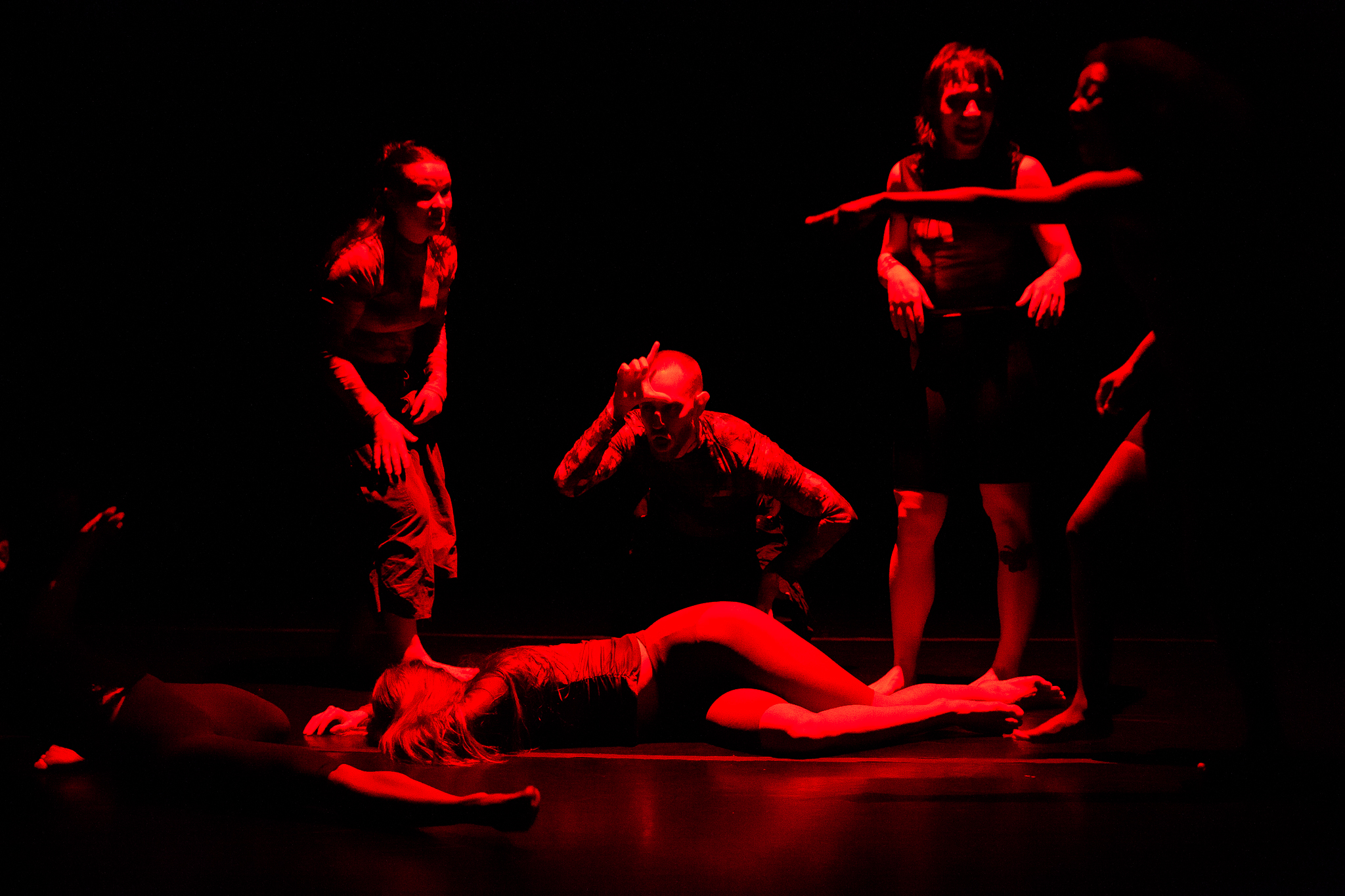
Chelsea Murphy and Magda San Milan also put forward a smart and engaging work. Their meandering dialogue covered the joys of touching unfamiliar textures, the stories that might be embedded in particular body parts, and their own anger. At the same time, both performers had their hands shoved down their pants performing their own dance, at times with fingers moving in unison and other times idly scratching. As a result, there were two tracks to follow in the same work, as well as the entertaining interplay between the two. In Portland choreographer Rachel Slater’s remix, different facets of the relationship between the two women were explored; facial caresses at first seemed sweet and then turned into something crueler. But the sense of playful abandon was preserved, with San Milan at one point doing a kind of crazy horse legs movement that I’ve never seen before and had me happily agape.
In each case, the remixed version seemed to preserve the essence of the original work, while adding new shapes or sounds or shadings. The performances made me wonder—What are the essential qualities of a dance? What creates its tone? How did the remixers choose what to retain and what to scramble? How do you stay true to someone else’s vision while simultaneously wrecking it? The Remix Festival suggests that collaboration can make us stronger artists by pushing us out of our sometimes too-safe, easy, or comfortable patterns.
The Remix Festival, artists Meredith Bove, John Jesurun, Chelsea Murphy and Magda San Milan, Jen Rosenblit, Greg Holt, Rachel Slater, Susan Rethorst, thefidget space, May 1-4, 2014.