Foreign to me I must admit.
Butoh.
Foreign.
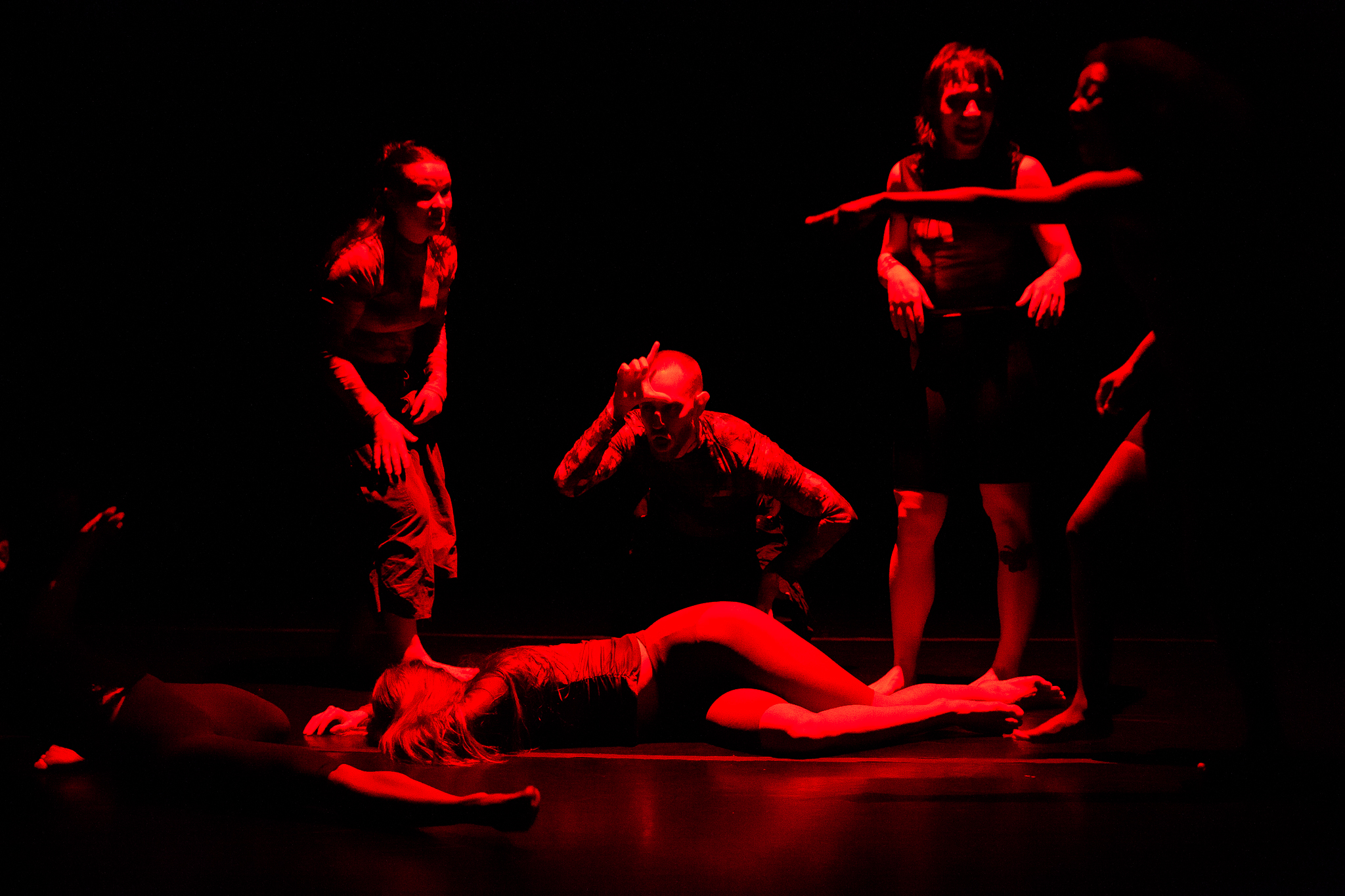
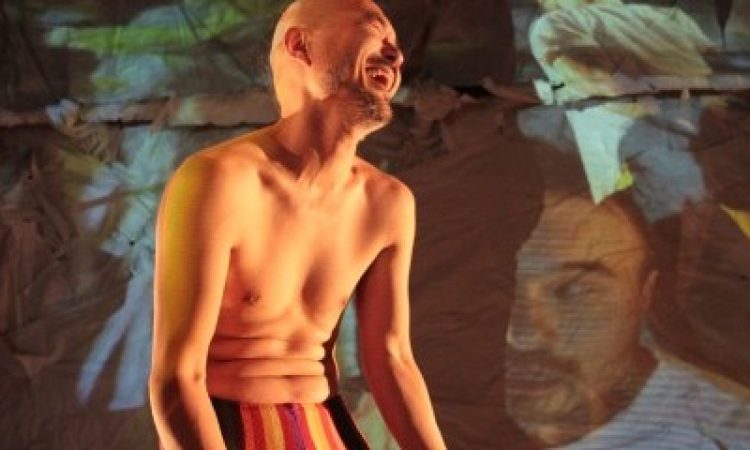
But my inquisitive self led me to Rhizomas: a performance art piece conceived by Butoh practitioner Ryuzo Fukuhara in collaboration with a local Philadelphia improvisational quartet, Wormhole Superette.
Inside the New Central Baptist Church, splashes of red, pink, blue, orange, and yellow leapt off the paintings by visual artist Tracy Lisk, also a member of the Superette.
A delay to the scheduled performance led to conversations between performer Fukuhara and members of the audience where he explained that sitting front row house left may not be wise due to the harshness of the sound coming from the musicians’ speakers. He also answered questions for those who yearned to pick his brain.
The breathy murmurs from Lisk, who stood before a microphone holding a guitar, ushered in the main event. Although the soundscape was reminiscent of a manipulative movie soundtrack, it merely served to set the tempo for Fukuhara’s improvisational task.
From the onset, it was hard not to notice the many contrasts, even if they were subtle. The chaotic strumming of each string, and the high pitch screeching echoing through the speakers were an anarchic counterpoint to Fukuhara’s orderly trance like movement ritual. He moved lightly, yet with noticeable weight, carrying his pelvis low to the ground, often maintaining a rounded torso which acted as the anchor to his angular limbs.
But it was the visibility of a different dance genre amidst the Butoh that completed the lesson in contrast.
As Fukuhara moved his mouth, shaping and reshaping his face, he created animated gestures riddled with sensibilities often associated with Butoh. He twitched slowly with accented precision, creating bent lines with leisurely initiations, gradual contractions, slow hyper-controlled movements of his contorted body. The strong expressivity in all this work had a Butoh-esque quality, while displaying identifiable markers aesthetically reminiscent of hip hop. Picturing these gestures in a different environment, possibly transferring them to a club setting performed with added speed, made it easy to imagine Fukuhara in a hip hop battle, possibly defending his crew.
Rhizomas, Ryuzo Fukuhara, Wormhole Superette, New Central Baptist Church, September 22, 2016