It seems like new construction appears overnight. It wasn’t so long ago your mother sang you to sleep. Wasn’t it just yesterday you rearranged the office and assembled that crib, only to pack it away this morning and send your baby off to college? Tonight you’ve tucked your father’s aging bones into bed, and tomorrow it will be you.
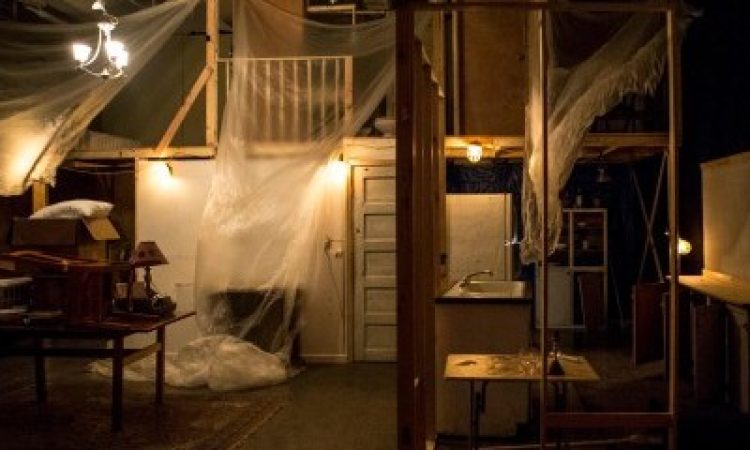
In HOME, Obie- and Bessie-award winner Geoff Sobelle explores the baffling concepts of time, space, permanence, and change, bringing to life the elusive mix of people, moments, and sentiments that anchor us existentially in this world. Featuring clever illusions, an ever-evolving house-under-construction set (Steven Dufala), Elvis Perkins’ dream-like troubadour tunes, and a talented cast who wrest powerful emotions out of everyday scenes, Sobelle’s world premiere is a gem in this year’s Fringe Festival.
Sobelle wrestles with a wall frame that opens and collapses like a folding screen, hovers above it in plank position, staples a plastic tarp to its corners and hoists it upright. He slides it one way and a bed appears, then the other and a doorway materializes. He lies down, tosses and turns, pulls the covers overhead, and re-emerges as a young boy (Josh Crouch). These tricks repeat. A young woman disappears and resurfaces a grandmother. As one woman exits through a door, another enters. Mother becomes child, partner becomes son, and a man lays his first home to rest.
Quirky, harp-tinged sounds reverberate from Perkins’ autoharp. His voice sweeps and echoes, his words evaporating in my mind like images upon waking. I catch “sun . . . shore . . . rent-controlled . . . foundations,” and “your only home is in and out of your bones.” Like a giant dollhouse, the bones of a dwelling emerge before our eyes and the cast build upon and furnish it.
They climb, change course, and descend the stairs, close on one another’s heels, repeating over and over again, then freeze, as if time can. They dress, toilet, and shower so many times you begin to see just where it is the time goes. Tango music floats through the air—famously melancholy, chock full of lyrics lamenting a homeland lost. Sunrise and sunset swallow the house and its inhabitants in the life cycle of a day, the structure of time mirroring the structure of space and its transformation into place.
I wonder what on earth I’d do if the beautiful skeleton of wood, brick, and steel that surrounds me disappeared tomorrow. I take comfort in a childhood friend’s words, “When I am with you, I am home,” and know that some things can be rebuilt.
HOME, Geoff Sobelle, Prince Theater, September 13-16, http://fringearts.com/event/home/.