In a quest to reach new audiences for performing arts in Philadelphia, Theatre Philadelphia and thINKingDANCE are joining forces and exploring how dance writing and discourse can provide new perspectives on theater. Beginning May 2018, tD writers have been lending their varied backgrounds, interests, and approaches to criticism to professional works of theater in Philadelphia. Let us know what you think in the comments!
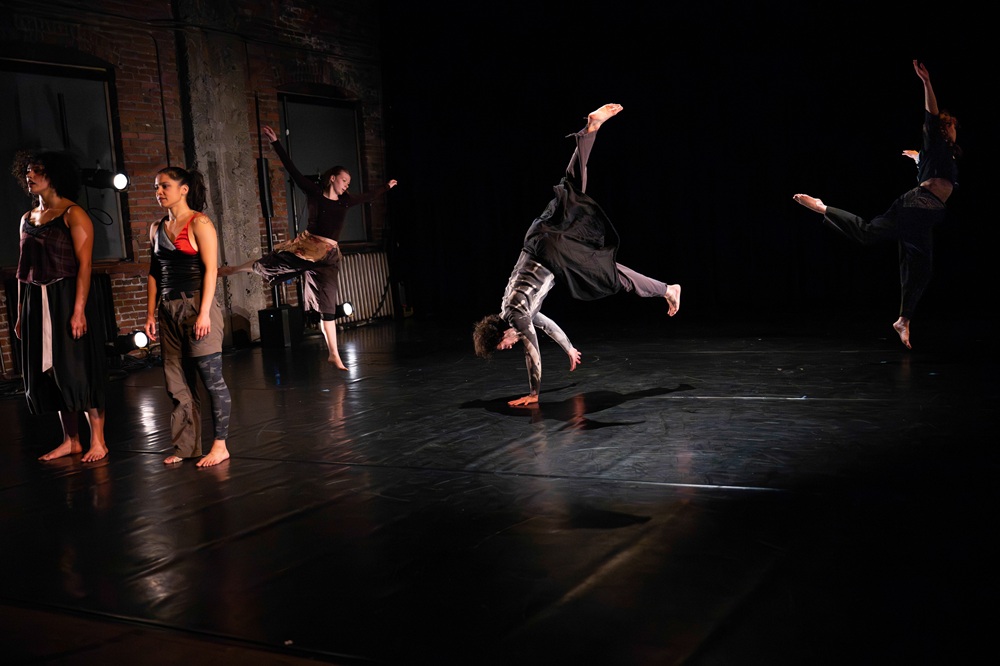
Radiant Bloom’s production of The F Word at Asian Arts Initiative is a carefully curated multi-media experience that connects waves of feminism through song, dance, photography, and narration. As the show opens, Demetria Joyce Bailey asks the audience, “What is feminism?” She calls on her fellow cast members, seated in the audience. Meredith Beck, Erica Cochran, Heeya Kim, and Kalyn West answer, responses ranging from, “there isn’t one type of feminism” to “we are all equal human beings.” Bailey states a working definition for the audience: “Feminism is the advocacy of women on the basis of the equality of the sexes.” The sounds of the piano, guitar, and cajón drum percolate as performers rise from the audience singing “Sisters are Doin’ It for Themselves.” Dressed in collared shirts and black pants, the five racially diverse women dance freely onto the stage, creating an infectious energy that makes me want to tap my feet and sing.
The story starts with Charles Darwin’s theory of woman. Suddenly, one of the white male musicians ascends off his drum and clutches the mic out of Bailey’s hand. Toxic male entitlement oozes onto the stage as he plays the character of Darwin, feigning a British accent, explaining women’s inferiority to men. He pushes each woman, placing them in evolutionary positions; down on all fours, hunched over, and standing. She is an object to be studied and set aside.
The female performers, clad in sashes reading “votes for women,” narrate the suffragettes’ fight for voting rights. Bailey reads Sojourner Truth’s poem, “Ain’t I a Woman?” reminding the audience of the racialization of nineteenth-century feminism. The prose leaves me with chills. Throughout the night, we hear examples of activists of color routinely left out of the Women’s Rights narrative.
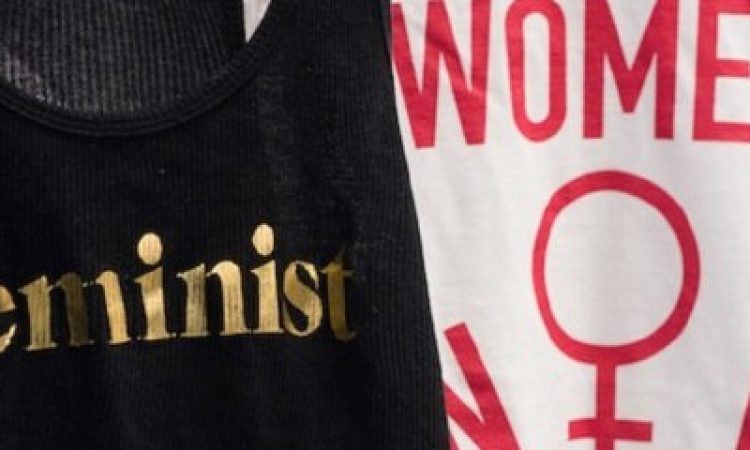
Each era is depicted through the same formula: historical narration, musical numbers, props, and movement as period postmarks. The Rosie-the-Riveter campaign is conveyed through red bandanas and arm flexes. The 1950s housewife is shown through aprons, feather dusters, and stifled conversations with husbands. Singing “You Don’t Own Me,” they angrily tear off their aprons. This energy erupts into the second wave of feminism. The women adorn protest t-shirts reading “Women Now” and “The Future is Female.” They throw symbols of oppression into a trash can as they recount that no bra was ever burned during the Miss America Protest. I think of how the bra-burning stereotype haunts us to this day. Each step towards equality has been met with propaganda from oppressors, clouding the truth with “alternative facts.”
We enter the third wave with a musical mash-up of songs such as “U.N.I.T.Y.” by Queen Latifah and “None of Your Business” by Salt-N-Pepa. The cast makes music while sitting on the stage, beating pink Solo cups against the hard black floor. In the fourth wave, they reference intersectionality and the inclusion of queer people, trans people, differently-abled people, and more.
The performers share statistics on sexual and physical violence as they explore the impact of the #MeToo movement. Finally, the cast sits on the stage like a group of friends, discussing the various feminisms, even those that don’t claim the term at all.
The F Word strikes the balance between education and entertainment, teaching in a digestible and captivating way. It communicates that a social-justice movement can only succeed if it constantly recalls its roots and pays homage to those who paved the way. In a culture of fast-paced communication and short attention spans, it can be hard for current-day feminists to slow down. The F Word asks us to pause, recall our history, and continuously redefine the future of feminism.
The F Word, Radiant Bloom Productions, Asian Arts Initiative, Sept. 15-19
To join the conversation, follow thINKingDANCE and Theatre Philadelphia online and on social media to read, share, and comment.