Although they were playing in Philadelphia directly opposite Alvin Ailey American Dance Theater—a company that competes for similar audiences—Dance Theatre of Harlem (DTH) drew a full house at the Annenberg Center (University of Pennsylvania). In that house on Saturday evening was the founder of Philadelphia Dance Company (PHILADANCO), Joan Myers Brown, who has ignited generations of dancers, particularly black dancers, in this city. Brown received a warm ovation when one of her former dancers, Robert Garland, acknowledged her from the Annenberg stage. Garland, DTH’s first Resident Choreographer, graciously acknowledged his Philly roots, his family, and his start with ’Danco. He then shared with the audience that the dancers from DTH and Ailey had gathered earlier with Brown and ’Danco to celebrate Brown’s contributions to their artistic trajectories and to the art of dance in Philly and beyond. That mood of warm, familial celebration set us up for the dancing that followed.
Thus, it was apt that Garland chose to premiere his new work, Nyman String Quartet No. 2, in Philadelphia, as the program-opener. The work mixed contrasting signals that I found difficult to reconcile: the ten dancers wore lush pink-and-purple costumes and flashed showy, virtuosic dance phrases, set against the minimalist shifts of Nyman’s music and the stripped-to-the-bare-walls backstage and wings. Oddly, the extra space this staging choice allowed the dancers—who certainly can move big!—remained unused, essentially unacknowledged. Garland sent the dancers onto the stage in varied groupings that alternated and occasionally intermixed boogie with batterie, bopping with bourrees, hip thrusts and shoulder circles with split-leaps and chasses. The dancers smiled warmly at one another and the audience as they threw themselves wholeheartedly into the dance.
Similar patterns—alternating social-dance moves with balletic formality—characterized the crowd-pleasing curtain closer, Return, a Garland work from 1999. Here, the music of James Brown, Alfred Ellis, Aretha Franklin, and Carolyn Franklin wooed and wowed the audience with familiar songs such as “Baby, Baby, Baby” and “Call Me,” danced by DTH with flair and complex partnering. The dancers also showed off favorite moves in solos that carried them through clapping, step-tapping lines of the thirteen-member company. Each of these flashy passages drew roars from the audience, who applauded exciting lifts and the dancers’ multiple turns that brought the ballet to a close.
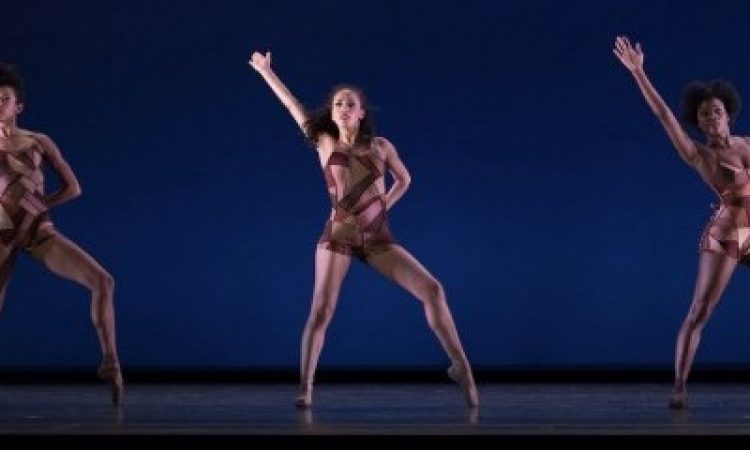
Between Garland’s two works was the meat of the evening: Dianne McIntyre’s Change (2016), to traditional a cappella singing recorded by the Spelman College Glee Club and newly composed instrumental music by Eli Fountain. Amanda Smith, Yinet Fernandez, and Daphne Lee paid homage to the “women—Black, Brown and Beige—who have refashioned the neighborhood, the country, the world through their vision, courage and endurance” (program). As in the other two works, the women danced on pointe, but here the seamless integration of ballet’s lift, stretch, and reach with modern-dance’s torso-initiated curves, twists, and floorwork told a story of oppression, opposition, endurance, and determination that the dancers’ powerful performances fully embodied and expressed.
This year marks a turning-point of sorts for DTH, as the company’s founding director, Arthur Mitchell, died this past September. His vision included open classes for children in a Harlem garage, and within a couple of years, he formed a professional “neo-classical” ballet company along the lines of George Balanchine’s New York City Ballet. Balanchine, the choreographer who hired and featured Mitchell in unforgettable roles at a time when vanishingly few black dancers were admitted to professional ballet companies, contributed to the early repertory of DTH. When I last saw the company, they danced some of these works and excerpts of established “chestnuts” like Swan Lake; they had just come back to life after an eight-year closing (2004–2012) caused by financial woes and were figuring out how to make their new incarnation viable. Clearly, the company I saw this weekend has moved into a different era, repertory, and expressive range under Virginia Johnson’s direction. Apparently, it still speaks, body and soul, to an eager and enthusiastic audience.
Dance Theatre of Harlem, Zellerbach Theatre, Annenberg Center Live, Mar. 1-2.