In a quest to reach new audiences for performing arts in Philadelphia, Theatre Philadelphia and thINKingDANCE are joining forces and exploring how dance writing and discourse can provide new perspectives on theater. Beginning May 2018, tD writers have been lending their varied backgrounds, interests, and approaches to criticism to professional works of theater in Philadelphia. Let us know what you think in the comments!
Katie Gould, costumed as a mangled fetus under a spotlight, squeaks, “Hello, Mommy. I am your baby. Can you see me? Hiiiii!” This marks the start of The Appointment, Lightning Rod Special’s new musical comedy about the American abortion debate. Throughout the song, dance, and shtick, Gould plays the aforementioned fetus, a Backstreet Boy-inspired mega-church pastor, a Thanksgiving turkey that comes to life, and a woman getting an abortion.
The Appointment handles the issue at hand with seemingly ambiguous morality. The cast humanizes the fetuses they portray through playful, specific physicalizations. They’re undeniably adorable, lovable even, although decidedly unhuman. The adult characters by contrast are too real for musical theatre. Through director Eva Steinmetz’s expertly captained clown work, the fetuses demand the audience’s attention and empathy. The adult characters mostly remain theatrically detached, rarely addressing the audience directly. This contrast conjures pro-life propaganda- a fetus has a soul and is entitled to life, while an abortion seeker is soulless and unentitled to reproductive rights. The Appointment never tells the audience how to feel about the cute fetuses, in favor of letting them do their own work around reconciling the pro-choice message and the fetuses’ lovability.
Lead Artist Alice Yorke’s characters have a consistent all-American WASP voice that views the abortion debate as an asinine impediment toward peaceful and quiet American suburbanism, a recurring theme in her jokes. Her comedic timing is impeccable. She shares stage-presence DNA with Jane Curtin, while her speech cadence is similar to Catherine O’Hara’s portrayal of a mid-western mother in Home Alone. Out of nowhere she belts like Siouxsie Sioux in her solo, which includes the Chaka Khan referential line, “I’m not every woman, I don’t want to be.” Yorke’s cultural specificity and context is critical to the show’s coherence as it veers into the surreal.
Choreographer Melanie Cotton’s and composer Alex Bechtel’s contributions fashion the dark comedy into a commercially appealing and comfortable experience. Cotton has an acute sense of timing, sprinkling in purposefully clunky jazz squares, lumbering chassés, and bits of hoofing to the stylistic vaudevillian sections.
In the second number, a song for the abortion providers, Scott Sheppard, Jaime Maseda, and Brenson Thomas sing testimonies of women who regret their abortions. Bechtel writes sweeping piano licks for Amanda Morton, to which Cotton responds with plucky leaps for the actors singing at full voice. The men croon, “What have I done?… I’ve slaughtered a daughter.”
Much of The Appointment carries this subversive irony, which dances between clever dark humor and offensive audience alienation. The cast performs about half of the show as fetuses. Their costume features a cone-shaped hat that looks simultaneously like a mushy-brained alien, a Catholic monk, and a baby in bunting. A brilliant recurring gag—an oversized white cane that pulls an actor off stage as a routine sours—appears as a looming coat hanger ripping out another fetus.
Maseda’s fetus portrayal comes across as a developmentally delayed toddler with low vision, poor balance, minimal motor skills, and non-opposing thumbs. At the top of his solo scene, Maseda, wearing a trash bag, bounds to center stage in a garbage pail, implying his status as a freshly discarded fetus. He bangs out a devilishly hilarious piano ballad detailing everything he’ll never get to do, with the refrain, “But I learned how to loooove.” His buffoonery contrasts perfectly with Yorke’s stoicism. The thought of this young, educated woman mothering Maseda’s lovable yet disaster-zone fetus is absurd.
Brett Ashley Robinson and Brenson Thomas, also costumed as mangled fetuses, emerge through red curtains. They, the sole black actors in the cast of seven, declare, “You might have noticed we’re different from the other fetuses, we’re the cute ones.” They nestle into the red, dubbing it their mother. The ubiquitous cabaret curtains transform into life-giving endometrial lining. While this theatre-architecture-as-maternal-space metaphor doesn’t carry through the show, at this moment it is gut-wrenching.
Robinson belts a joyous number about how she would prefer to stay inside her mother’s uterus because it’s safer than being out in the real world as a black person. In the soulful refrain she resounds, “You’ll have to rip me out, you’ll have to rip meeee ouuut… I don’t consent to being sent out theeeere…” Robinson triumphantly hits a belted high note in a satisfying key change.
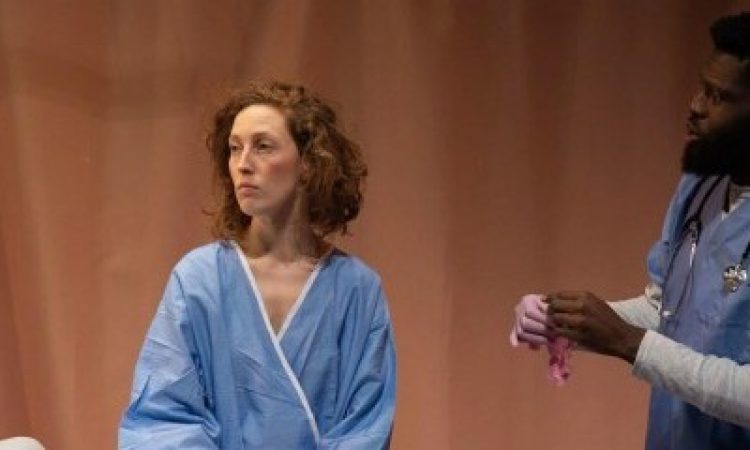
In the final scene, four women sit in an abortion recovery room. Robinson and Lee Minora gab in a low whisper. Yorke and Gould sit proudly and calmly; Yorke’s character finally finds peace and quiet. These two women appear silently bonded to one another through coded, shared circumstances, like women waiting in line at Victoria’s Secret or mothers watching their children at a playground.
Just before the show concludes with a sudden blackout, one of Maseda’s lyrics from his deranged fetus solo returns to my mind: “I never learned the difference between a dream and a wish.” In Yorke’s world the fetuses never develop beyond immature wishing and the women pursue their dreams, and that is just fine, that is just.
The Appointment, Lightning Rod Special, FringeArts, March 20–31.