“At this threshold of solitude and togetherness, my every muscle aches—the prickling, lightning bolts reminding me there is music in our moving … that breathing, too, is a practice.” – donia salem harhoor
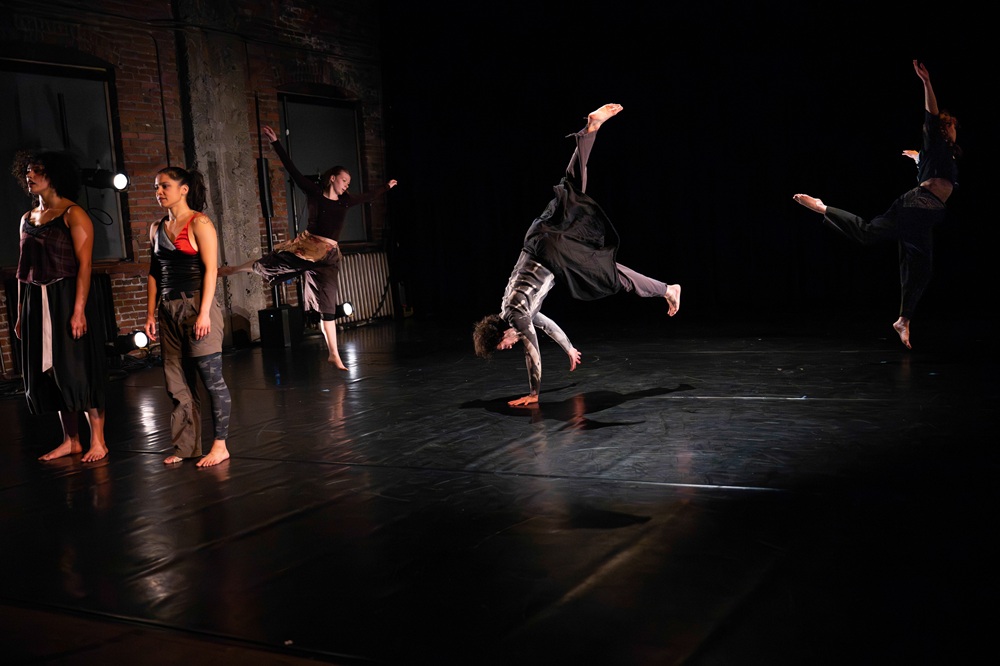
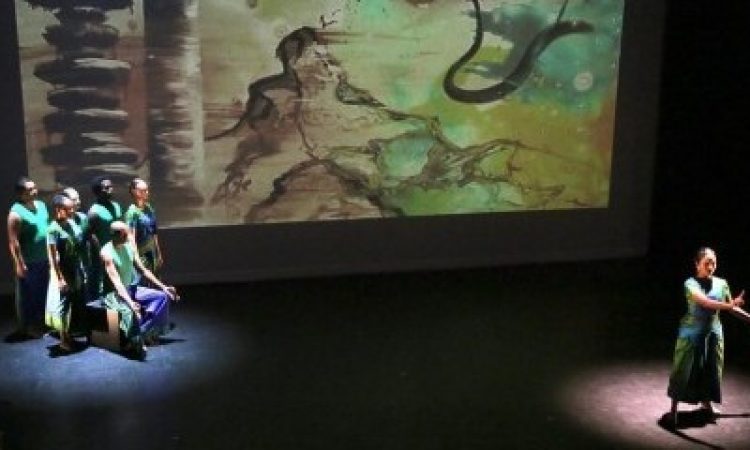
The four Eastern dance companies that came together for the third annual Facing East Festival at FringeArts employed their different styles of dance for the larger goal of bridging traditional arts and current societal issues. The Festival’s show Riyazz (an Arabic word meaning practice), celebrated the multicultural heritage within Eastern dance: Courtyard Dances showcased Kathak; Sakshi Productions brought neo-classical Odissi; Sattriya Dance Company featured Satrriya; and Dakshina/ Daniel Phoenix Singh Dance Company exhibited Bharatanatyam.
In a contemporary variation to the usual Eastern dance presentation, the artists presented poetry and dance-theatrical elements throughout as critical to their understanding of Riyaaz. As a once-upon-a-time Bharatanatyam student, I learned that the dancing often begins with an invocation. There was no traditional invocation in Riyaaz. Instead, the show started with dancers appearing onstage and simulating a pre-show body practice of stretching and warming up before a performance. They practiced footwork, uttered rhythmic syllables, and one dancer executed a ballet tendu exercise. It struck me that the process of warming up before a show is, in fact, a dancer’s invocation.
In both of Courtyard Dances’ Kathak works, Riyaaz and Ghazal Aaj Janne Ki, the use of dance theater was evident. In Riyaaz, the company featured the tabla played by Aqeel Bhatti who, at the end of one piece, joined the dancer on stage. The dancer expressed frustration at not getting the rhythms. Choreographer Pallabi Chakravorty, who performed the bol padhant (syllables for rhythmic beats), joined the dancer onstage and gestured theatrically to keep practicing. In Ghazal Aaj Janne Ki, a dancer with a hookah sat next to the musician, smoking sensuously from the pipe, drawing on the imagery of courtesans in the Islamic courts of South Asia, known as Tawaif. The dancers, wearing large circular skirts and spinning repetitively, resembled whirling dervishes, Islamic Sufis who dance as a meditative practice. This made sense since Kathak was once a traditional temple-dance form that became a court dance with Persian influences. The dances showed Kathak embodying both Hindu and Islamic forms.
Sakshi Productions used poetry and digital media with abstract components to discuss socially-conscious themes. The work Dam//age, performed by the young dancers Manav and Armaan Sikand Thompson, along with Nandini Sikand, delivered a discourse on generational trauma. The audio included the words “sticks and stones may break my bones but your words hurt,” words that linger in my memory even days later. Gestures of Longing, the dance performed by donia salem harhoor , Jubil Khan, and Nandini Sikand, was in silence, exploring intersections between Odissi’s gestural vocabulary and American Sign Language. I enjoyed the use of Odissi’s movements—hip thrusts, torso isolations, and facial expressions. However, considering the heavy themes introduced, I would love to see each piece develop into a more fleshed-out commentary on their subjects.
Sattriya Dance Company floored me with their fine-tuned delivery and sense of ease and knowingness. The dancers showed a clear juxtaposition between Prerona Bhuyan’s agility and Madhumusita Bora’s grace. Their mature execution employed elements of stillness along with subtleties such as an angry face, a smirk, and eyes that widened and then slowly closed. It seemed to me that their purpose was not to present a performative act of dance; the dance was an offering, a quiet conversation from the dancer to the divine.
When I studied Bharatanatyam at Apsaras Dance of Richmond, VA, my guru, Priti Patil, taught me that every dance is a devotion to a god or deity. Beyond its technical demands of physicality and musicality, it is first and foremost a prayer. It was thus interesting to me to see Dakshina/ Daniel Phoenix Singh Dance Company merge an ancient form of prayer with contemporary forms. The company was an ensemble of highly trained dancers in both Bharatanatyam and modern dance. They used choreographic modes such as spatial patterns, variations, and accumulations. As much as I enjoyed the dance composition and execution, I was confused that a festival entitled Facing East would unapologetically make room for Western dance. On the other hand, perhaps this is a statement of the multiplicities in today’s dance world.
Facing East Festival was a feast, perhaps with too many heavy-laden themes to ingest for one night. I would have appreciated a shorter program than the 2.5 hours presented. A festival with two different programs would have allowed me to feel a bit more rejuvenated upon leaving the theater.
Riyaaz made me think beyond the superficial message that practice makes perfect; it honors the processes behind the curtain and suggests that perhaps dance, like life, is a forever-orbiting act of practice.
*I have previously collaborated with donia salem harhoor in the project BrideNext and with Madhumusita Bora in my 2016 Fringe work, For/eign Four/out .
Facing East Festival, Riyaaz, FringeArts, Oct. 10-11.