In the film Redoubt, a sharpshooter and artist track each other through Idaho’s remote Sawtooth Mountains. Bereft of dialogue, the film relies on dance to present a loose narrative inspired by the myth of Diana, Roman goddess of the hunt.
Organized into six hunts, Redoubt follows Diana (Anette Wachter) as she pursues various animals alongside her dancing companions, the Calling Virgin (Eleanor Bauer) and Tracking Virgin (Laura Stokes). The Engraver (Matthew Barney) watches this group from afar and creates abstract etchings on copper sheets. At the end of each hunt, the Engraver takes his work to the Electroplater (K.J. Holmes), who submerges the engravings in vats of blue water containing electric current. During the day, the Electroplater creates sculptures that echo the performance of a Hoop Dancer (Sandra Lamouche) who practices in a nearby town’s recreation center. Writer and director Matthew Barney ties these disparate artists together through celestial imagery that lends their work cosmic importance.
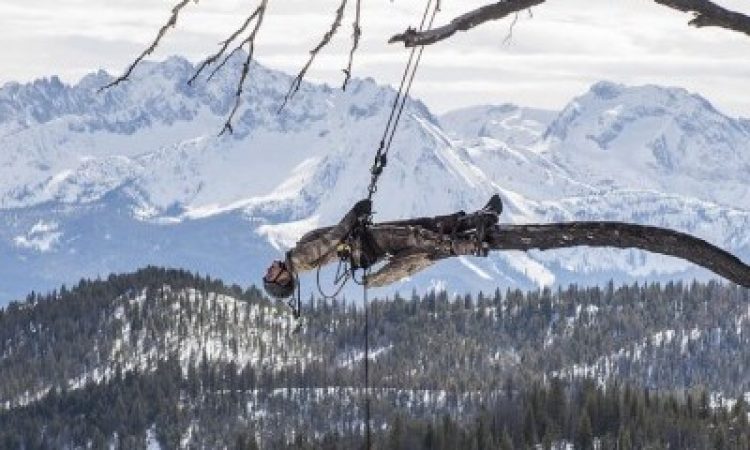
Redoubt is a beautiful film. Drone footage captures the snow-covered, tree-spotted mountains, while closer shots reveal its inhabitants, from scavenging magpies to napping bobcats. Director of photography Peter Strietmann represents the scenery with breathtaking precision, even making clear the shapes of snowflakes.
The dancing and choreography acknowledge this setting in surprising ways. Bauer and Stokes adopt unexpected positions with casual fluidity despite extreme conditions, like chest-high water or knee-deep snow. In one scene, one of them traverses thick snow by lifting her leg much higher than necessary, stretching it behind her back and pitching her torso forward before reversing that sequence to take a step. In another scene, they both stand motionless on a slope during snowfall and alternate melodramatic collapses into the fresh powder.
Though often visually stunning, Redoubt is also boring. The captivating dancing is disjointed from the other action, as the film lacks a concrete plot. Barney’s engravings would be better appreciated in a museum exhibit than in this two-hour-and-fifteen-minute movie. The powerful score by Jonathan Bepler perfectly suits the film but features silence as much as sound. The scenes that occur indoors, with no wilderness to admire, have me looking at my watch instead.
Barney is an internationally-renowned, avant-garde multimedia artist. For some, this may be reason enough to watch Redoubt. For others, I’m ambivalent about recommending it. Though I didn’t love the viewing experience, I am glad I saw the film. I admire the way Barney and editor Katharine McQuerrey juxtapose scenes of dance, visual art, and nature to hint at a narrative, even if it is a weak one. I also appreciate the reverent attention Barney gives to hunting, engraving, and Native American hoop dancing. The actors are masters of these on-screen crafts in real life, and the film honors elements of these practices I’d otherwise be unaware of. So while I wasn’t entertained while watching Redoubt, I do feel altered from having seen it—and isn’t a work’s ability to change its viewer the definition of great art?
Redoubt, Grasshopper Films, Lightbox Film Center, February 21.