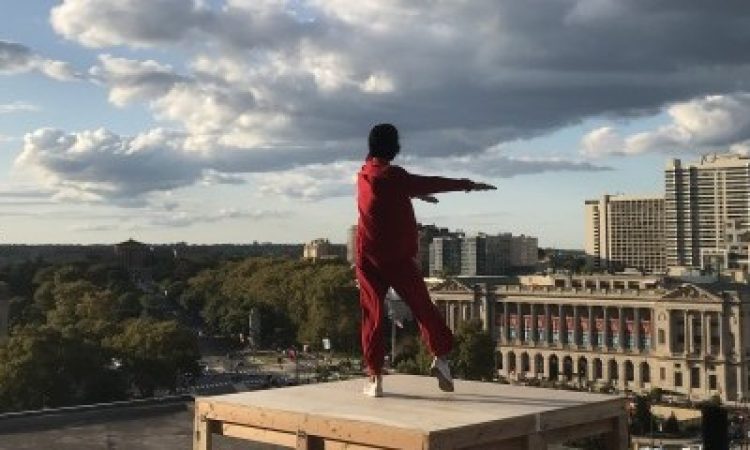
The first time I saw the Trisha Brown Dance Company perform Roof Piece was on top of a hotel in Logan Circle. I was hired as temporary production staff to safely see a dancer up to her roost and to signal via walkie-talkie when she was in position to begin. My palms were sweaty anticipating the initial ascents up the rung ladder and fiddling with the rooftop hatch, but by the first showing during golden hour on a warm evening last September, I was swept up in the magic. From my perch, I could see the other dancers on the roofs of the Franklin Institute, the Free Library, and the Academy of Natural Sciences. A dancer clad in red, a pinprick of blood on the urban horizon, moved with deftness and exactness in front of me as she peered across the circle trying to follow the dancing of another. In braver moments during rehearsal, I army-crawled towards the ledge to see the remaining two dancers down below on the ground at either end of the circle. The Parkway seemed to sail away from me, culminating in the saffron pillars of the Philadelphia Museum of Art. Through a sweeping red arm or the cutting slice of a red leg, I could see people milling about below: some pausing to notice us, others in cars drifting by. I had never been more in love with dance; I had never been more in love with my city. The sacred and the mundane were thunderously colliding before me and I felt electricity running out of my fingertips.
The last time I saw the company perform Roof Piece was 34 minutes ago, on my laptop, in the form of a Zoom recording on their website’s homepage.
Things have changed in recent weeks and this seminal work from Trisha Brown is not untouched. Redubbed Room/Roof Piece, the video tracks nine company members in homes spanning from Australia to Wisconsin moving through the improvisational game of dance “telephone.” The score as originally conceived relies on each dancer focusing on only one other, trying to mimic whatever dance they see unfolding before them as another watches them doing just the same. Midway through, the “initiator” switches facings, and the tail becomes the head. The virtual version maintains the integrity of this idea as much as possible; dancers are limited to seeing one other dancer on Zoom at a time, with a secondary screen capture recording the work as a whole.
The piece still parses the notions of distance and closeness, ideas that are more tangible now than ever. And yet, somehow, it feels useless to muse on them. I grasp for lines to draw between the abstractness of these concepts and the immediacy of the crisis, to point at something and say, “This is what this all means! This is why we are going through this!” What good does it do for me to wax poetic on the beauty and horror of it all? A dear friend called me yesterday to tell me they had a fever and were feeling short of breath. Platitudes about the ensuing social revolution, the emotional closeness fostered in a time of physical distance, feel like convenient coping mechanisms. “Sacred” and “scared,” while so close to one another grammatically, seem as distant now as Australia and Wisconsin.
Unlike the en plein air version, I can see all of the dancers in Room/Roof Piece at once on my screen. Despite the manageable expanse, bite-sized compared to the feast that was Logan Circle, I find it overwhelming to take in all at once. I trace the generation of a phrase and its transmission to the next dancer, the minutiae of their idiosyncrasies adjusting the movement ever so slightly until it’s recognizable, yes, but different. A jutting red hip cascades down the line, a rock in a riverbed whose edges are softened by the tumble, rippling out into the ether as a gentler swing.
As with everything nowadays, I sift for the golden significance, but come up empty-handed.
Room/Roof Piece, Trisha Brown Dance Company, online, April 2020.